
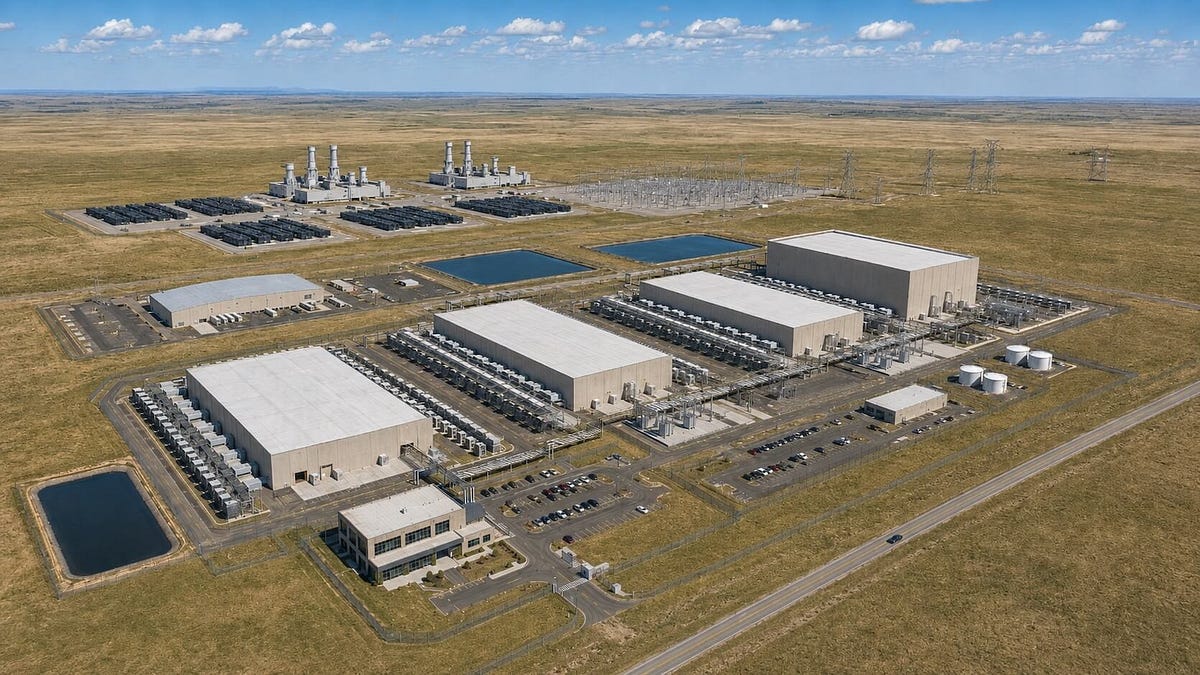
Google has signed a 22-year contract with Black Hills Corporation for 590 MW of power in Wyoming. The great majority of it comes from a gas plant that does not exist yet. The contract is one of only two US gas offtake agreements Enerdatics has recorded since the start of 2024, and both were signed by a technology company.
Key takeaways
- Black Hills Corporation has signed a 22-year corporate power purchase agreement with Google for 590 MW of energy supply in the US, of which 564 MW comes from a new natural gas plant and 26 MW from market energy purchases and retail utility service.
- The 564 MW plant will be built at Black Hills' existing Cheyenne Prairie Generating Station in Cheyenne, Wyoming, and will be developed and owned by a non-regulated affiliate of Black Hills rather than by the regulated utility.
- Black Hills plans to invest about $1.8 billion between 2027 and 2029 to develop the new generation facilities, and the plant will support Google's planned data centre in Cheyenne.
- The agreement includes contractual protections against early termination and provisions ensuring that Google bears the costs associated with serving its planned data centre.
- Enerdatics records only two US natural gas PPAs since the start of 2024: this one and Chevron's 2,670 MW, 20-year agreement with Microsoft for the Kilby project in ERCOT in June 2026. Both offtakers are classified as Tech or Telecom.
What is Google actually contracting for?
Two different things inside one number. Of the 590 MW, 564 MW will come from a new gas plant to be developed and maintained by Black Hills at the Cheyenne Prairie site. The remaining 26 MW is not new generation at all. It is a combination of market energy purchases and retail utility service provided by Black Hills, which is to say electricity bought from the wholesale market and standard utility supply. Read as a generation deal, the agreement is 564 MW. Read as a supply agreement, it is 590 MW, and the gap is a small tail of conventional service wrapped into the same contract.
The term is unusual. Enerdatics records 137 US power purchase agreements of 20 years or more since the start of 2024, and almost all are 20, 25 or 30 years. Twenty-two points to a term negotiated around the plant's economic life and investment recovery rather than chosen from market convention.
Who carries the cost if the data centre does not materialise?
Google does, the structural heart of the deal. The agreement includes contractual protections against early termination and provisions ensuring that Google bears the costs associated with serving its planned data centre. Those two clauses exist because of how the plant is owned. It will sit in a non-regulated affiliate of Black Hills, not in the regulated utility.
That distinction decides who is exposed. When a regulated utility builds generation, the cost enters the rate base and is recovered from all customers through approved tariffs, so if the demand that justified it fails to appear the remaining customers carry the stranded cost. A non-regulated affiliate sits outside that mechanism. Its revenue comes from the Google contract alone, and the termination protections mean Google cannot walk away and leave the affiliate holding a 564 MW plant with no buyer. Wyoming ratepayers are insulated by the ownership structure, and the cost-bearing provisions close the gap the structure leaves open.
The investment figure needs care. Black Hills plans to invest about $1.8 billion between 2027 and 2029 to develop the new generation facilities. If all of that went to the 564 MW plant it would be about $3.19 million per MW, which is high for combined-cycle gas but not implausible given current turbine lead times and equipment pricing. The record describes the figure as covering new generation facilities across a three-year programme rather than this plant alone, so treat $3.19 million per MW as an upper bound on the plant's share rather than its cost.
Why is a technology company buying gas on a 22-year term?
Because the alternative is not available at the hours and scale required. A data centre runs flat around the clock; Wyoming's cheap resource is wind, which does not. Firming 564 MW of that load with renewables and storage in one location is a far larger undertaking than contracting a gas plant beside an existing generating station with an established interconnection.
What makes the choice legible is what Google did on the same day. Enerdatics records that on 6 October 2026 Google also signed an 890 MW, 20-year agreement with Constellation Energy in PJM, part of a pair of nuclear contracts examined in how Google split 3.6 GW of Constellation power into two contracts. One buyer, one day, two very different resources matched to different locations and needs. The pattern across the wider market is the same. LS Power closed a $6 billion fund in October 2026 and pointed roughly $1.7 billion of it at about 5 GW of gas-fired plants, which is capital arriving at the same conclusion from the supply side.
Enerdatics records only two US natural gas power purchase agreements since the start of 2024. This one and Chevron's 2,670 MW, 20-year agreement with Microsoft for the Kilby project in ERCOT in June 2026. Both offtakers are classified as Tech or Telecom. Every US gas offtake contract on the record was signed by a hyperscaler, which says less about gas becoming popular than about who is now large enough to sign a two-decade generation contract. Black Hills itself has pursued other routes at the same site: Enerdatics records the company winning a $16 million Wyoming Energy Authority grant for a coal-to-hydrogen plant with carbon capture at its Neil Simpson station in Gillette.
What does the deal signal for US power procurement?
The deal signals that data centre load is now being met with new thermal generation under structures that keep the cost off the regulated utility. The non-regulated affiliate, the cost-bearing provisions and the termination protections together form a template: the hyperscaler gets firm round-the-clock power at a known price for two decades, the utility's shareholders get a contracted asset, and existing customers neither fund nor inherit the plant if the load disappears.
The second signal is how to read corporate clean energy portfolios. The same buyer contracting nuclear in PJM and new gas in Wyoming on the same day is not inconsistent. It is matching resource to location and to the hourly shape of a specific load. Expect more gas contracted this way where load is concentrated and firm, held in unregulated affiliates, with published capacity figures that include a tail of ordinary utility service.
Frequently asked questions
How much power is Google contracting from Black Hills?590 MW under a 22-year corporate power purchase agreement. Of that, 564 MW comes from a new natural gas plant at the Cheyenne Prairie Generating Station in Cheyenne, Wyoming, and 26 MW from a combination of market energy purchases and retail utility service.
Who pays for the new gas plant?A non-regulated affiliate of Black Hills will develop and own it, and Black Hills plans to invest about $1.8 billion between 2027 and 2029 in new generation facilities. The agreement includes provisions ensuring Google bears the costs associated with serving its planned data centre, plus protections against early termination.
How common are gas PPAs in the US?Rare on Enerdatics' record. Only two US natural gas power purchase agreements have been recorded since the start of 2024: this agreement and Chevron's 2,670 MW, 20-year contract with Microsoft for the Kilby project in June 2026. Both offtakers are technology companies.
Ready to get deal-ready answers in seconds? Try Enerdatics Leap AI and access verified intelligence across M&A, financings, PPAs, projects and energy market developments through natural language.

.jpeg)