How Google Split 3.6 GW of Constellation Power Into Two Contracts
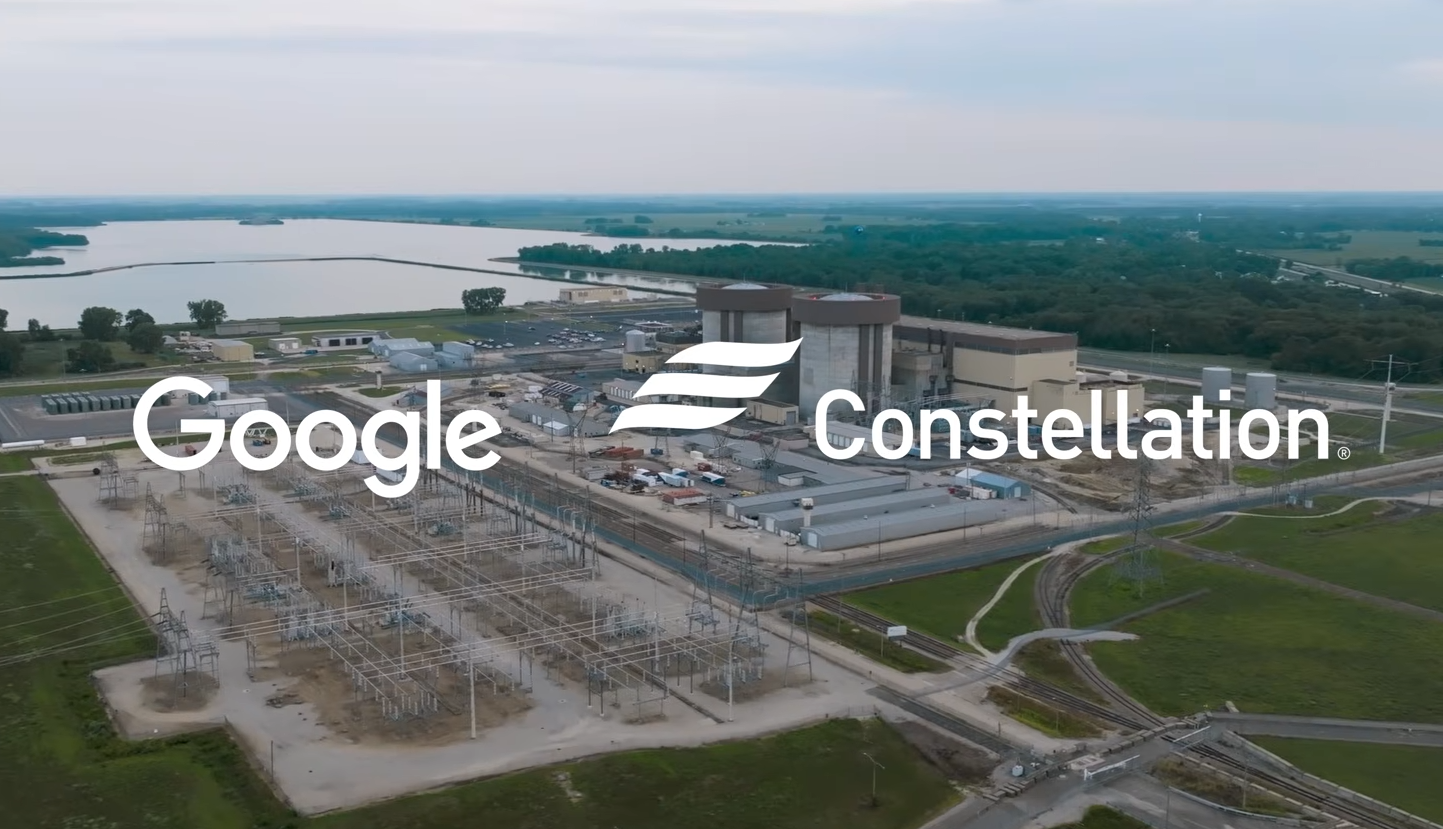
Google has signed two power purchase agreements with Constellation on the same day, one for 890 MW and one for 2,700 MW. The smaller agreement runs five years longer than the larger one. That is the clue to what separates them, because one of the two is paying for electricity that does not exist yet.
Key takeaways
- Constellation Energy has signed a 20-year power purchase agreement with Google for 890 MW from 11 nuclear projects across PJM, under which Google will support investment in new equipment and technology upgrades that raise the plants' efficiency and allow additional power to reach the grid. The first incremental capacity is expected in 2028.
- Alongside it, Constellation signed a separate 15-year agreement with Google for 2,700 MW from its PJM fleet. Enerdatics records that this electricity is not tied to a specific generation source and will be supplied from Constellation's existing fleet.
- The 11 nuclear projects sit in Illinois, Pennsylvania and New Jersey. Enerdatics identifies nine of them, including the 2.64 GW Peach Bottom, 2.38 GW Braidwood, 2.34 GW Byron, 2.32 GW La Salle, 2.31 GW Limerick and 2.28 GW Salem stations, the last of which Constellation owns 43 percent of with PSEG holding 57 percent.
- Constellation plans to upgrade turbines, steam generators and digital control systems to raise the thermal and electrical efficiency of the units, which is the mechanism producing the 890 MW.
- Enerdatics records 19 US nuclear power purchase agreements since the start of 2024 and not one discloses a tariff. Google is the off-taker on five of them covering 4,405 MW, and Constellation is the supplier on six covering 6,412 MW.
Where does 890 MW of nuclear capacity come from without a new reactor?
From upgrades to reactors that already run.
An uprate is an increase in a reactor's output achieved through equipment upgrades and regulatory approval rather than new construction. It is capital expenditure on a working plant, and like any capital expenditure it needs a reason to be approved. The nine projects Enerdatics identifies in this set total roughly 19.8 GW between them, so 890 MW is about 4.5 percent of the fleet it is spread across. That is the scale of efficiency gain that turbine, steam generator and control system work can deliver on plants of this size.
What matters commercially is the order of events. Google is not contracting 890 MW of today's output; it is underwriting the programme that creates it, with first delivery expected in 2028. The contract comes before the capacity. Enerdatics traced the same structure at Calvert Cliffs, where 190 MW of the 690 MW Amazon contracted is an uprate Constellation has yet to build. A twenty-year agreement with an investment-grade technology company is now the instrument that makes a nuclear capital programme financeable.
What does the 2.7 GW agreement actually deliver?
A claim on output rather than a claim on a plant.
Enerdatics records the electricity under this agreement as not tied to a specific generation source, supplied instead from Constellation's existing PJM fleet, which comprises its 11 nuclear projects alongside wind and hydro assets. So the 2,700 MW is backed by a portfolio, and Constellation decides which units serve it. The distinction between a contractual volume and the electrons behind it is not academic: Enerdatics has covered a wind farm fully contracted to Google where the contract covers the renewable energy credits while a third party markets the physical power into PJM.
For Constellation the two agreements do different jobs, and the terms show it. The fleet agreement converts output from assets that are already built and already earning into fifteen years of contracted revenue, which is a hedge. The uprate agreement funds new capital spending, and capital spending has to be amortised, which is why it carries twenty years rather than fifteen. Read the two terms side by side and the structure explains itself: the longer commitment is attached to the money that has to be spent before anything is delivered.
Why does neither agreement carry a price?
Because in a market this contested the tariff is the most valuable thing either party holds.
Enerdatics records 19 US nuclear power purchase agreements since the start of 2024 and not a single one discloses a tariff. Volume and term are published freely; price never is. Twelve of the 19 disclose a contract duration, and those run from 15 to 25 years, so the only observable left in a nuclear offtake deal is how long the counterparties were willing to commit. The first generator to publish a price would hand every subsequent hyperscaler negotiation an anchor, and so far none has.
Enerdatics records 19 US nuclear power purchase agreements since the start of 2024, and Google is now the off-taker on five of them, covering 4,405 MW: these two Constellation agreements at 890 MW and 2,700 MW, 565 MW from NextEra's Duane Arnold plant, 200 MW from Commonwealth Fusion Systems and 50 MW from the Tennessee Valley Authority's Hermes 2 project. Constellation is the supplier on six of the 19, covering 6,412 MW, more than any other generator in the set. Fourteen of the 19 have a technology company as the off-taker, four a utility or independent power producer and one a retailer, which is the clearest available measure of who is actually buying American nuclear output.
What does the deal signal for US nuclear?
It signals that corporate offtake has become the funding mechanism for nuclear capital spending rather than merely a route to market for the output. Uprates and life extensions are long-dated, expensive decisions that a merchant generator struggles to justify against volatile wholesale prices, and a twenty-year contract from a counterparty with Google's credit removes that problem. Expect more uprates to be announced alongside the contract that pays for them rather than ahead of it.
The second agreement shows the other half of the demand. Hyperscalers also need plain volume, in quantity, and will take it unattributed from a fleet on a shorter term. Those are two different products and they price differently, which is the real lesson of a 15-year contract sitting next to a 20-year one. For Constellation the pair converts an operating fleet into contracted cash flow while funding its expansion, with a single counterparty, at the same time as it releases roughly 5 GW of gas-fired generation to LS Power. That is a portfolio being deliberately reshaped toward contracted nuclear, not a company standing still.
Frequently asked questions
How much power has Google contracted from Constellation?Two agreements totalling 3,590 MW: 890 MW for 20 years from 11 nuclear projects, tied to efficiency upgrades with first incremental capacity expected in 2028, and 2,700 MW for 15 years from Constellation's existing PJM fleet. Neither discloses a tariff.
What is a nuclear uprate?An increase in an existing reactor's output achieved through equipment upgrades and regulatory approval rather than by building a new reactor. Here it comes from work on turbines, steam generators and digital control systems across 11 units.
Which plants are covered by the 890 MW agreement?Eleven nuclear projects, which the record places in Illinois, Pennsylvania and New Jersey. Enerdatics identifies nine of them, among them Peach Bottom, Braidwood, Byron, La Salle, Quad Cities, Limerick, Dresden and Salem. Its identified list also carries Calvert Cliffs in Maryland, which sits outside those three states, so the geography of the set is not fully settled.
Enerdatics records the volume, term, structure and counterparty behind every US nuclear offtake agreement, including which megawatts already exist. Browse more transaction analysis in the Enerdatics insights archive.