Why 190 MW of Amazon's Nuclear Contract Does Not Exist Yet
.jpeg)
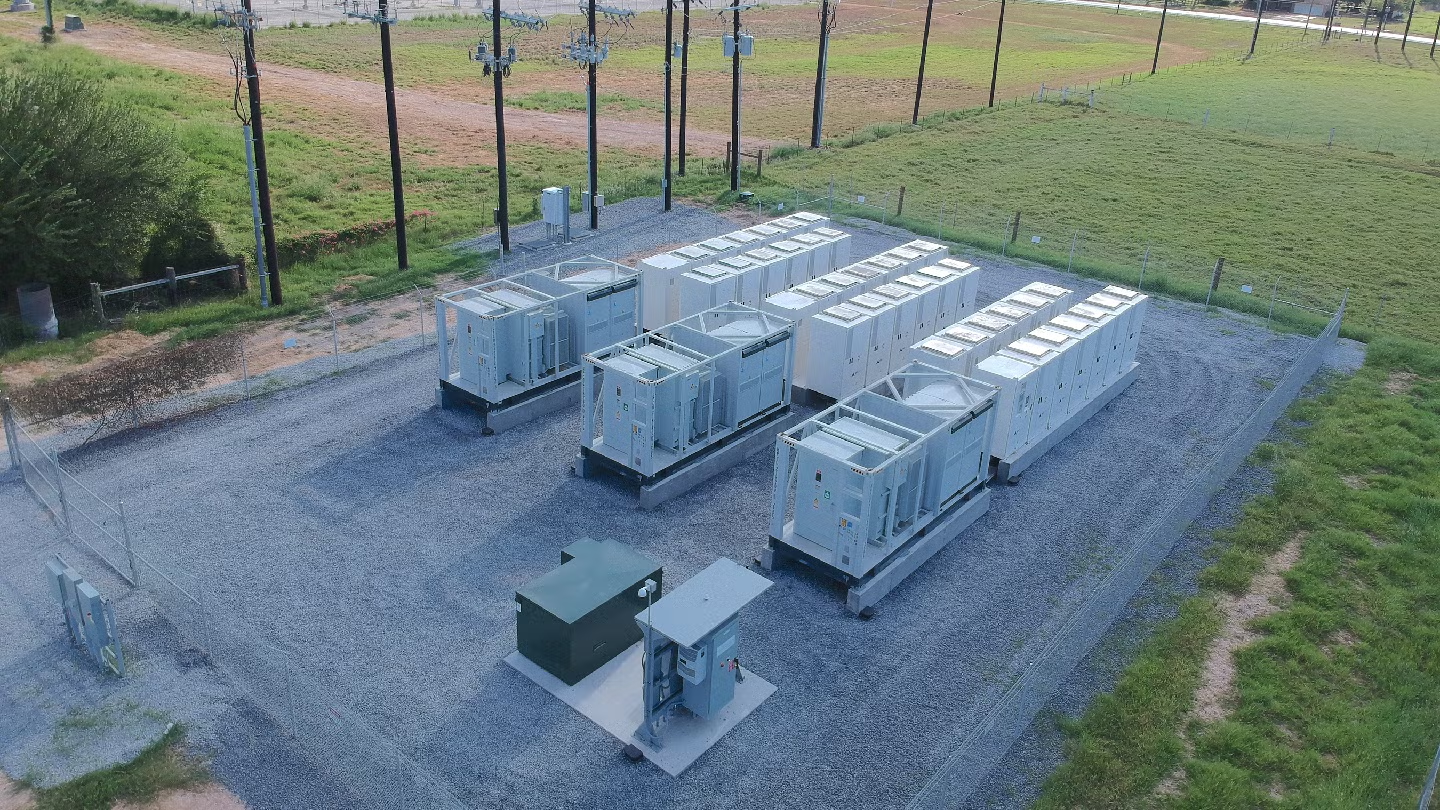
Amazon has signed a 20-year agreement for 690 MW from Constellation's Calvert Cliffs nuclear plant on the Chesapeake Bay. The plant runs at 1,980 MW today and has operated since the 1970s. The contract covers 690 of those megawatts, except that 190 of them have not been built yet.
Key takeaways
- Constellation Energy has signed a 20-year power purchase agreement with Amazon for 690 MW from the Calvert Cliffs nuclear project in the US, a volume that includes a 190 MW uprate Constellation plans to add through upgrades to the existing facility.
- Calvert Cliffs is a 1,980 MW nuclear plant near Lusby, Calvert County, on the Chesapeake Bay. It generated approximately 14,515 GWh in 2025, equivalent to a capacity factor of roughly 83.7 percent.
- The agreement is intended to provide revenue certainty supporting continued investment in and relicensing of the Calvert Cliffs facility. Contracted output is around 5,058 GWh a year.
- Constellation and Amazon have separately signed a retail supply agreement covering Amazon's operations across the 13-state PJM market, a second contract distinct from the plant-level PPA.
- Enerdatics records 16 US nuclear PPAs since the start of 2024 and not one discloses a tariff. Eleven of the 16 have a technology company as the off-taker.
How can a contract cover capacity that does not exist?
Because the contract is what pays for the capacity, not the other way round.
An uprate is an increase in a reactor's output achieved through equipment upgrades and regulatory approval rather than by building a new reactor. It is capital expenditure on a plant that already runs, and it needs a reason. Subtract the 190 MW from the headline and Amazon is contracting 500 MW of today's output, which is around 25 percent of the plant as it stands. The remaining 190 MW arrives only if Constellation spends the money, and Leap's record states that the agreement provides revenue certainty to support continued investment and relicensing of the facility.
So the sequence runs contract first, capacity second. Against the plant's current 1,980 MW the contract covers about 35 percent; against the 2,170 MW it would reach after the uprate, about 32 percent. Both figures are arithmetic on Leap's record rather than disclosures, and the record gives no timetable for the uprate. Constellation has run this playbook before: Enerdatics records its September 2024 agreement with Microsoft for 835 MW from the Crane Clean Energy Center, where long-dated corporate offtake underwrote bringing capacity back into service. A twenty-year contract with an investment-grade technology company is, in both cases, the instrument that makes a nuclear capital programme financeable.
What is the second contract most readers will miss?
The retail supply agreement, which does a completely different job from the PPA.
A power purchase agreement buys the output of a named plant. It fixes a volume and a price against that specific generator, and it is what gives Constellation the revenue certainty to invest in Calvert Cliffs. It does not keep the lights on in any particular Amazon building. A retail supply agreement is the contract that actually serves load: Constellation supplies the electricity Amazon's operations consume across the 13 states of the PJM market, wherever those operations sit.
Put together, the pair lets Amazon claim a defined share of a specific nuclear plant's output while also buying the power its facilities draw. Neither contract achieves that alone, and the PPA is the one that gets reported. Leap's record notes the retail agreement without giving a volume, term or price, so its size relative to the 690 MW is not something the record settles.
Why is there no price in any of these deals?
Because in a market this contested the price is the most valuable thing either side holds.
Enerdatics records 16 US nuclear PPAs since the start of 2024 and not a single one carries a disclosed tariff. That is total opacity across a cohort that includes Talen and Amazon at Susquehanna, Vistra and Meta across three plants, Constellation and Meta at Clinton, NextEra and Google at Duane Arnold, and this agreement. Nuclear offtake pricing has become the reference point for every subsequent negotiation between a generator and a hyperscaler, and the first party to publish one hands the next counterparty an anchor.
The pattern extends past nuclear. Across all 43 US power purchase agreements Enerdatics records with Amazon as off-taker since the start of 2024, covering roughly 13,266 MW, not one discloses a tariff either. Contract duration is disclosed far more readily: 20 years is the most common term in the nuclear set, matching this agreement, with Susquehanna at 16 years and the Duane Arnold contracts at 25.
Enerdatics records those 43 Amazon contracts as overwhelmingly solar and wind by count, but not by volume. Only five of the 43 are for firm, dispatchable supply: three nuclear, one gas and one geothermal. Those five carry 6,310 MW between them, which is 47.6 percent of all the capacity Amazon has contracted in the US over the period. Its nuclear position alone now stands at 3,810 MW across Calvert Cliffs, the 1,200 MW Comanche Peak agreement with Vistra in September 2025 and the 1,920 MW Susquehanna agreement with Talen in June 2025. Constellation is the most frequent supplier in the nuclear set, with four contracts since the start of 2024 covering Calvert Cliffs, Crane, Clinton and Dresden.
What does the deal signal for the US nuclear market?
It signals that corporate offtake has become the funding mechanism for nuclear capital spending, not merely a route to market for it. Relicensing an ageing plant and uprating its reactors are expensive, long-dated decisions that a merchant generator struggles to justify against volatile wholesale prices. A twenty-year contract from a counterparty with Amazon's credit removes that problem, and it is now arriving before the investment rather than after it. Expect uprates and life extensions at other PJM and MISO plants to be announced alongside the contract that pays for them.
It also shows how far the balance of Amazon's procurement has shifted. Five contracts out of 43 carrying almost half the megawatts is the clearest available measure of what data centre load actually requires, which is supply that runs regardless of weather. The renewable contracts continue, and Enerdatics has shown elsewhere that an Amazon PPA can be the most valuable thing attached to a solar asset, but the volume is moving to firm capacity. The same demand is reshaping the other side of the market too, where uncontracted late-stage solar is now bought on the expectation that data centre buyers will arrive. At Calvert Cliffs they already have.
Frequently asked questions
How much of Calvert Cliffs has Amazon contracted?690 MW for 20 years, which is about 35 percent of the plant's current 1,980 MW nameplate and roughly 32 percent of the 2,170 MW it would reach after the planned 190 MW uprate. Contracted output is around 5,058 GWh a year.
What is a nuclear uprate?An increase in an existing reactor's output achieved through equipment upgrades and regulatory approval, without building a new reactor. Constellation plans to add approximately 190 MW at Calvert Cliffs this way, and that capacity is included in the 690 MW Amazon has contracted.
What price is Amazon paying for the power?Not disclosed. Enerdatics records 16 US nuclear PPAs since the start of 2024 and none carries a tariff, nor does any of the 43 US agreements with Amazon as off-taker over the same period.
Ready to get deal-ready answers in seconds? Try Enerdatics Leap AI and access verified intelligence across M&A, financings, PPAs, projects, and energy market developments through natural language.
.jpeg)