Why a State Power Authority Stopped at 51 Percent of a Solar Project
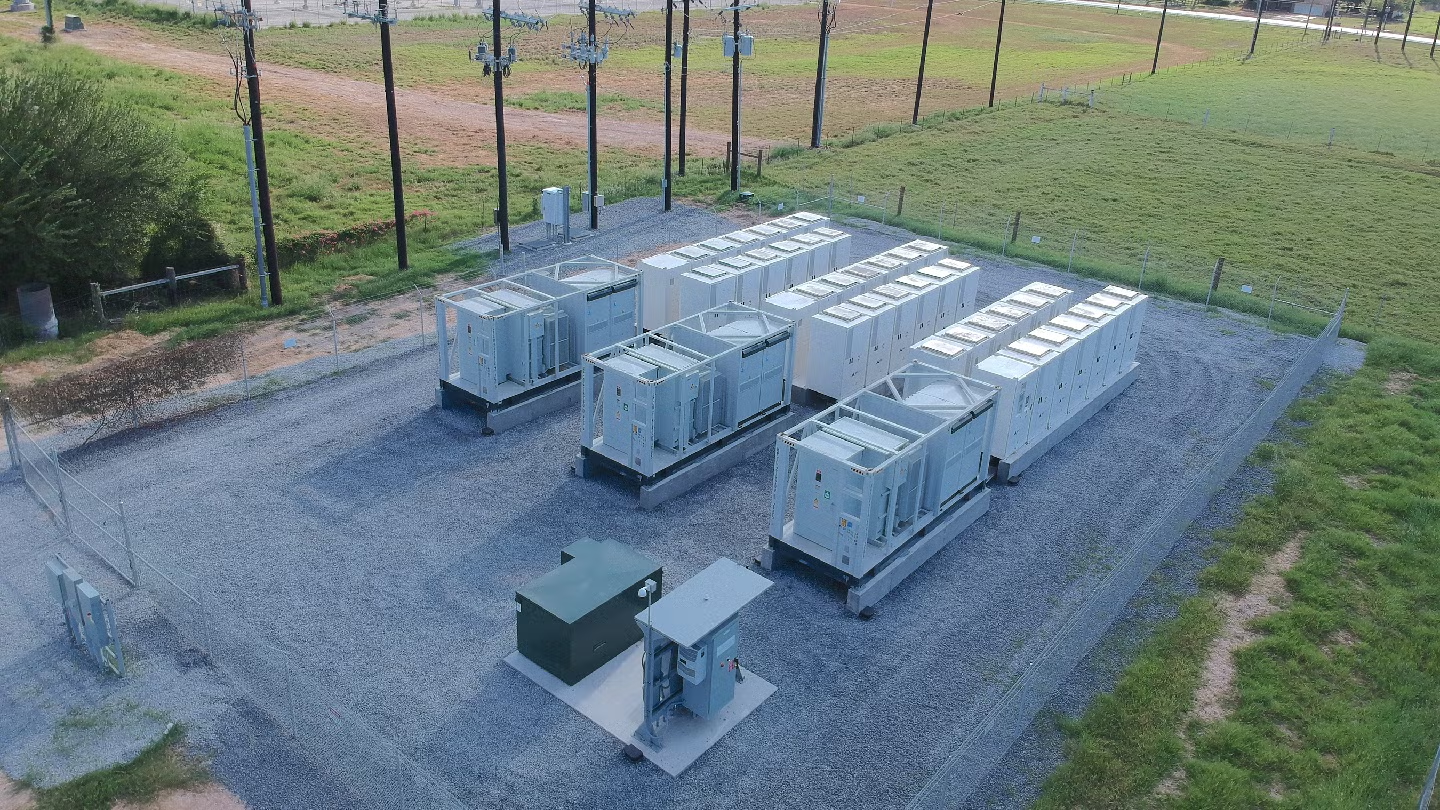
The New York Power Authority has bought a majority of a 240 MW solar project in St. Lawrence County from EDF. It took 51 percent, left the seller with 49 percent, and asked the seller to stay on and run construction. That split reads like a compromise. It is closer to a tax calculation.
Key takeaways
- The New York Power Authority has acquired a 51 percent stake in the 240 MW Rich Road solar project and its 20 MW battery in the Town of Canton, St. Lawrence County, New York, from EDF Power Solutions. Terms were not disclosed.
- EDF Power Solutions North America remains a 49 percent minority owner and will oversee construction. Rich Road is the first large-scale renewable energy project NYPA has acquired through the public-private structure created under New York's 2023-24 Enacted State Budget.
- That structure allows NYPA to benefit from direct-pay federal tax credits on its ownership stake, a monetisation route open to tax-exempt public entities that cannot use conventional tax equity.
- Rich Road holds a 20-year Tier 1 Renewable Energy Certificate contract from NYSERDA's 2025 Renewable Energy Standard solicitation, and received its final siting permit from the New York Office of Renewable Energy Siting in September 2024. Construction starts in late 2027 and operations in 2029.
- Enerdatics records 38 New York solar transactions since the start of 2024, of which nine carry a disclosed value. The only priced EDF development-stage sale in the state is AES Corp's February 2025 purchase of a 302.5 MW portfolio for $30 million, or $0.10 million per MW.
Why would a public power authority stop at 51 percent?
Because the ownership split decides how the project's federal tax credits turn into cash, and NYPA and EDF cannot use the same route.
A tax credit is only worth face value to an owner with enough tax liability to absorb it. Private developers solve that by bringing in tax equity investors or by selling credits. A public power authority has no federal tax bill at all, so neither route was ever open to it. Direct pay fixes that by letting a public entity collect the credit as a payment from the government instead. What it cannot cover is a project NYPA does not own: the credit follows the equity.
So a majority stake is not a governance preference. It sets how much of the project's credit value runs through the route that works for a state entity. Leap's record states that the structure enables direct pay on NYPA's stake, but does not set out the arithmetic behind the particular 51 and 49 split, so the reason for that line rather than another is an inference. The rest is less abstract: NYPA has not built utility-scale solar at this size and EDF has, so leaving the seller in charge of construction buys delivery capability a full purchase would have removed.
What does a 20 MW battery actually do next to 240 MW of solar?
Not much of what the pairing suggests. The battery is 20 MW and 80 MWh, a four-hour system. Battery duration is energy capacity divided by power rating, so 80 MWh at 20 MW gives four hours at full power.
Its power rating is 8.3 percent of the solar nameplate, and its store is a small fraction of what 240 MW of panels produces on a clear summer day. A battery sized to absorb that midday output would be several times larger. This one cannot shift the solar profile. What it can do is trade in NYISO markets on its own terms using an interconnection position the project already holds, though Leap's record gives the configuration without the reasoning behind the sizing.
Why does the timetable matter more than the price here?
Because the deadline that produced the deal and the schedule of the asset it produced do not line up.
In September 2025, New York State called on state entities to fast-track shovel-ready renewable energy projects to capture expiring federal tax credits. NYPA responded by exploring partnerships and acquisitions, and Rich Road is the first large-scale result. Yet construction does not begin until late 2027 and the project does not operate until 2029. A mandate framed around speed has landed on an asset more than two years from breaking ground.
That says something about what is actually scarce. The siting permit arrived in September 2024 and the REC contract came from the 2025 solicitation, so the slow parts are done. Permits and offtake take years and cannot be bought with capital. Construction can. Enerdatics has covered the opposite case in the same market, where 715 MW of late-stage US solar changed hands with no power contract attached at all. Here the offtake is the point, which mirrors the logic behind a 105 MW New York portfolio bought on the strength of 20-year NYSERDA contracts.
Enerdatics records 38 New York solar transactions since the start of 2024, and only nine carry a disclosed value, so roughly three in four changes of ownership in the state leave no price behind. EDF appears as seller in three of them and only one is priced: the 302.5 MW development portfolio AES Corp bought in February 2025 for $30 million, or $0.10 million per MW. Applied to the 122.4 MW of solar that NYPA's 51 percent represents, that comparable implies roughly $12 million, an inference from a single data point rather than a disclosure. NYPA appears twice as a buyer in the same records, the other being the 20 MW Somers project bought from CS Energy in March 2025, and neither deal is priced.
What does the deal signal for the New York solar market?
It signals that public capital in New York has moved from contracting for power to owning the plants. Rich Road puts a state authority on the cap table of a project that also holds a NYSERDA contract, the public sector on both sides of one asset. Direct pay is what makes that affordable, because without it a tax-exempt owner would forfeit a large slice of the project's value simply by owning it.
For sellers, it adds a bidder with an unusual cost of capital. EDF has been a consistent net seller of New York development assets, and a counterparty that collects credits directly, funds at public-sector rates and still leaves the developer a stake and the construction role is not a fund. It reaches the same place as the tax equity and credit transfer structures private sponsors rely on, which Enerdatics has traced where financing closed around locked-in tax credit monetisation before operations began, but without the intermediary. Disclosure has not changed: the state's largest public buyer is adding assets without adding price data.
Frequently asked questions
How much did NYPA pay for the 51 percent stake in Rich Road?Terms were not disclosed. Enerdatics records 38 New York solar transactions since the start of 2024 with only nine priced, the closest being AES Corp's February 2025 purchase of a 302.5 MW EDF development portfolio for $30 million, or $0.10 million per MW.
What are direct-pay federal tax credits?They let a tax-exempt entity such as a public power authority receive the cash value of a federal energy tax credit directly from the government, rather than needing taxable income to absorb it. The credit attaches to the owner's share, which is why the size of NYPA's stake matters.
When will Rich Road solar be built?Construction is expected to begin in late 2027 and operations in 2029. It received its final siting permit in September 2024 and holds a 20-year Tier 1 REC contract from NYSERDA's 2025 solicitation.
Ready to get deal-ready answers in seconds? Try Enerdatics Leap AI and access verified intelligence across M&A, financings, PPAs, projects, and energy market developments through natural language.
.jpeg)
.jpeg)