Why $268 Million of Battery Equity Does Not Buy Any Batteries
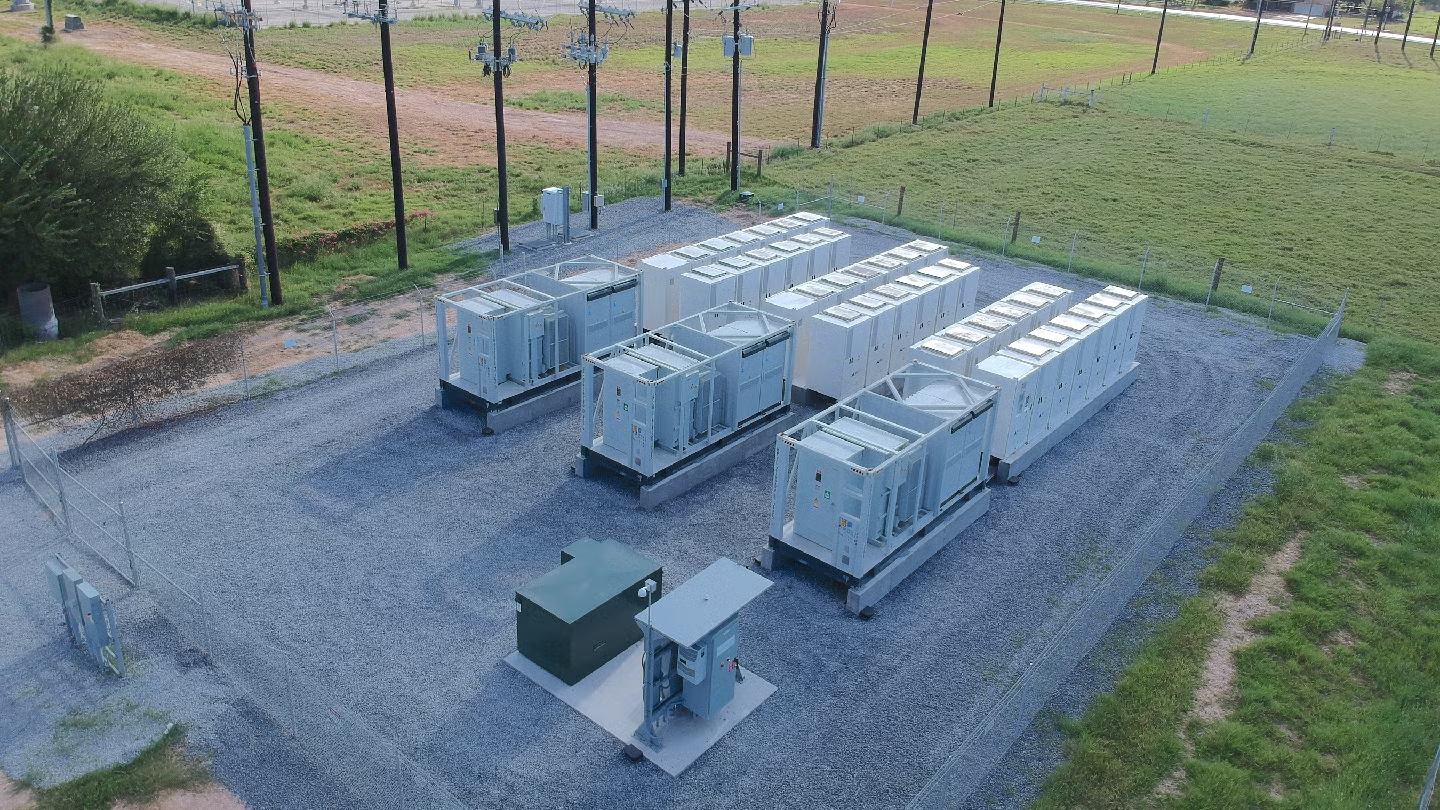
SMT Energy has raised $268 million from Climate Adaptive Infrastructure to develop battery storage across the US. It is the largest equity cheque Enerdatics records going into a US battery project developer since the start of 2024. None of it will pay for a battery.
Key takeaways
- SMT Energy has raised $268 million from Climate Adaptive Infrastructure for the development of battery energy storage projects in the US, structured as a parent-company equity investment. It follows a prior $32 million investment by the same backer, taking the total to $300 million.
- The equity will work alongside tax equity and project-level debt raised for each individual project. The capital supports the development, construction and ongoing operation of battery storage assets across the US.
- Founded in 2019 and based in Boulder, Colorado, SMT Energy develops, owns and operates battery storage, specialising in distributed-generation, utility-scale and powered land projects. With FlexGen it has built more than 12 ERCOT-connected battery projects in Texas, including SMT Houston IV, operational since September 2026.
- Expedition Infrastructure Partners was financial adviser to SMT Energy and Stoel Rives its legal adviser. Orrick advised Climate Adaptive Infrastructure.
- Enerdatics records 23 US battery equity financings since the start of 2024, of which 21 disclose an amount, at a median of $225 million. At $268 million this is the eighth largest, and the largest raised by a project developer rather than a technology or manufacturing business.
What does parent-company equity actually pay for?
The years before a project is financeable by anyone else.
Parent-company equity sits above any individual project. It funds land control, interconnection deposits, permitting, engineering and development overhead, all spent long before a project has a revenue contract or a construction schedule. It then funds the sponsor's own equity cheque at each project's financial close. Tax equity, which is investment by a party with enough tax liability to use a project's federal credits, and project-level debt both arrive later and both require an asset that is close to being built.
That ordering is why the headline figure misleads. Leap's record is explicit that this equity works alongside tax equity and project-level debt raised for each individual project, so the $268 million is the layer that unlocks the other layers rather than the cost of the assets. It is the same reading problem Enerdatics has flagged in debt, where a $260 million facility against 85 MW of community solar measured a rolling build programme rather than construction cost. The record does not state the gearing SMT expects at project level, so how far $268 million of sponsor equity ultimately reaches is not something the figure itself answers.
Why is a 2019 company raising the largest developer cheque in the set?
Because it is already building, and most of the larger raises in the market are not for building anything.
The seven US battery equity raises above this one since the start of 2024 are dominated by companies selling a product rather than selling electricity. Base Power raised $1 billion twice for a distributed storage platform and its manufacturing. Form Energy took $405 million for iron-air batteries, Sila $375 million for a silicon anode facility, Redwood Materials $350 million, and Eos Energy roughly $316 million for zinc-based manufacturing. Those are technology and factory bets, priced on cost curves and order books.
SMT belongs to a different group: developers raising platform equity to build and own sites. In that group its $268 million is the largest disclosed, ahead of esVolta at $243 million, NineDot Energy at $225 million, Liminal Energy at $200 million and Arevon at $186 million. The split between product companies and developers is a reading of the records rather than a field in them, so the ranking depends on where that line is drawn. What is not a judgement call is the track record attached: more than 12 ERCOT-connected projects already built with FlexGen is an unusual base for a company six years old.
What is powered land, and why is it in a battery company's description?
Powered land is a site that comes with secured grid capacity, offered to a large electricity consumer that needs a connection faster than the queue will provide one. The product is the interconnection position, not the ground.
It appears in a battery developer's description because the two businesses accumulate the same asset. A storage developer spends years acquiring sites with firm grid capacity in constrained parts of the network, which is exactly the inventory a data centre operator is short of. Having built that position in ERCOT, SMT can either put a battery on it or sell access to it. Leap's record lists powered land among the company's specialisms without detailing the business, so this is stated scope rather than a disclosed strategy, and the split of the $268 million between the two uses is not given.
Enerdatics records 23 US battery equity financings since the start of 2024, of which 21 disclose an amount, at a median of $225 million and a range running from $5 million to $1 billion. Climate Adaptive Infrastructure's $268 million takes its total commitment to SMT to $300 million, which is more than any other single investor in the set has put into one developer over the period. ERCOT runs through the group as the common market: of the disclosed raises, the Texas grid is named more often than any other, and SMT's own operating fleet sits there. Enerdatics has separately recorded 125 US battery sector financings since the start of 2024 across debt and equity, of which only five fund manufacturing capacity rather than projects, which is the structural reason a developer rather than a factory now attracts the largest equity cheque.
What does the deal signal for US battery storage?
It signals that the scarce capital in US storage has moved back up the structure. Project debt and tax credit monetisation for a contracted battery are well understood and widely available. What remains hard to raise is the patient money that funds a pipeline for years before any of it is bankable, and a $268 million cheque into a six-year-old developer says at least one infrastructure investor now regards that as the better risk.
The second signal is about what a battery developer is becoming. A company describing itself through distributed generation, utility-scale storage and powered land in the same sentence is not organised around a technology. It is organised around grid capacity in places where capacity is short, and it will monetise that through whichever buyer pays most. Expect more storage platforms to raise against that framing, and expect the line between a battery developer and a data centre site developer to keep blurring.
Frequently asked questions
How much has Climate Adaptive Infrastructure invested in SMT Energy?$300 million in total: the $268 million parent-company equity investment announced in September 2026, plus a prior $32 million commitment. The new capital funds development, construction and operation of battery storage assets across the US.
What is tax equity in a US battery financing?It is investment from a party with enough federal tax liability to use a project's tax credits, which the developer cannot always use itself. It sits at project level and arrives close to construction, which is why it does not substitute for parent-company equity raised years earlier.
How large is this raise compared with the US market?Enerdatics records 23 US battery equity financings since the start of 2024, 21 of them disclosed, at a median of $225 million. At $268 million SMT's is the eighth largest overall and the largest for a project developer rather than a technology or manufacturing company.
Ready to get deal-ready answers in seconds? Try Enerdatics Leap AI and access verified intelligence across M&A, financings, PPAs, projects, and energy market developments through natural language.
.jpeg)
.jpeg)