Why an $87 Million Battery Factory Loan Is Not New Money
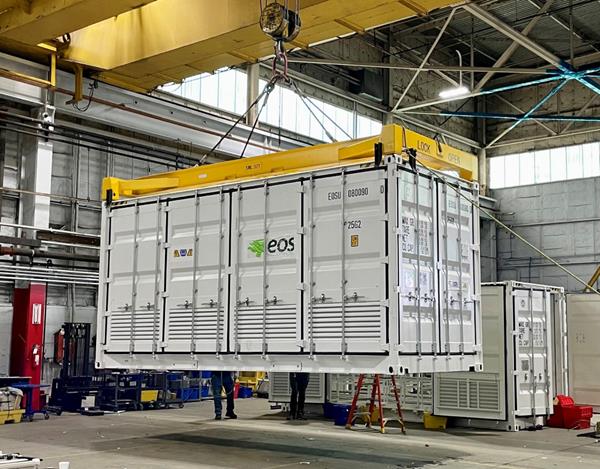
Eos Energy Enterprises has secured $87 million from the US Department of Energy to build a second production line at its Thorn Hill manufacturing facility. Read quickly, that is a new government loan to a battery maker. It is not. The money was committed before this announcement, and what the draw actually reveals is a running total that has been building since 2024.
Key takeaways
- Eos Energy Enterprises has secured $87 million from the US Department of Energy for the development of its Thorn Hill manufacturing facility, structured as the first advance of the second tranche of an existing loan facility.
- The draw brings total funding under the DOE facility to roughly $178 million since 2024. The loan was issued by the DOE Loan Programs Office under the Title 17 Clean Energy Financing Program.
- Proceeds will finance the construction and development of a second production line at Thorn Hill. Once the planned expansion phases are complete, annual output at the site is expected to reach nearly 4 GWh across two dedicated lines.
- Eos is a public battery manufacturer founded in 2008 and headquartered in Edison, New Jersey, producing long-duration storage systems on its proprietary Znyth zinc-based platform rather than lithium-ion.
- Enerdatics records 125 US battery sector financings since the start of 2024. Five were provided by the US Department of Energy, and five fund manufacturing capacity rather than projects.
What does the first advance of a second tranche actually mean?
It means the lender agreed to this money some time ago and is releasing it in stages. A tranche is a defined portion of a committed loan facility, and an advance is a single drawdown within that portion. Eos has been drawing on this DOE facility since 2024, and the $87 million announced in September 2026 opens the second of those portions rather than adding a new one.
The distinction is practical rather than semantic. A new loan tells you a lender has just underwritten a borrower. A drawdown tells you the borrower has hit whatever conditions the facility attaches to releasing the next portion, which for a construction loan usually means physical and financial milestones verified by the lender. That is a statement about progress on site, not about credit appetite. The figure worth tracking is therefore the cumulative $178 million, because that is what the DOE has actually advanced against the project to date.
Why does a battery manufacturer borrow from a government lender at all?
Because factories do not finance the way power projects do. A battery project has a revenue contract, a fixed asset and a predictable operating life, which is the shape commercial banks and infrastructure lenders are built to price. A manufacturing plant has a cost curve, competitors who can move faster than it can, and output sold into a commodity market. Repayment depends on winning orders, not on collecting contracted payments.
Title 17 exists precisely for that gap. It is the DOE programme that lends to energy projects and facilities that private lenders find difficult to underwrite alone, typically because the technology or the market position is not yet proven at scale. Znyth is a zinc-based chemistry rather than lithium-ion, which puts Eos outside the supply chain most battery lending has been built around, and long-duration storage is a younger market than the four-hour lithium standard. That combination is a hard sell to a bank syndicate and a reasonable fit for a federal facility.
The private market does fund manufacturing when the story is legible enough. Suniva raised $835 million in September 2026 to build a 4.5 GW solar cell plant, and that package came from credit funds and alternatives platforms rather than from banks, with no commercial bank named as a provider of capital. Manufacturing risk gets priced by whoever is equipped to price it. For solar cells that is private credit. For an unproven battery chemistry it is the DOE.
What does $178 million buy at Thorn Hill?
A second line, and the difference between a demonstration site and a plant. Eos expects annual output at Thorn Hill to reach nearly 4 GWh once both dedicated lines are complete. Set the advances made so far against that figure and the DOE has committed roughly $45 for every kilowatt hour of eventual annual output capacity. The total size of the facility is not disclosed in the record, so this is a measure of money advanced against capacity planned rather than a full cost of the plant.
Eos has not relied on the DOE alone. Enerdatics records the company raising approximately $315.5 million in equity from Cerberus Capital Management in June 2024 to expand zinc-based battery manufacturing, and a further $75 million from Hudson Bay Capital in June 2026 to deploy its long-duration storage project pipeline. Its stated business model pairs Z3 battery sales to independent power producers with strategic equity investments in platforms such as Frontier Power USA, which means the company sits on both sides of some of its own demand.
Enerdatics records only four other US battery financings since the start of 2024 that fund manufacturing capacity rather than a project pipeline. They are Eos taking the Cerberus equity in June 2024, Sila raising $375 million for a silicon anode production facility that same month, Base Power raising $200 million in April 2025 to build a manufacturing unit, and StarPlus Energy securing a $7.54 billion DOE loan in December 2024 for two lithium-ion plants. Set five factory financings against 125 transactions and the shape of the market is clear. American battery capital has overwhelmingly gone into building storage sites rather than the factories that supply them.
What does the deal signal for US battery manufacturing?
It signals that federal lending remains the route for domestic battery chemistries that sit outside the lithium-ion mainstream, and that the money arrives slowly and conditionally. Two tranches and roughly $178 million over more than two years is a very different rhythm from a single closing, and it gives the lender a check at every stage. For a manufacturer scaling an unfamiliar technology that is the trade: cheaper and more patient capital than the private market would offer, in exchange for building to someone else's milestone schedule.
It also underlines how thin the domestic manufacturing pipeline still is. Five manufacturing financings out of 125 is not a build-out. Demand for long-duration storage is rising, and the September 2026 record shows plenty of capital reaching US storage, including a $260 million facility for 85 MW of community solar where the headline per-megawatt figure measured something other than construction cost. Reading these announcements correctly matters for the same reason in both cases. The number in the headline is rarely the number that describes the business.
Frequently asked questions
How much has Eos Energy drawn from the US Department of Energy?Roughly $178 million in total since 2024, of which $87 million was announced in September 2026 as the first advance of the second tranche. The loan comes from the DOE Loan Programs Office under the Title 17 Clean Energy Financing Program.
What is Znyth technology?Znyth is the proprietary zinc-based battery platform Eos uses for its long-duration energy storage systems, an alternative to the lithium-ion chemistry that dominates grid storage. Eos manufactures in the United States and sells its Z3 systems to independent power producers.
How much capacity will Thorn Hill have?Annual output is expected to reach nearly 4 GWh across two dedicated production lines once the planned expansion phases are complete. The $87 million advance funds construction and development of the second of those lines.
Ready to get deal-ready answers in seconds? Try Enerdatics Leap AI and access verified intelligence across M&A, financings, PPAs, projects, and energy market developments through natural language.
.jpeg)