Suniva has raised $835 million to build a solar cell factory in South Carolina. The size of the number is not the interesting part. What stands out is that the money is going into construction at all, because most of the capital US solar manufacturers have raised since the start of 2024 came from selling tax credits on capacity that already exists.
Key takeaways
- Suniva has secured an $835 million financing package to fund construction of a 4.5 GW high-efficiency monocrystalline solar cell manufacturing facility in Laurens County, South Carolina.
- The facility will expand Suniva's total US solar cell manufacturing capacity from 1 GW to 5.5 GW, adding to the 1 GW plant the company already operates in Norcross, Georgia.
- Senior secured credit facilities came from Goldman Sachs Alternatives and I Squared Capital, JBA Asset Management provided a second-lien facility, and the equity was backed by Lion Point Capital, Electron Capital Partners, Orion Infrastructure Capital and Rubric Capital Management.
- J.P. Morgan acted as sole structuring agent and Roth Capital Partners as lead private placement agent, with Rodman & Renshaw as financial advisor and Kilpatrick Townsend & Stockton as legal advisor to Suniva.
- Enerdatics records 17 US solar manufacturing financings since the start of 2024, of which eight are transfers of Section 45X advanced manufacturing production tax credits.
What does $835 million buy in solar cell manufacturing?
Roughly 19 cents of capital for every watt of annual output the plant will produce. The package funds 4.5 GW of new cell capacity, which is about $186 million per gigawatt. That figure is worth holding, because the comparable raises in Enerdatics' record price well below it and the reason is not that Suniva overpaid.
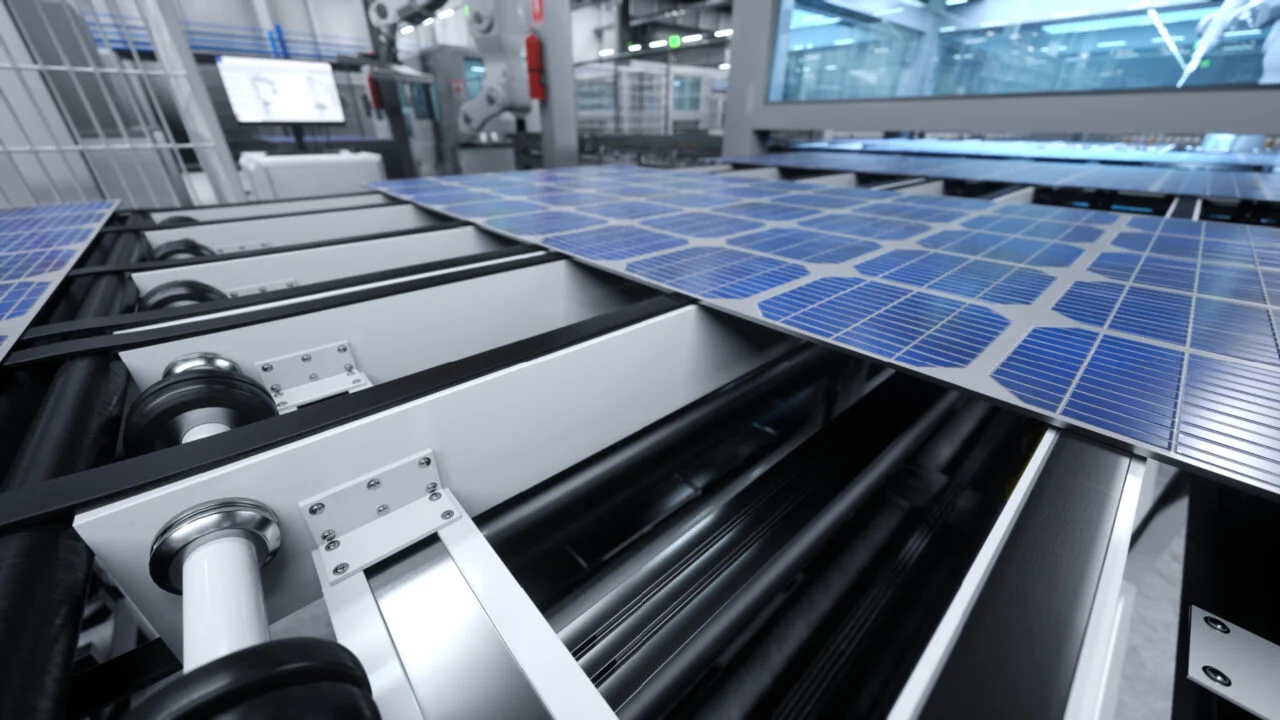
Trina Solar secured a $235 million green loan from Standard Chartered in August 2024 for a 5 GW solar panel factory, closer to five cents per watt. Meyer Burger raised $228 million through a rights issue in April 2024 for a 2 GW module production facility, roughly 11 cents per watt. Both of those build modules, the step where cells, glass, backsheet and framing are assembled into a finished panel. Cells are made earlier in the chain, through wafer handling, diffusion, deposition and metallisation, which need cleanroom conditions and process equipment a module line does not. That capital intensity gap explains the spread, and it is why a cell plant and a module plant should never be compared on one dollars-per-watt line.
Why did this money come from credit funds rather than lenders?
Because what is being underwritten is manufacturing risk, which does not fit the template most project lenders use. A solar project has a contracted or forecastable revenue stream attached to a long-lived asset, which is what makes it financeable at bank pricing. A cell factory has a cost curve, competitors who can move faster than it can, and an output that sells into a commodity market. That is a credit story rather than an infrastructure one.
The provider list reflects that. Senior secured facilities came from Goldman Sachs Alternatives and I Squared Capital, an alternatives platform and an infrastructure investment firm rather than balance-sheet lenders. JBA Asset Management provided a second-lien facility, meaning debt that ranks behind the senior lenders for repayment if the borrower defaults and is priced higher for sitting further back in the queue. Equity came from Lion Point Capital as lead sponsor and largest shareholder, alongside Electron Capital Partners, Orion Infrastructure Capital and Rubric Capital Management. J.P. Morgan appears as sole structuring agent and Roth Capital Partners as lead private placement agent, arranging roles rather than lending ones. Enerdatics' record names no commercial bank as a provider of capital, though the debt and equity split is not disclosed.
What has US solar manufacturing actually been financing?
Credits, more often than capacity. Section 45X is the advanced manufacturing production tax credit, which pays a US manufacturer a set amount for each unit of qualifying component it produces domestically, and the credit can be sold for cash to a third party with tax to shelter. Eight of the 17 US solar manufacturing financings Enerdatics records since the start of 2024 are transfers of exactly this kind. First Solar accounts for three, raising $645 million and $225 million from Visa in December 2024 and $296.27 million in June 2025. T1 Energy raised $160 million against its G1 Dallas facility in December 2025, and SEG Solar and Heliene $50 million each.
The distinction matters because a 45X transfer is not construction capital. It converts a credit already earned on production that has already happened into cash today. That improves working capital, but it cannot fund a plant that does not exist yet, and a sector financed predominantly that way is monetising its installed base rather than adding to it.
Enerdatics records Suniva's $835 million as the largest privately provided US solar manufacturing financing in that set. Only one entry is larger, Qcells securing a $1.45 billion loan from the US Department of Energy in December 2024, and that is government lending rather than private capital. The closest structural comparable is Silfab Solar's $100 million package in November 2024 from Breakwall Capital, SR Alternative Credit and ARC Financial Corporation, also to scale a US cell manufacturing facility and also through alternative credit. Suniva's raise is more than eight times that, using the same shape of capital, which shows how much larger the cheques here have become in under two years.
What does the deal signal for US solar manufacturing?
The deal signals that domestic cell capacity is now financeable at scale, and that the capital willing to fund it is private credit rather than the banking system. Cells have been the thinnest link in the US solar supply chain for years. Module assembly was built out quickly because it is cheap to tool, leaving a large domestic module industry consuming imported cells. A 4.5 GW cell plant is a direct move at that gap.
Whether the pattern repeats depends on what buyers reward. Enerdatics' H1 2026 outlook expects North American buyers to weight supply-chain traceability and compliance more heavily as tax credit economics weaken, which is the demand-side condition a domestic cell producer needs. The project side is the instructive contrast, where capital arrives through bank syndicates and tax equity, as in the Darden financing in which a five-bank debt syndicate and tax credit purchase agreements carried the stack. Factories funding themselves through credit funds while projects fund themselves through banks is not a coincidence. It is two different risks priced by the institutions equipped to price them.
Frequently asked questions
How much is Suniva raising and what is it building?An $835 million financing package, funding construction of a 4.5 GW high-efficiency monocrystalline solar cell manufacturing facility in Laurens County, South Carolina. The facility takes Suniva's total US cell manufacturing capacity from 1 GW to 5.5 GW alongside its existing plant in Norcross, Georgia.
Who provided the financing?Senior secured credit facilities came from Goldman Sachs Alternatives and I Squared Capital, with a second-lien facility from JBA Asset Management. Equity was backed by Lion Point Capital, Electron Capital Partners, Orion Infrastructure Capital and Rubric Capital Management. J.P. Morgan was sole structuring agent and Roth Capital Partners lead private placement agent. The debt and equity split is not disclosed.
What is the Section 45X tax credit?It is the advanced manufacturing production tax credit, paying US manufacturers a set amount for each qualifying component produced domestically. The credit can be transferred to a third party for cash, and eight of the 17 US solar manufacturing financings Enerdatics records since the start of 2024 are transfers of this kind.
Ready to get deal-ready answers in seconds? Try Enerdatics Leap AI and access verified intelligence across M&A, financings, PPAs, projects, and energy market developments through natural language.