Why the Amazon Contract, Not the 14 Megawatts, Is What Sun Trinity Has Actually Bought
.png)
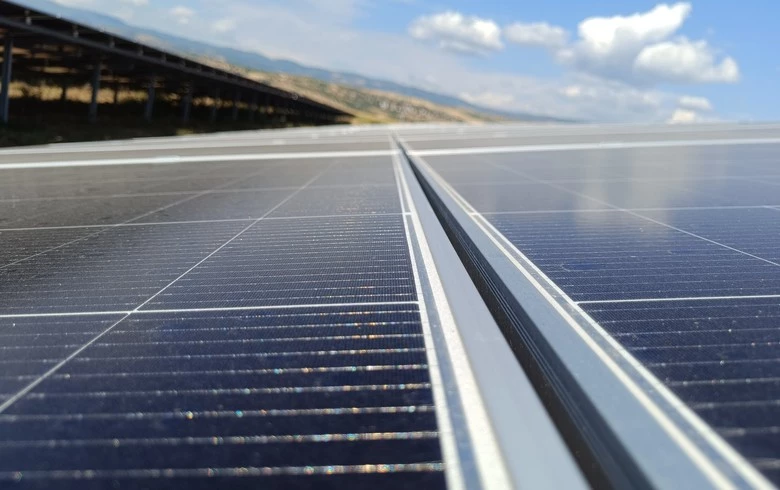
X-Elio has sold the 14 MW Funaki solar park in Ube, Yamaguchi prefecture, to Sun Trinity, the platform controlled by Sumitomo Corporation and Shikoku Electric Power. Terms were not disclosed. The plant was built on a former golf course, has been generating since summer 2025, and produces more than 17,000 MWh a year under a 20-year power purchase agreement with Amazon. X-Elio, owned by Brookfield, retains 393 MW of operating Japanese solar and a 494 MW development pipeline. At 14 MW this is a small asset by any measure, which is precisely why the contract matters more than the capacity.
What did Sun Trinity acquire?
Sun Trinity acquired the Funaki solar park in full, a 14 MW plant commissioned in summer 2025 generating over 17,000 MWh annually, which implies a load factor of roughly 13.9 percent, consistent with utility-scale solar in Japan. The site is a converted golf course in Ube. Terms were not disclosed, which is the norm here: Enerdatics records 22 Japanese solar transactions since the start of 2023 and only four carry any disclosed value. Among the operating examples, Nozomi Energy paid $1.14 million per MW for 120 MW from Banpu in June 2025, Canadian Solar paid $1.46 million per MW for 17.46 MW from Erable Infrastructure in January 2025, and Obton with GSSG Solar paid $2.53 million per MW for 117.3 MW from BCPG in December 2023. That is a wide band for a market this active, and it reflects how much the contract attached to each asset differs.
Why does a corporate PPA change what is being sold?
A corporate power purchase agreement commits a company to buy a plant's output at an agreed price for a defined term, in this case 20 years with Amazon. For the owner it converts merchant exposure into a fixed contractual receivable from an investment-grade counterparty, which is what allows the asset to support long-term debt at low cost. The buyer is therefore acquiring a contracted revenue stream with a credit profile closer to Amazon's than to the Japanese wholesale market. That distinction matters more in Japan than in most markets, because much of the country's installed solar sits on legacy feed-in tariffs that are expiring, leaving owners to find new routes to market. A plant that already has 20 years of corporate offtake attached solves that problem at the point of purchase.
Why is a former golf course the site?
Because Japan has more disused golf courses than it has easy sites for utility-scale solar. The country is mountainous, densely populated and short of flat, contiguous, gently sloping land with existing road and grid access, which is exactly what a golf course provides. Courses built during the asset bubble of the late 1980s have been closing for decades, and converting them avoids the land acquisition, grading and permitting friction that constrains greenfield development. The trade-off is scale, since a single course supports something in the region of 10 to 20 MW rather than hundreds. That is why Japanese solar deal flow is characterised by many small transactions rather than few large ones, and why a 14 MW plant is a perfectly normal unit of trade here.
Enerdatics' data shows how consistently that pattern holds. Of the 22 Japanese solar transactions recorded since the start of 2023, the median size is modest and the buyer field is dominated by domestic trading houses, utilities and financial groups: Shikoku Electric Power appears twice before this deal, taking 2.99 MW in March 2026 and 120 MW alongside Tokyo Gas from Pacifico Energy in April 2023, while Sumitomo Mitsui entities, Osaka Gas, Daiwa Energy, ENEOS, Mitsubishi and Toyota Group all appear on the buy side. X-Elio itself has been rotating in this market before, having sold 16 MW to Keiyo Gas in July 2023. Funaki represents around 3.6 percent of the 393 MW X-Elio still holds in Japan, so this is portfolio management rather than retreat.
What does the deal signal for Japanese solar?
The deal signals that corporate offtake has become the distinguishing feature in Japanese solar transactions, separating assets that can be sold readily from those that cannot. As feed-in tariff vintages roll off and new capacity competes in feed-in premium auctions, the plants that carry long-dated contracts with creditworthy corporate buyers are the ones infrastructure capital will underwrite without hesitation. Expect developers to pursue corporate PPAs specifically to make assets saleable, and expect the pricing gap between contracted and uncontracted Japanese solar to widen as more legacy tariffs expire.
For the buyer the logic is complementary. Sun Trinity's stated ambition is to offer flexible renewable procurement solutions, which requires owning contracted generation to sell from. A platform combining a trading house with a regional utility is well suited to aggregating small contracted assets into a portfolio that can serve corporate demand, and Japan's fragmented supply of 10 to 20 MW plants is well suited to being aggregated. The 14 MW is not the point. The Amazon contract, and the ability to add more like it, is.
Key takeaways
- X-Elio sold the 14 MW Funaki solar park in Ube, Yamaguchi prefecture to Sun Trinity, the platform controlled by Sumitomo Corporation and Shikoku Electric Power. Terms were not disclosed.
- The plant was built on a former golf course, has generated since summer 2025, and produces more than 17,000 MWh a year, implying a load factor of roughly 13.9 percent.
- Output is sold under a 20-year power purchase agreement with Amazon, which converts merchant exposure into a contracted receivable from an investment-grade counterparty.
- Enerdatics records 22 Japanese solar transactions since the start of 2023, of which only four carry a disclosed value, with operating examples ranging from $1.14 million to $2.53 million per MW.
- X-Elio retains 393 MW of operating Japanese solar and a 494 MW development pipeline, so Funaki represents around 3.6 percent of its operating fleet in the country.
Frequently asked questions
How much did Sun Trinity pay for the Funaki solar park?Terms were not disclosed. Enerdatics records only four of 22 Japanese solar transactions since the start of 2023 as carrying a value, with operating assets ranging from $1.14 million per MW paid by Nozomi Energy for 120 MW to $2.53 million per MW paid by Obton and GSSG Solar for 117.3 MW.
What is a corporate power purchase agreement?A corporate PPA commits a company to buy a plant's electricity at an agreed price over a defined term, here 20 years with Amazon. It replaces exposure to wholesale prices with a contracted receivable from a creditworthy counterparty, which supports long-term debt and makes the asset considerably easier to sell.
Why are Japanese solar parks often built on golf courses?Japan is mountainous and densely populated, with limited flat, contiguous land that has existing road and grid access. Disused golf courses, many of which closed after the late 1980s asset bubble, offer exactly that, avoiding much of the land assembly and grading work greenfield development requires.
Ready to get deal-ready answers in seconds? Try Enerdatics Leap AI and access verified intelligence across M&A, financings, PPAs, projects, and energy market developments through natural language.
.jpeg)
.jpeg)