Why a Wind Farm Fully Contracted to Google Still Sells Its Power Into PJM

EGCO Group has bought 49 percent of two operating US renewable projects from Apex Clean Energy. Both are fully contracted. One sells its electricity into PJM at whatever the market pays that hour. Both statements are true at once.
Key takeaways
- EGCO Group has acquired a 49 percent stake in the 339 MW Pinnacle IV portfolio in the US from Apex Clean Energy, which retains 51 percent and continues to manage operations. Terms were not disclosed and the deal completed on 25 September 2026.
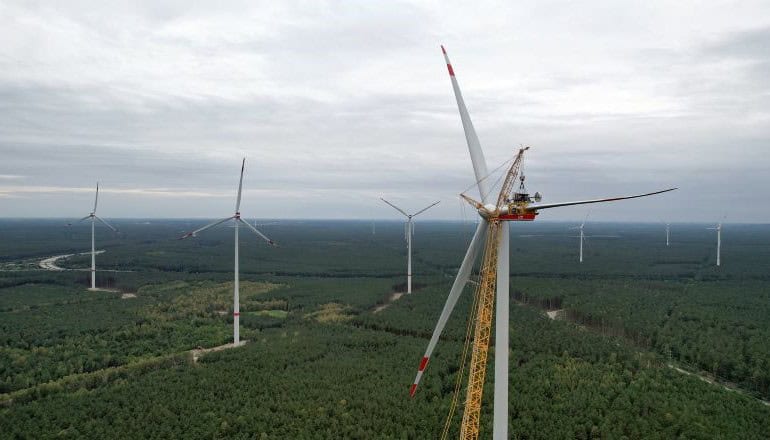
- The portfolio is two operating projects: the 189 MW Timbermill wind farm in North Carolina, online since December 2024, and the 150 MW Coldwater solar project in Michigan, online since July 2025.
- Timbermill's full 189 MW is contracted to Google under a PPA signed in August 2023 under which Google buys the project's Renewable Energy Credits, while Tenaska Power Services separately markets the physical electricity in PJM under an Energy Management Agreement.
- Coldwater's full 150 MW is contracted to DTE Electric Company under a 30-year PPA signed in February 2024 covering both the energy and the associated Renewable Energy Credits.
- This is EGCO's second 49 percent purchase from Apex, after the 251 MW Pinnacle II wind and solar portfolio agreed in April 2025, where ownership of each project transferred only once it reached commercial operation.
What is actually inside a 339 MW wind portfolio?
Less wind than the label suggests. Pinnacle IV is 189 MW of onshore wind in North Carolina and 150 MW of solar in Michigan, so 44 percent of the capacity generates from sunlight. The two assets sit in different power markets, reached commercial operation seven months apart, were financed separately, and sell into entirely different commercial arrangements. Treating the portfolio as a single wind position hides the fact that the buyer has taken two distinct positions in one transaction.
It is the second time EGCO has done this with Apex. Pinnacle II was 126 MW of wind in Maine paired with 125 MW of solar in Ohio, again a near even split, again labelled a wind portfolio. The pairing looks deliberate: bundle one wind asset with one solar asset of similar size and sell 49 percent of the pair.
What does Google actually buy from Timbermill?
Certificates, not electricity. A Renewable Energy Credit is a tradable instrument representing the environmental attribute of one megawatt hour of renewable generation, and it can be sold separately from the power that created it. Under the August 2023 agreement Google purchases Timbermill's credits, while Tenaska Power Services markets the physical output into PJM under a separate energy management agreement.
So the sentence that Timbermill's full capacity is contracted does real work, but not the work most readers assume. It fixes the price of the attributes, not the power. Revenue tracking the electrons moves with PJM wholesale prices, so the wind half of this portfolio carries merchant price exposure alongside a long-term contract for its certificates.
Coldwater is the opposite structure. DTE Electric buys the energy and the credits together under one 30-year contract, and a regulated utility on a three-decade term is about as firm as US renewable offtake gets. Set the two side by side and the shape of the asset changes: of the 339 MW EGCO has bought into, 150 MW has a contracted power price running to the 2050s and 189 MW has none at all.
Why did EGCO wait for commercial operation this time?
Because the last one showed what construction stage costs in time. Pinnacle II was agreed while both projects were still being built, and the equity capital contribution agreement deferred transfer of each until it became operational. EGCO signed in March 2025 and the deal completed only at the end of September.
Pinnacle IV inverts that sequence. Timbermill had been running 21 months and Coldwater 14 when the agreement was executed, and completion followed a week later. EGCO's own framing is that the investment lets it recognise cash flows and share of profit immediately, the language of a buyer that has stopped underwriting delivery.
The financing says the same. Apex closed a bank debt package and a Goldman Sachs tax equity investment on Timbermill in December 2024, and Coldwater reached financial close in 2024 with Royal Bank of Canada participating. Tax equity is the US structure in which an investor funds part of a project in exchange for its federal tax credits, and it is among the harder pieces of a US capital stack to assemble. EGCO is buying into a structure someone else already built and drew down, which is the pattern visible in how Apex assembles project-level debt and tax equity asset by asset rather than at platform level.
Enerdatics records 36 operational US wind transactions since the start of 2024, of which 16 carry a disclosed value, at a median of $0.88 million per MW of transacted capacity in 2024 and $0.97 million per MW in 2026. Those medians are struck on the full capacity named in each deal, so minority stakes sit artificially low inside them and must be grossed up first. The closest priced structural comparable is ITOCHU's 50 percent purchase of the 211 MW Grandview wind farm from BlackRock for $109 million in June 2024, which grosses up to roughly $1.03 million per MW for the whole asset. On that arithmetic 339 MW implies near $350 million for 100 percent and around $170 million for 49 percent, an implication drawn from a comparable rather than a disclosed figure.
What does the deal signal for US renewable M&A?
The 49 percent operating stake has become a standing product, and it is almost never priced in public. Enerdatics records Ardian taking 49 percent of a 460 MW US wind portfolio from MEAG in August 2026, and Hamilton Lane and GCM Grosvenor taking 49.9 percent of the 240 MW Big Sky wind farm in April 2026, neither at a disclosed value. Sellers keep control, buyers get cash flow without a development team, and the price stays private. It also lets a developer recycle capital without losing the asset, the pattern behind Apex's steady monetisation of advanced portfolios, and the logic recently extended to minority stakes funded project by project as each asset reaches operation.
The second signal is about reading offtake. Enerdatics records 77 US wind PPAs since the start of 2024, of which 23 covering 4,750 MW went to technology and telecom offtakers, second only to utilities and independent power producers. A growing share of those buy attributes rather than energy. For anyone underwriting an operating US wind asset described as fully contracted, the question that decides the valuation is which of the two the contract covers.
Frequently asked questions
What is the Pinnacle IV portfolio?It is a 339 MW pair of operating US renewable projects held by Apex Clean Energy: the 189 MW Timbermill wind farm in North Carolina, operating since December 2024, and the 150 MW Coldwater solar project in Michigan, operating since July 2025.
Does Google buy Timbermill's electricity?Google buys the project's Renewable Energy Credits under a PPA signed in August 2023 covering the full 189 MW. The physical electricity is marketed separately into PJM by Tenaska Power Services, so the contract fixes the price of the certificates rather than the price of the power.
How much did EGCO pay for its Pinnacle IV stake?The consideration was not disclosed, and nor was it for EGCO's earlier 49 percent purchase of Apex's Pinnacle II portfolio. Enerdatics records 16 disclosed values across 36 operational US wind transactions since the start of 2024, so an unpriced minority stake is the norm here rather than an exception.
Want the offtake structure, financing and ownership behind every US wind and solar transaction as it is announced? Explore the Enerdatics Insights page.