
Why Three Turbines in Brandenburg Exist Because a Law Changed in 2022
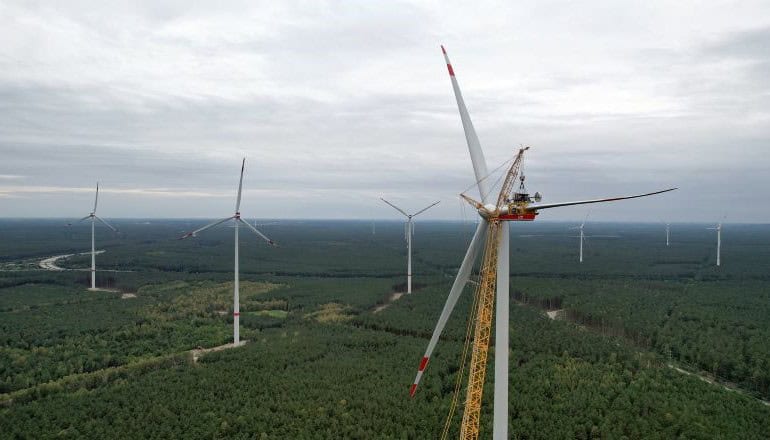
Trianel has bought an 18 MW wind project extension in Brandenburg from a developer working through a restructuring. Three turbines, permitted, due to operate in 2028. Nothing about the site changed to make them possible. A law did.
Key takeaways
- Trianel has acquired the 18 MW Dreieck Spreeau wind project extension in Spreenhagen, Brandenburg, Germany, from ABO Energy. Terms were not disclosed.
- The extension comprises three Vestas V150 turbines of 6 MW each with a total height of 244 metres, and received approval for construction and operation in July 2025. Construction is scheduled to start in early 2027 and operations are expected in 2028.
- Enerdatics reports that the three extension turbines were approved following amendments to Germany's Federal Nature Conservation Act in 2022.
- Trianel already owns the adjacent 33.6 MW Dreieck Spreeau wind farm, which it bought from ABO Energy in 2020 and which runs on eight Vestas V150 turbines of 4.2 MW each, commissioned at the end of 2021.
- Enerdatics calculates the extension's construction cost at $29 million, or $1.61 million per MW, and describes that estimate as in line with reported figures for onshore wind projects of this scale in the region.
What did the 2022 conservation law change do to this site?
It changed the test, not the place. The Federal Nature Conservation Act, or BNatSchG, is the German law governing species protection, and in wind permitting it decides whether a turbine can stand where protected birds are present. The 2022 amendments standardised that assessment across Germany, setting common criteria for judging risk to protected species and defining the mitigation that can offset it.
The eight turbines already operating at Dreieck Spreeau were permitted under the older approach, when each authority worked to its own reading of the same law. The three new ones sit north-northeast of them, on the same forested plateau, in the same wind regime, on land that has not moved. What arrived between the two permits was a clearer national rule about what counts as an acceptable risk to a protected bird.
That is why the extension exists as a saleable asset at all. Trianel is not buying newly discovered wind. It is buying capacity that legislation turned from unpermittable into permitted, after ABO Energy carried it through the amended process to a July 2025 approval.
Why is 18 MW worth buying when Trianel already owns the farm next door?
Because the extension does not need most of what a wind farm needs. A standalone 18 MW project has to find a grid connection, build a substation, secure access roads and set up an operations arrangement, and each of those is slow, expensive and capable of killing the project on its own. Trianel built all of it at Spreeau five years ago for the first eight turbines, so the extension arrives on top of infrastructure that is already paid for and already working.
The turbine choice makes the point sharper. Both phases use the same Vestas V150 rotor. The difference is the rating behind it: the original eight machines are 4.2 MW each, the three new ones are 6 MW each. A platform that produced 33.6 MW across eight positions in 2021 now produces 18 MW across three, and the new machines stand 244 metres to tip against a hub height of close to 170 metres on the originals. Three turbines in 2028 will deliver more than half of what eight turbines delivered seven years earlier, on a site where the hard work of connecting to the grid was done once.
What does an unpriced German wind permit actually cost?
Nobody publishing can say, and that absence is the finding rather than a hole in the record. Terms were not disclosed here, as they were not when Trianel bought the first eight turbines in 2020.
What can be bracketed is the range the price has to sit inside. A permitted project that has not been built is worth less than the same project finished, and more than a bare land option. The only priced pre-operational German onshore wind transaction in the record since the start of 2024 is Encavis buying the 18 MW Dannhausen III wind farm from RB Holding for $26.35 million in September 2024, or $1.46 million per MW. That project was already in construction, so its price sits close to a full build cost. Enerdatics puts the Spreeau extension's own construction cost at $29 million, an estimate rather than a disclosed figure.
At the other end, operating German onshore wind has cleared higher: Enel paid $1.84 million per MW for 51 MW in December 2025 and Encavis $2.68 million per MW for the 28.5 MW Everswinkel farm in December 2024. A permit changing hands four years before the turbines turn belongs well below both.
Enerdatics records 90 German onshore wind transactions since the start of 2024, of which three carry a disclosed value. Split by stage, the 32 development-stage deals covering 2,119 MW contain no disclosed price at all, the 31 in-construction deals contain one, and the 27 operational deals contain two, at a median of $2.26 million per MW. ABO Energy alone accounts for ten German wind sales since April 2026, totalling 189.5 MW, none of them priced.
What does the deal signal for German onshore wind?
Permitting reform is generating tradable capacity on sites that already look finished. An extension is the cheapest megawatt in the market because it inherits a grid connection, and the party best placed to value that inheritance is whoever already owns the rest of the site. That narrows the bidder pool to one or two names before a process even starts, which is part of why these transactions keep closing without a number attached. It also explains the pattern in recent ABO Energy sales, where the buyer is often the neighbour or a utility with an established position in the same state.
For sellers, a permit obtained under the post-2022 rules is a liquid product, and a restructuring seller can move it quickly. ABO Energy has been selling German wind at close to one project a fortnight since April. For buyers, the question has shifted from whether a site can be permitted to which sites have room left on an existing connection. Trianel's route into the extension was owning the first phase, the same preference for execution certainty over origination risk that shaped its 100 MW onshore wind partnership in North Rhine-Westphalia. Enerdatics expects the extension to draw a 20-year feed-in premium under Germany's Renewable Energy Sources Act, on the basis that the existing Spreeau turbines already do, and that expectation is an assessment rather than a confirmed award.
Frequently asked questions
What is the Dreieck Spreeau wind extension?It is an 18 MW addition to the existing Dreieck Spreeau wind farm in Spreenhagen, Brandenburg, Germany, made up of three Vestas V150 turbines of 6 MW each with a total height of 244 metres. It holds a construction and operating approval granted in July 2025 and is expected to start operating in 2028.
Why did ABO Energy sell the project?The sale forms part of ABO Energy's ongoing restructuring and its efforts to strengthen its financial position. Enerdatics records ten German wind sales by the company since April 2026, covering 189.5 MW, none at a disclosed price.
What is an EEG feed-in premium?It is a market premium paid under Germany's Renewable Energy Sources Act on top of what a project earns selling its electricity, awarded for 20 years through competitive auctions. Enerdatics understands the extension is expected to qualify because the existing Spreeau turbines already do, which is an expectation rather than a confirmed award.
Want to track German wind M&A, permitting outcomes and the prices behind them as they happen? Explore the Enerdatics Insights page.


