Why Blue Elephant Bought Two German Wind Farms Three Months Before They Switch On
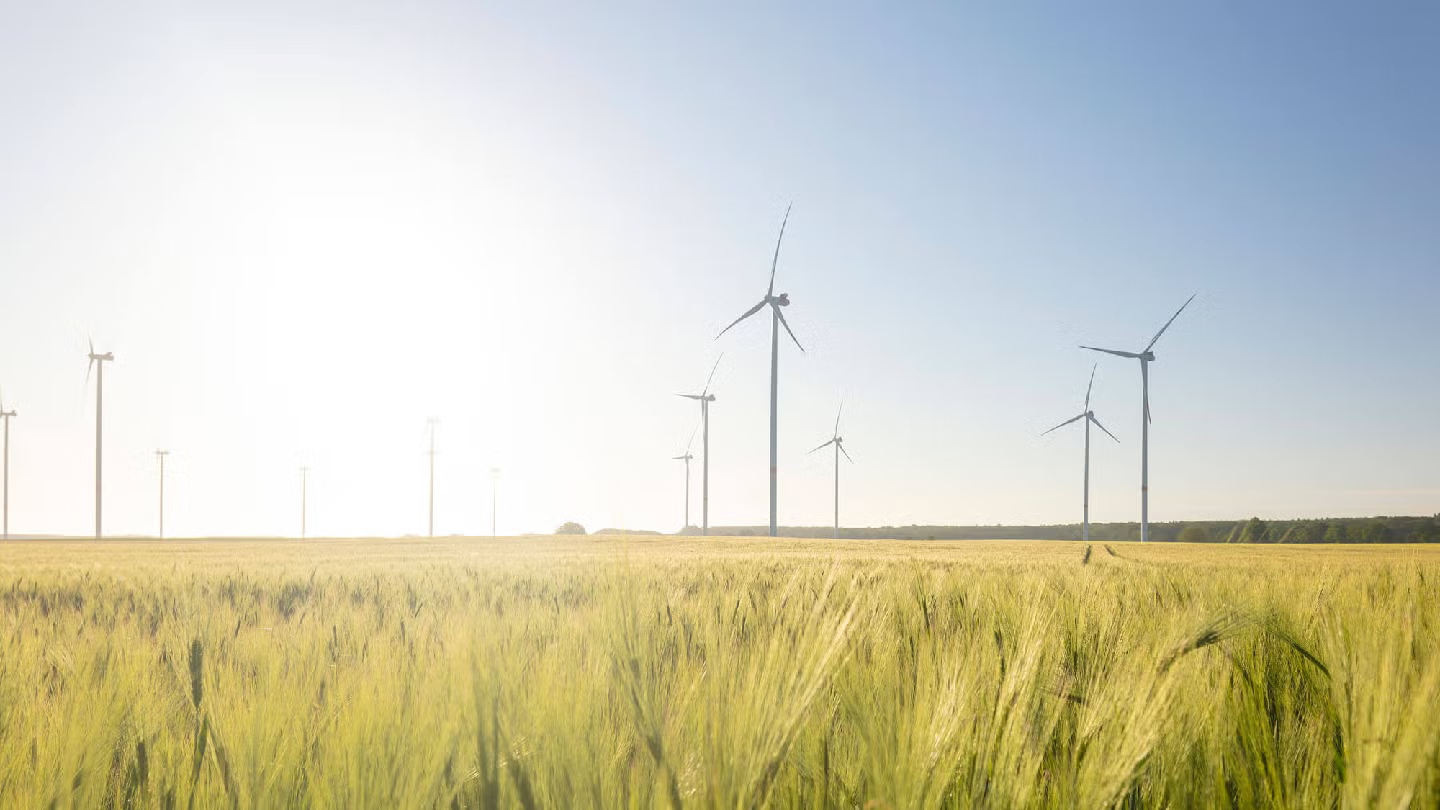
Blue Elephant Energy has bought two German wind projects from ABO Energy. Both are under construction and both are due to switch on in December 2026, about three months after the sale. A developer normally holds a wind farm through that stretch, because that is when the risk falls away and the value arrives. ABO Energy sold anyway.
Key takeaways
- Blue Elephant Energy has acquired the 12 MW Heimbach-Vlatten and 21 MW Ortenberg wind projects in Germany from ABO Energy, 33 MW in total. Terms were not disclosed, and ABO Energy has said the sale forms part of its ongoing restructuring.
- Heimbach-Vlatten in North Rhine-Westphalia is a repowering project that replaces three Enercon E-40 turbines with two 6 MW Vestas V162 turbines, and it is expected to generate about 6.7 times more electricity than the turbines it replaces.
- Ortenberg in Hesse comprises three 7 MW Enercon E-175 turbines and is expected to generate about 47 GWh a year. Site works began in September 2025.
- Both Blue Elephant Energy projects hold a 20-year feed-in premium under Germany's Renewable Energy Sources Act, awarded in August 2024, and both are scheduled to commission in December 2026.
- Enerdatics records eight German wind project sales by ABO Energy since April 2026, totalling 143.5 MW, and none of them carries a disclosed price.
Why sell a wind farm three months before it earns money?
Because a seller under restructuring values cash now over value later. The last months of construction are when a project is worth the most to its developer. Permits are settled and the revenue support is locked in. What remains is the final spend to finish the build.
That final spend is the problem for ABO Energy. It is working through a restructuring with the stated aim of strengthening its financial position, and carrying a project through completion ties up capital. Selling before commissioning passes the remaining construction cost to the buyer and brings cash in earlier.
This is not a one-off. ABO Energy has been selling German wind projects at every stage this year. Vattenfall bought a permitted extension it could share a substation with, as covered in why Vattenfall bought the wind project next door. ABO Energy has also sold whole country businesses, including its Polish and Hungarian subsidiaries to PPC. The Blue Elephant sale sits at the late end of that range: projects that are close to finished.
What makes these two projects low risk for Blue Elephant?
Nearly everything that can go wrong with a German wind project has already been cleared. Both projects hold a BImSchG permit, the licence under Germany's Federal Immission Control Act that allows a wind farm to be built and run. Heimbach-Vlatten received its permit in November 2023. Ortenberg received its permit in March 2024 and a modification approval in August 2025.
Revenue is also fixed in shape. Both projects won a 20-year feed-in premium in August 2024 under the EEG, Germany's Renewable Energy Sources Act. A feed-in premium is a top-up paid on market revenue, set by auction, that supports a project's income for the life of the award.
The repowering at Heimbach-Vlatten adds a second layer of certainty. Repowering means replacing old turbines on an existing site with fewer, larger ones. The site already has a proven wind resource and an existing grid connection. Swapping three old machines for two modern ones is expected to lift output about 6.7 times, enough for around 7,000 households. That is the same logic behind a tariff-backed capacity upgrade KGAL bought earlier this year.
What does the €73.3 per MWh award figure actually describe?
Probably the auction round, not these two projects. Leap's record gives the award as a range of bid values from €57.3 to €73.5 per MWh, with a volume-weighted average of €73.3 per MWh.
A range and a weighted average are statistics for a group of bids. Two projects cannot produce a spread from €57.3 to €73.5 that averages €73.3 unless almost all the volume sits at the top. The same €73.3 average also appears on the Rekum repowering project Enerdatics has covered. The likeliest reading is that these figures describe the August 2024 onshore round as a whole.
That matters for anyone modelling the acquisition. The project-specific award values for Heimbach-Vlatten and Ortenberg were not disclosed. The round figures bracket what the projects probably received, but they are not the contract Blue Elephant has bought.
Enerdatics records 88 German onshore wind transactions since the start of 2024, and three of them carry a disclosed deal value. Encavis paid $1.46 million per MW for the 18 MW Dannhausen III project under construction in September 2024, and $2.68 million per MW for the operating 28.5 MW Everswinkel wind farm in December 2024. Enel paid $1.84 million per MW for 51 MW of operating wind in December 2025. Of the 29 German onshore wind deals recorded so far in 2026, none has a disclosed value.
What does the deal signal for German onshore wind?
It signals that late-stage German wind is changing hands as a steady supply from one motivated seller. ABO Energy's eight German wind sales since April have gone to a utility, an infrastructure fund, an established IPP and several smaller buyers. Buyers get construction-stage projects with permits and 20-year premiums already in hand.
Blue Elephant fits that pattern well. It bought a 381 MW operating German wind portfolio from WIND-projekt in December 2025, and it has bought from ABO Energy before, taking 45 MW of Greek solar in 2021. Adding 33 MW that start generating within months builds operating scale with little development risk left to carry.
The cost is visibility. With no price on any of ABO Energy's 2026 German sales, and none on any German onshore wind deal this year, the market is being set in private. The only public anchors remain three transactions from 2024 and 2025.
Frequently asked questions
What did Blue Elephant Energy buy from ABO Energy?Two German wind projects under construction: the 12 MW Heimbach-Vlatten repowering project in North Rhine-Westphalia and the 21 MW Ortenberg project in Hesse, 33 MW in total, both due to commission in December 2026.
Why is ABO Energy selling German wind projects?ABO Energy has said the sale forms part of its ongoing restructuring and its efforts to strengthen its financial position. Enerdatics records eight German wind sales by the company since April 2026.
How much did Blue Elephant pay?The price was not disclosed. Enerdatics records no disclosed value on any German onshore wind transaction announced in 2026.
Enerdatics tracks every renewable energy transaction in Germany and across Europe, including the growing share that never discloses a price. Explore the Enerdatics platform to benchmark German wind deals, sellers and buyers before your next transaction.