
Why ABO Energy's Poland and Hungary Sale to PPC Prices a Pipeline Under Restructuring
.png)
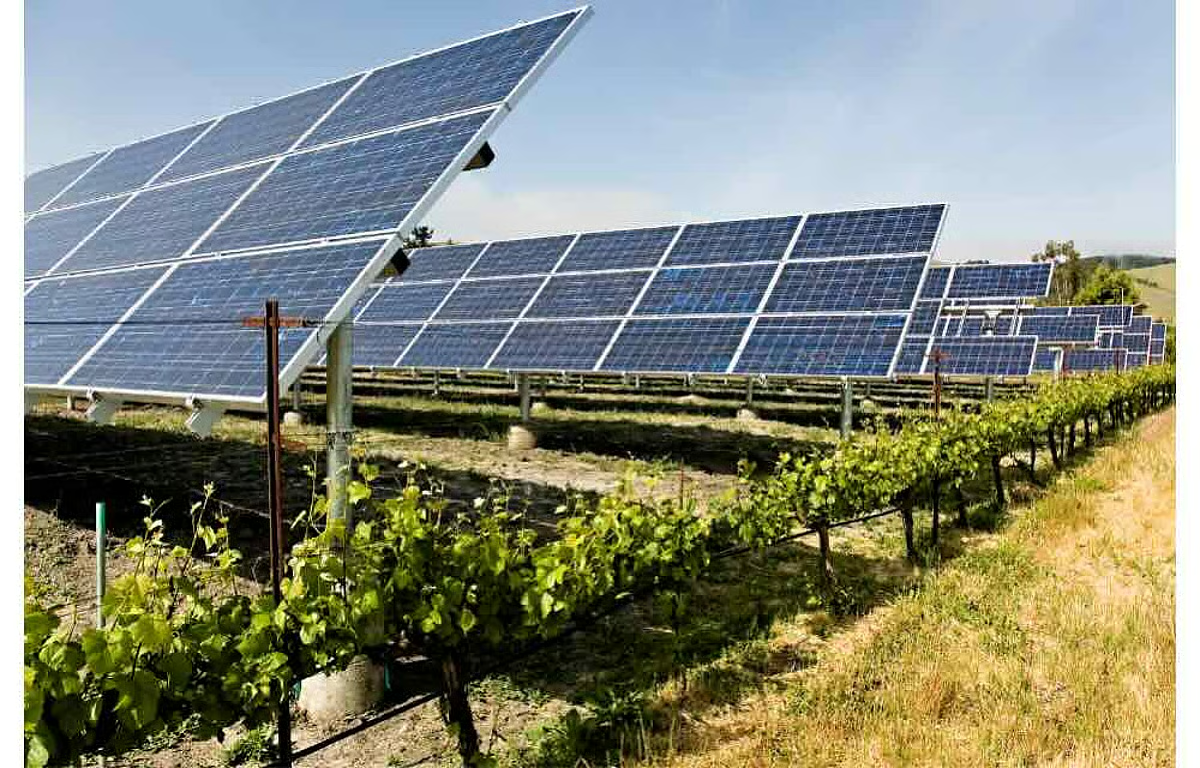
ABO Energy has agreed to sell its Hungarian and Polish subsidiaries in full to PPC, the Greek integrated utility. The transaction transfers a development pipeline of around 2 GW, five operational solar parks totalling 82 MW, a 17 MW solar farm nearing completion, and all 38 ABO Energy employees in the two countries, including the Szarvas solar park in Hungary commissioned in 2024. Terms were not disclosed and closing is expected by the end of the year, subject to regulatory approval. ABO Energy has been developing in both countries since 2019. The company is also in the middle of a formal restructuring, and that context sets the price.
What is PPC acquiring from ABO Energy?
PPC is acquiring both country subsidiaries as going concerns rather than buying assets out of them. That means the 2 GW development pipeline, 99 MW of operating and near-complete solar across six parks, and the entire 38-person team transfer together. Terms were not disclosed. Acquiring the corporate entities preserves the permitting relationships, landowner agreements and grid queue positions that sit inside them, and it hands PPC an operating platform in two markets without the delay of recruiting one. ABO Energy managing director Karsten Schlageter framed the sale as focusing on countries where the company can achieve sustainable long-term commercial success, following earlier disposals of its Greek subsidiary and most of its Finnish wind pipeline.
What does restructuring mean for a project developer?
Restructuring here refers to renegotiating a company's debt and capital structure with its lenders rather than to a simple reorganisation. ABO Energy has entered a standstill agreement under which its financing partners agreed not to enforce termination rights while a restructuring plan is negotiated, commissioned a restructuring report from an external consulting firm, appointed a chief restructuring officer, and in June 2026 engaged Boston Consulting Group on the equity side and Rothschild as financial adviser to the financing partners on balance sheet restructuring. For a developer, that situation changes the economics of every disposal. Pipeline is an illiquid asset that consumes cash while it matures, so a company under lender scrutiny sells it to stop the outflow and demonstrate progress, which is a different objective from maximising value per megawatt.
Why sell whole countries rather than individual projects?
Because selling projects one at a time takes longer than a restructuring timetable allows. A country subsidiary can be marketed once, diligenced once and closed once, whereas a 2 GW pipeline broken into individual assets would run for years and leave stranded overheads behind at each stage. Selling the entity also removes the local cost base, since the 38 employees move with the business rather than becoming a redundancy provision. The trade-off is price. A single buyer taking two countries, a pipeline, an operating portfolio and a team has very limited competition, and the seller has a disclosed reason to transact. Sequencing matters too: Greece went first, then most of the Finnish wind pipeline, now Poland and Hungary, each disposal narrowing the group to the markets it intends to keep.
Enerdatics' data shows what ABO Energy's pipeline has been fetching. The company ranks third among European wind sellers since the start of 2024 in Enerdatics' records, with 10 disposals covering 6,476.7 MW but only $81.98 million of disclosed value across the set, a blended figure of roughly $12,700 per MW. The Finnish transaction gives the clearest single reading: a 4.4 GW portfolio of 29 wind projects sold to Fortum for €40 million on a cash and debt-free basis, which works out at about €9,100 per MW, or roughly $0.01 million per MW. Set that against Enerdatics' benchmark of $0.12 million per MW for Italian early-stage solar and $0.05 million per MW for European development-stage standalone batteries, and the Finnish pipeline cleared at roughly a tenth of the former and a fifth of the latter. Early-stage pipeline is cheap everywhere, but that is cheap even by the standards of early-stage pipeline.
What does the deal signal for European development?
The deal signals that development pipeline is the first thing to go when a developer's balance sheet comes under pressure, and that it goes cheaply. Pipeline carries no contracted revenue, consumes cash through permitting and grid studies, and cannot be refinanced against, so it is exactly the wrong asset to hold through a restructuring. Buyers with utility balance sheets are the natural counterparties, which is why PPC is on the other side. Expect more European developers to be tested on the same maths as auction pricing tightens and construction costs stay elevated, and expect pipeline valuations in distressed sales to sit well below the developer premiums recorded in ordinary transactions.
For PPC the acquisition consolidates a position it has been building quickly. The company bought the 57.47 MWp Kira solar project in Hungary from Greenvolt Group in July 2026 and agreed a 277.3 MW wind and solar portfolio in Poland from EDP Renewables days later, and this transaction adds 2 GW of pipeline, an operating base and a local team in both of those same markets. Buying assets, then buying the developer, is a fast way to turn two market entries into two operating businesses.
Key takeaways
- ABO Energy agreed to sell its Hungarian and Polish subsidiaries to PPC, transferring around 2 GW of development pipeline, 82 MW of operating solar across five parks, a 17 MW project nearing completion and all 38 employees. Terms were not disclosed.
- The sale follows disposals of ABO Energy's Greek subsidiary and most of its Finnish wind pipeline, and runs alongside a formal restructuring involving a lender standstill agreement, a chief restructuring officer, and advisers appointed in June 2026.
- Enerdatics ranks ABO Energy third among European wind sellers since the start of 2024, with 10 disposals covering 6,476.7 MW but only $81.98 million of disclosed value, roughly $12,700 per MW blended.
- The company's 4.4 GW Finnish wind portfolio sold to Fortum for €40 million cash and debt-free, about €9,100 per MW, against Enerdatics benchmarks of $0.12 million per MW for Italian early-stage solar and $0.05 million per MW for European development-stage batteries.
- PPC has now made three moves in these markets within weeks, following the 57.47 MWp Kira solar acquisition in Hungary and a 277.3 MW portfolio agreed with EDP Renewables in Poland.
Frequently asked questions
How much is PPC paying for ABO Energy's Polish and Hungarian subsidiaries?Terms were not disclosed. For context, Enerdatics records ABO Energy's 10 European wind disposals since the start of 2024 as covering 6,476.7 MW with $81.98 million of disclosed value, roughly $12,700 per MW, and its 4.4 GW Finnish wind portfolio sold to Fortum for €40 million, about €9,100 per MW.
Why is ABO Energy selling subsidiaries?ABO Energy is pursuing a restructuring and financing solution with its lenders, having entered a standstill agreement, commissioned a restructuring report and appointed a chief restructuring officer. It has sold its Greek subsidiary and most of its Finnish wind pipeline, and says it is focusing on markets where it can achieve sustainable long-term commercial success.
What exactly transfers in the transaction?Both country subsidiaries transfer as going concerns, including a development pipeline of around 2 GW, five operational solar parks totalling 82 MW, a 17 MW solar farm nearing completion, and all 38 ABO Energy employees in Poland and Hungary. Closing is expected by the end of 2026, subject to regulatory approval.
Ready to get deal-ready answers in seconds? Try Enerdatics Leap AI and access verified intelligence across M&A, financings, PPAs, projects, and energy market developments through natural language.
.jpeg)


