
Why Kelag Bought Its Second Italian Solar Portfolio From the Same Developer
Kelag has agreed to buy a 64.4 MW agrivoltaic solar portfolio in northern Italy from JUWI. It is the second time in eighteen months that Kelag has bought an Italian solar portfolio from JUWI. In a market where Enerdatics records 96 solar transactions since the start of 2024, almost no buyer and seller pair appears twice. This one now has.
Key takeaways
- Kelag, through its subsidiary Kelag International, has agreed to acquire the 64.4 MW Eridano agrivoltaic solar portfolio in Italy from JUWI Group. Terms were not disclosed.
- The portfolio comprises eight projects located primarily in Lombardy and Emilia-Romagna in northern Italy. Seven are at ready-to-build stage and one is at an advanced stage of development.
- Combined annual production is put at 107 GWh, which against 64.4 MW of capacity works out at roughly 1,661 MWh per MW, or a capacity factor of about 19 per cent.
- The transaction follows Kelag Italia's acquisition of a roughly 50.5 MW Italian solar portfolio from JUWI in April 2025, taking the total Kelag has bought from the same developer to about 115 MW.
- Of the 96 Italian solar transactions Enerdatics records since the start of 2024, only two involve the same buyer and seller pairing more than once: Kelag and JUWI, and Sonnedix and Capital Dynamics.
Why buy from the same developer twice?
Because the second transaction costs far less to execute than the first. A developer and a buyer who have already closed together have settled what consumes time in a project sale: the share purchase agreement, the warranty package, the diligence checklist, how land title and grid documentation are presented, and whether the developer delivers what it promised. None of that has to be rebuilt.
That matters more in Italian solar than in most markets, because the assets are small. Eight projects averaging around 8 MW each is a lot of separate legal entities, land registries and municipal authorisations for 64.4 MW. Diligence cost does not scale down neatly with project size, so a portfolio of small assets is disproportionately expensive to buy from a counterparty you do not know.
It also tells you something about JUWI's position. A developer that sells twice to the same buyer is not running a competitive auction each time, which usually means trading some price for certainty and speed. For a developer recycling capital into the next projects, a buyer who closes reliably can be worth more than the highest bid.
What does 107 GWh from 64.4 MW actually tell you?
It tells you where the portfolio is and how it is built. Dividing 107 GWh by 64.4 MW gives about 1,661 MWh per MW a year, which is a capacity factor of roughly 19 per cent. For Italian solar that is a modest number, and two things explain it.
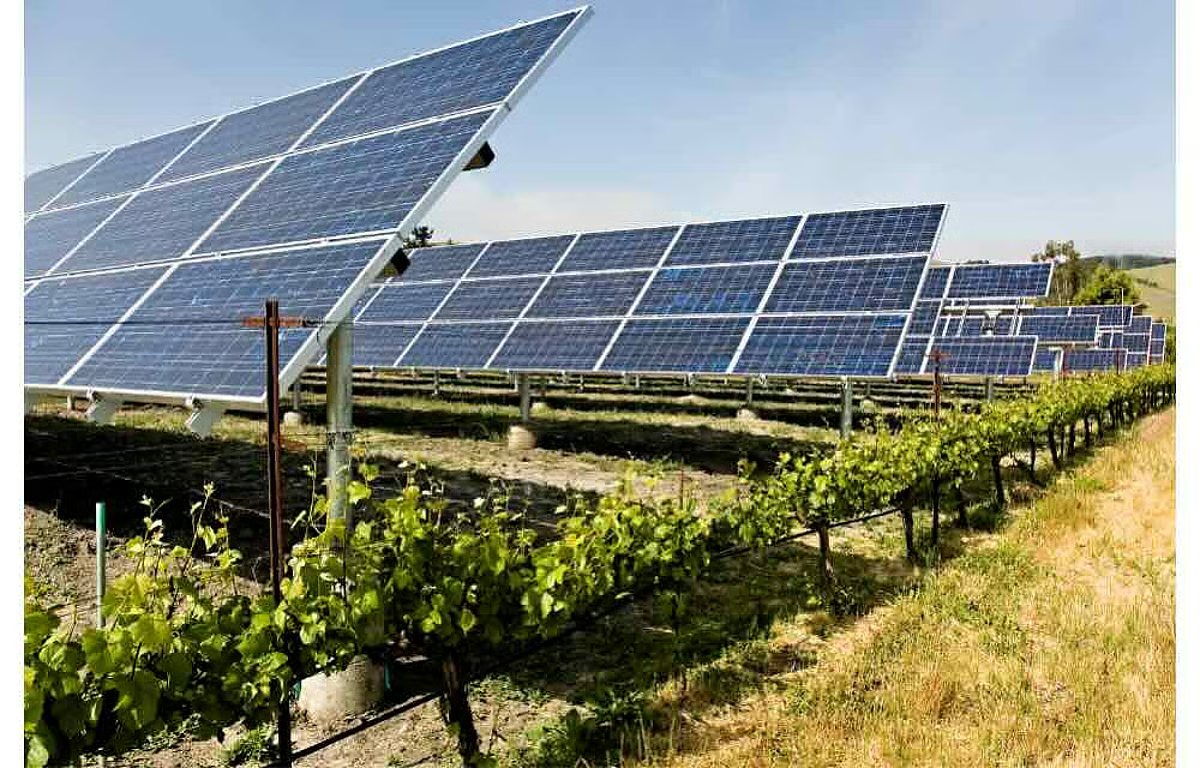
The first is latitude. Lombardy and Emilia-Romagna sit in the Po Valley, several hundred kilometres north of the Italian solar heartland in Puglia and Sicily, with less irradiation and more winter haze. The second is the technology. Agrivoltaics means solar generation designed to share land with continuing agricultural use, typically by raising the panels higher and spacing the rows wider so that crops or livestock can occupy the ground beneath. That spacing costs output per hectare and usually costs some output per megawatt too, because the layout is set by the farming as much as by the sun.
Neither is a defect, and treating 19 per cent as underperformance would be the wrong read. Agrivoltaic design is what makes these projects permittable on agricultural land at all, and permitting rather than irradiation is the binding constraint in Italian solar. Enerdatics saw the same trade in the south when L&B Capital bought a permitted 90 MWp agrivoltaic project in Puglia, where the land-use argument was the asset. What the yield figure does tell a buyer is that the revenue model has to work at 19 per cent, not at the number a southern portfolio would produce.
Where does the power go without a PPA?
Into Kelag's own book, on Enerdatics' reading. The record carries no power purchase agreement, and Enerdatics understands that output from the portfolio will support Kelag International's broader energy commercialisation and trading activities across Europe. That is an assessment rather than a disclosed contract, and it should be read as such.
If it holds, it changes who this portfolio suits. A fund buying Italian solar generally wants contracted revenue before it commits, whether through a corporate offtaker or Italy's FER X auction, because lenders want visibility. A utility with a European trading desk does not need the contract in the same way. It can absorb the volume internally, hedge it alongside the rest of its position, and treat the plant as supply rather than as a standalone investment.
That is consistent with how Kelag has been building in Italy. It bought eight hydropower plants and a wind park there in April 2026, as covered when Kelag expanded its Italian renewables platform with hydro and wind. Solar at 19 per cent utilisation sits differently against hydro than it does alone, and a buyer assembling a multi-technology position is buying shape as much as volume.
Enerdatics records 96 Italian solar transactions since the start of 2024. Only 33 carry a disclosed value, and 22 of those 33 involve Zenith Energy on one side, a listed company that announces its land prices. Strip Zenith out and the entire Italian solar market has produced 11 priced transactions in 21 months. Repeat pairings are rarer still: Kelag and JUWI, and Sonnedix and Capital Dynamics, are the only buyer and seller combinations that appear more than once across the whole set, though many of Zenith's acquisitions carry no named seller and so cannot be assessed.
What does the deal signal for Italian solar?
It signals that relationships are starting to substitute for price discovery. In a market this opaque, a buyer cannot benchmark what it pays against much, so it manages risk through the counterparty instead. Doing the second deal with a developer whose first portfolio performed is a rational answer to having almost no comparables, and it is the pattern to expect from utilities rather than funds.
The visible price problem is not improving. As Enerdatics noted when Zenith's Lombardy deal matched the Italian median it largely sets, the benchmark most people quote for Italian development solar mostly describes one buyer's cost of land. A 64.4 MW ready-to-build agrivoltaic portfolio is a different asset entirely, and nothing in the public record prices it. Expect more Italian solar to trade between parties who have transacted before, and expect the gap between what the market does and what the market discloses to stay roughly where it is.
Frequently asked questions
How much did Kelag pay for the Eridano agrivoltaic portfolio?Terms were not disclosed. Enerdatics records 96 Italian solar transactions since the start of 2024, of which only 33 carry a disclosed value and 22 of those involve Zenith Energy, so there is little public benchmark for a ready-to-build portfolio of this size.
What is agrivoltaics?Agrivoltaics is solar generation designed to share land with continuing agricultural use, usually by raising panels higher and spacing rows wider so crops or livestock can use the ground beneath. It typically reduces output per hectare but improves the land-use case in permitting.
How much will the portfolio generate?Combined annual production is put at 107 GWh across 64.4 MW, about 1,661 MWh per MW or a capacity factor near 19 per cent. Seven of the eight projects are ready to build and one is at an advanced stage of development.
Ready to get deal-ready answers in seconds? Try Enerdatics Leap AI and access verified intelligence across M&A, financings, PPAs, projects, and energy market developments through natural language.
.jpeg)


