
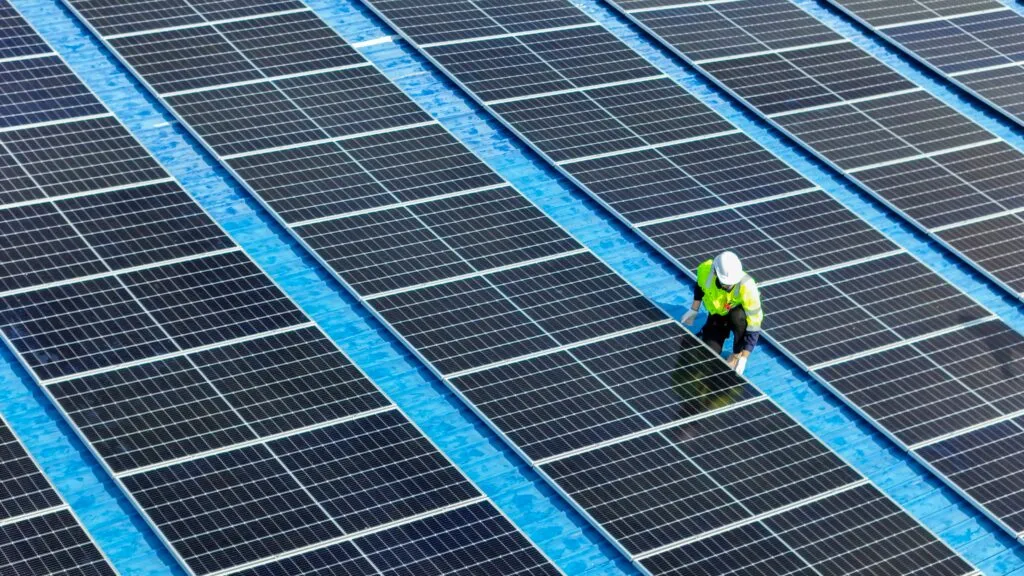
Concord New Energy has raised $400 million to build its first utility-scale project in the United States. A quarter of that money is not debt and it is not ordinary equity either. Goldman Sachs Alternatives wrote $90 million of preferred equity into the stack, an instrument Enerdatics has recorded in only six US renewable financings since the start of 2024.
Key takeaways
- Concord New Energy has secured $400 million for the Chisme solar and battery project in Texas, comprising $310 million in debt and letters of credit and $90 million in preferred equity.
- Goldman Sachs Alternatives provided the $90 million of preferred equity through its Climate Credit strategy, accounting for 22.5 percent of the total financing package.
- Chisme pairs a 215 MWdc / 147 MWac solar plant with an integrated 147 MW / 358 MWh battery, a 2.4 hour system sized to absorb the solar plant's entire AC output.
- Chisme is Concord New Energy's first utility-scale renewable energy development in the United States, with construction under way and operations expected in 2028.
- Enerdatics records only six US renewable financings carrying a preferred equity component since the start of 2024: Chisme, Matrix Renewables' $1.18 billion package, Arevon's $919 million Nighthawk and $258 million Peregrine deals, Spearmint's $447 million Red Egret and SMT Energy's $135 million Houston IV.
What is preferred equity doing in a project financing?
Filling the gap between what a bank will lend and what a sponsor can afford to put in. Preferred equity ranks behind debt for repayment but ahead of ordinary equity, and it is paid a fixed return before common holders see anything. It is more expensive than senior debt because it absorbs loss first, and cheaper in ownership terms than selling common equity because the provider takes no share of the upside beyond its coupon.
For a sponsor building its first US project, that trade is attractive for a specific reason. Concord New Energy has no US operating track record to show lenders, which caps how much senior debt the project can carry. The alternative to preferred equity would be writing a much larger cheque from the parent balance sheet or selling a meaningful stake in the asset. The $90 million from Goldman Sachs Alternatives' Climate Credit strategy does neither. It is credit in the firm's own description, structured as equity for ranking purposes. The three financial institutions in the senior package are First Citizens Bank, Associated Bank and Goldman Sachs, which means Goldman appears on both sides of the stack.
How unusual is this structure in US renewables?
Rare enough to be worth naming. Enerdatics records six US renewable financings carrying a preferred equity component since the start of 2024, out of 456 US solar financings alone in the same period. Four of the six are battery projects: Arevon's $919 million Nighthawk package in March 2026 and its $258 million Peregrine package in February 2025, Spearmint Energy's $447 million Red Egret in May 2026 and SMT Energy's $135 million Houston IV in February 2025. Only two sit in the solar sector, Matrix Renewables' $1.18 billion construction and refinancing package in June 2026, and Chisme.
The pattern is informative. Preferred equity has been showing up where cash flows are merchant or volatile, which describes a standalone battery in ERCOT better than it describes a contracted solar farm. Chisme is a hybrid, and its storage half is exposed to the same Texas market dynamics. Adjacent instruments are spreading for the same reason: Solar Landscape's community solar portfolio used a $117 million preferred tax equity investment from Nuveen in April 2026, a different instrument built on the same logic of ranking capital ahead of common equity without lending against it.
Why does the battery match the solar plant exactly?
Because 147 MW is what the grid connection will take. Chisme's solar plant is rated 215 MWdc on its panels and 147 MWac at the point of export, and the battery is 147 MW with 358 MWh of energy, giving it 2.4 hours at full power. Matching battery power to the AC export rating means the storage can absorb everything the plant is able to send out, and discharge the same amount later. Nothing is curtailed for want of somewhere to put it, and nothing is oversized relative to the connection.
In ERCOT that design is about price rather than reliability. Texas solar output peaks in the middle of the day when prices are often lowest, and the market's highest prices arrive in the early evening after solar has fallen away. A 2.4 hour battery sized to the full export rating lets the project move a large share of its midday generation into those hours. The panel oversizing on the other side, 215 MWdc against 147 MWac, exists to keep the plant at full export for longer in weaker light. Together the two choices describe a project built to sell firm evening power rather than raw daytime volume, which is what West Texas sites are increasingly being valued for, as the repricing of West Texas power sites around data centre demand has shown.
Enerdatics records that the $400 million splits into $310 million of debt and letters of credit and $90 million of preferred equity, so leverage and credit-like capital together account for the whole disclosed package. Against the 147 MWac export rating that is about $2.72 million per MW, and against the 215 MWdc panel rating about $1.86 million per MW. Neither figure is comparable to a solar-only project, because roughly half of what is being built is a battery.
What does the deal signal for US solar and storage?
The deal signals that a first-time US sponsor can now reach investment scale without a US track record, provided it accepts a more expensive slice of capital to do it. Concord New Energy is building a 215 MWdc hybrid as its opening US project, which a few years ago would have been an unusually large first step. The structure is what makes it possible. Preferred equity priced as credit lets a lender sit behind a thicker cushion than the sponsor alone would provide.
The second signal is about who is supplying that cushion. Goldman Sachs Alternatives is lending in the senior package and taking the preferred position, which concentrates the project's capital relationships in one institution. For a sponsor that reduces negotiation across parties and speeds execution. It also means that if Chisme underperforms, one counterparty holds both the loan and the instrument that absorbs losses before common equity. Expect more of this shape where the sponsor is new to the market and the asset carries merchant exposure, and expect the per-MW figures on hybrid projects to keep resisting comparison with solar-only comparables.
Frequently asked questions
How much has Concord New Energy raised for Chisme?$400 million, comprising $310 million in debt and letters of credit arranged by three financial institutions and $90 million in preferred equity from Goldman Sachs Alternatives through its Climate Credit strategy. The preferred equity is 22.5 percent of the package.
What is preferred equity?Preferred equity ranks behind debt for repayment but ahead of ordinary equity, and earns a fixed return before common holders receive anything. It costs more than senior debt because it takes losses first, and dilutes less than selling common equity because the provider does not share in the upside beyond its return.
How big is the Chisme project?A 215 MWdc / 147 MWac solar plant with an integrated 147 MW / 358 MWh battery, located in Texas. Construction is under way and operations are expected in 2028. It is Concord New Energy's first utility-scale renewable development in the United States.
Ready to get deal-ready answers in seconds? Try Enerdatics Leap AI and access verified intelligence across M&A, financings, PPAs, projects and energy market developments through natural language.

.jpeg)