
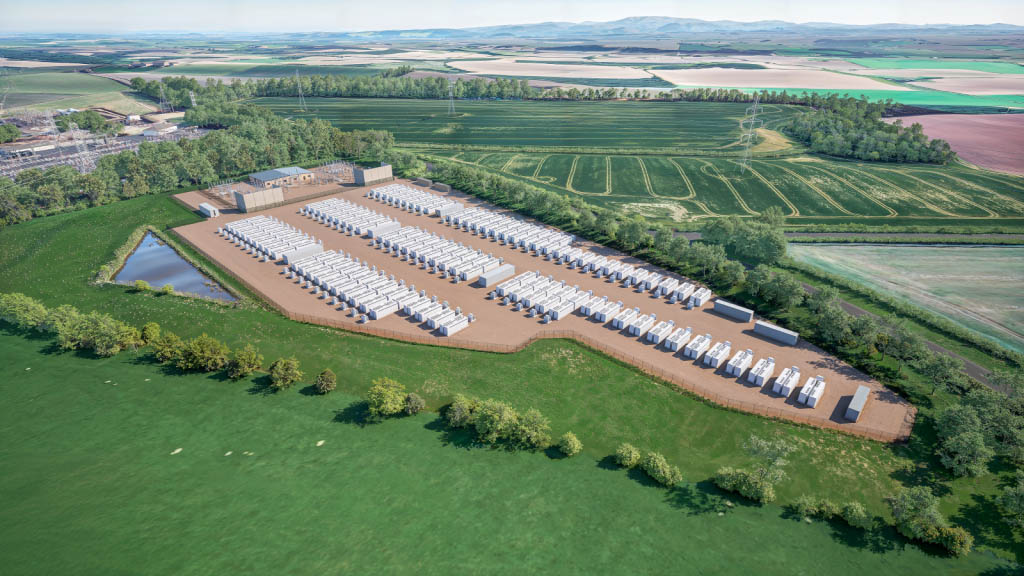
Eccles and Kilmarnock are the same battery twice. Both are 500 MW and 1,000 MWh, both sit beside a Scottish substation, both were consented within four months of each other, and both hold a fifteen year Capacity Market agreement. One of those agreements pays more than twice as much per kilowatt as the other.
Key takeaways
- The National Wealth Fund is investing up to 87 million pounds ($114.5 million) for minority stakes in the Eccles and Kilmarnock battery projects in Scotland, acquired from Matrix Renewables and announced on 19 November 2026, with Matrix retaining a majority holding in both.
- The two projects are each 500 MW and 1,000 MWh, a combined 1 GW and 2 GWh sited along the transmission corridors between Scotland and England, with Eccles consented on 16 December 2024 and Kilmarnock on 7 April 2025.
- Eccles secured a fifteen year Capacity Market agreement for 71.196 MW in the 2028/29 T-4 auction at 60 pounds per kW per year ($79.01), while Kilmarnock secured 74.732 MW in the 2029/30 T-4 auction at 27.10 pounds per kW per year ($35.68).
- Eccles began construction in November 2025 for operations in October 2027, with Tesla as EPC contractor and 245 million pounds ($331.7 million) of non-recourse debt from CIBC, MUFG Bank and NatWest; Kilmarnock starts construction in December 2026.
- Enerdatics records 60 UK battery storage M&A transactions since the start of 2024, of which 18 carry a disclosed value, two of them rival bids for the same target that were later withdrawn.
Why does a 500 MW battery hold a capacity agreement for 71 MW?
Because the Capacity Market does not pay for power, it pays for power it can count on. The mechanism procures firm capacity for a future delivery year through a competitive auction, and every technology entering it is derated: its nameplate rating is multiplied by a factor reflecting how reliably it can deliver during a stress event. For batteries that factor depends on duration, which is energy capacity divided by power capacity, because a short battery runs out before a winter evening peak does.
At 1,000 MWh on 500 MW, each project has two hours of duration. The resulting agreements cover 71.196 MW at Eccles and 74.732 MW at Kilmarnock, about 14 and 15 percent of nameplate. The other 85 percent has to earn its return elsewhere. For Eccles that means the trading floor: Matrix signed a Battery Optimisation Agreement with EDF in March 2026, under which EDF dispatches the asset across wholesale and balancing markets through its Powershift platform.
A derated figure is therefore the contracted floor under a largely merchant business, not a description of the asset. The same point runs through Econergy's purchase of 106 MW of one hour English batteries, where duration determined which markets the fleet could reach and what it was worth.
Why did two identical batteries clear at such different prices?
Because they entered different auctions. A T-4 auction procures capacity four years ahead of the delivery year, so Eccles bid into the auction for 2028/29 and Kilmarnock into the one for 2029/30, twelve months later. Eccles cleared at 60 pounds per kW per year. Kilmarnock cleared at 27.10 pounds, or 45 percent of that.
Nothing about the assets explains the gap. Same power rating, same energy capacity, same duration, same developer, consents four months apart. An auction clears where the last megawatt needed is procured, so a year in which more derated capacity turns up than the system needs clears cheaper for everyone in it, including units identical to those that cleared dear a year earlier.
The consequence is a revenue stack that differs across two assets a buyer will treat as one. Eccles earns about 4.3 million pounds a year of capacity revenue and Kilmarnock about 2.0 million, each for fifteen years from its own delivery year. Together that is roughly 6.3 million pounds a year, or about 94 million pounds undiscounted over fifteen years. That is more than the National Wealth Fund is putting in, on a portfolio where capacity payments cover a seventh of the nameplate.
What does 87 million pounds buy of a 1 GW portfolio?
Not what the arithmetic appears to offer. Divide $114.5 million by 1,000 MW and you get $0.11 million per MW, which would be the cheapest print for an in-construction UK battery on Enerdatics' record by a wide margin. The figure is meaningless, because it divides the price of a minority stake by 100 percent of the capacity. Minority stakes have to be grossed up before they are compared, the same correction Ares Management's stake in Statera Energy's UK portfolio required.
The four priced UK stake sales on the record, grossed up, run from $0.66 million to $1.25 million per MW: AIP Management's 49 percent of a 700 MW BW Group portfolio at $1.25 million, JBR Energy Holdings' 24.7 percent of Afon Wysg 1 at $0.92 million, E.ON's half of a 230 MW Quinbrook project at $0.80 million, and the Strioga Family Foundation's 35 percent of Glassenbury at $0.66 million.
Apply that band to 1,000 MW and the pair would be worth between $660 million and $1.25 billion in full, putting $114.5 million at somewhere between 9 and 17 percent. That is comparables talking, not a disclosure, and it is softer than it looks: Eccles already carries 245 million pounds of non-recourse debt, so this cheque is written against equity value while most comparables are quoted against whole projects. Without a stake percentage, what can be said is only that Matrix retains the majority and that nothing here is consistent with $0.11 million per MW.
Enerdatics records 60 UK battery storage M&A transactions since the start of 2024 and only 18 disclose a value, two of them withdrawn bids for the same investment trust. Seven in ten price in private, which is why a disclosed figure attached to an undisclosed stake percentage can mislead more than no figure at all.
What does the deal signal for UK battery storage?
That state-backed capital has settled into one position in this market, and it is the same position every time. The National Wealth Fund joined EIG Global Energy Partners in a roughly $603 million commitment to Fidra Energy in September 2025, and Equitix and Aware Super in a $673.6 million investment in Eelpower a month earlier. It takes minority positions in assets someone else builds and runs, the shape Ares, AIP, Sumitomo and E.ON have all taken.
The second signal is that the Capacity Market is becoming a weaker anchor for these investments, not a stronger one. Two physically indistinguishable assets now carry contracted revenue differing by more than half, decided by which auction they happened to reach. A buyer underwriting UK batteries in 2026 is underwriting trading revenue with a thin floor beneath it, set by a timing accident.
Frequently asked questions
What has the National Wealth Fund bought from Matrix Renewables?Minority stakes in the Eccles project in the Scottish Borders and the Kilmarnock project in East Ayrshire, each 500 MW and 1,000 MWh, through an equity investment of up to 87 million pounds ($114.5 million). Matrix retains a majority holding in both.
How much Capacity Market revenue do the two projects hold?Eccles holds a fifteen year agreement for 71.196 MW at 60 pounds per kW per year from 2028/29, and Kilmarnock one for 74.732 MW at 27.10 pounds from 2029/30: roughly 4.3 million and 2.0 million pounds a year.
Why is the deal value per MW misleading?Because the consideration buys a minority stake while the capacity figure covers the whole portfolio. Dividing $114.5 million by 1,000 MW gives $0.11 million per MW, far below every priced UK battery comparable. Grossing up the four priced UK stake sales gives $0.66 million to $1.25 million per MW.
Ready to get deal-ready answers in seconds? Try Enerdatics Leap AI and access verified intelligence across M&A, financings, PPAs, projects and energy market developments through natural language.


