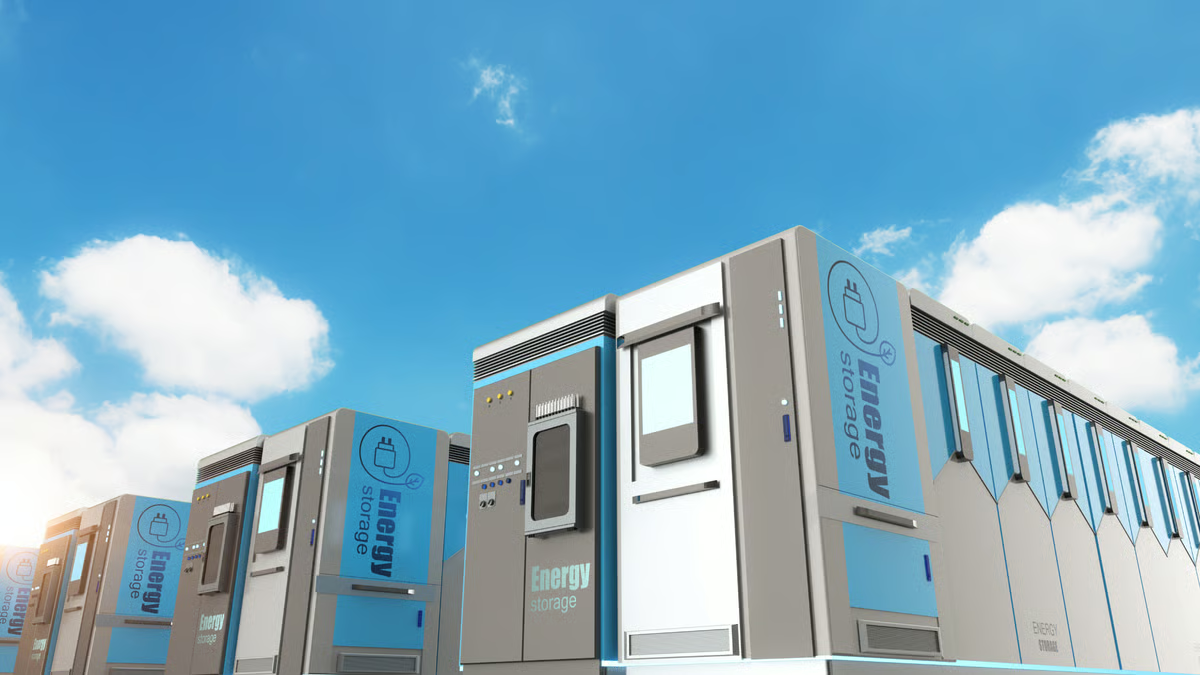
Econergy has agreed to buy four operating battery projects in England from RGreen Invest. The price for the shares is nominal. What Econergy hands over is a loan repayment, and what it gets is 106 MW of batteries that run for one hour. The upgrade that would make them worth more has not been built, and the seller is paid only if it happens.
Key takeaways
- Econergy signed a binding agreement, announced on 28 October 2026, to acquire a 106 MW battery storage portfolio in England from 4 Renewable Energy Sarl, an entity controlled by RGreen Invest.
- The consideration is a nominal payment for the shares, repayment of a 25 million euro ($27.87 million) shareholder loan, and up to 5 million euros ($5.57 million) contingent, about $33.4 million of disclosed cash in total.
- The contingent 5 million euros is payable only if Econergy brings the projects to shovel ready status for an upgrade from one hour to three hour duration by 30 September 2029, with no earn out for any project that misses the conditions.
- The portfolio is four operating projects totalling about 106 MW and 106 MWh, all commissioned in 2023: the 49.9 MW Potmans Lane in East Sussex, 20 MW Back Lane in Chesterfield, 20 MW Ernesettle in Plymouth and 18 MW Gipsy Lane in Rochdale.
- The projects are expected to generate EBITDA of 4.7 million pounds ($6.26 million) in 2027 before any duration upgrade, and the agreement allows the share transfer to be reversed if compensation disputes are unresolved by 17 December 2026.
What does a nominal share price actually mean here?
It means the equity is worth close to nothing on its own and the money is in the debt. Econergy pays a nominal sum for the shares in Infragreen 4 RE UK Limited, which holds the four project entities, then repays the 25 million euro shareholder loan RGreen Invest had advanced to that company, funded through a new shareholder loan from Econergy's UK arm. On top sits up to 5 million euros of contingent consideration.
A shareholder loan is funding an owner lends to its own project company rather than injecting as equity, and it ranks ahead of equity when value is distributed. Priced this way, the seller recovers its loan rather than a gain on its shares. RGreen Invest bought these four greenfield projects from Arlington Energy in November 2021 through its INFRAGREEN IV fund, and exits five years later with its loan repaid and the rest of its return conditional on work the buyer has yet to do.
The disclosed cash components total about $33.4 million against 106 MW, or roughly $0.32 million per MW. That is the consideration, not an enterprise value, because the record does not state how much remains of the 27 million pound ($33.84 million) facility Santander UK provided in May 2022. Against the stated 2027 EBITDA of $6.26 million, the consideration is about 5.3 times.
Why is a one hour battery worth so much less than a two hour one?
Because duration determines which markets a battery can sell into. Battery duration is the number of hours an asset can sustain its full power rating, or energy capacity divided by power capacity. At about 106 MW and 106 MWh, this portfolio runs for one hour. It can sell frequency response and capacity, which reward being available at full power for a short burst, but it cannot arbitrage the daily price spread, which requires charging through a cheap period and discharging across an expensive one.
The pricing follows. Drax paid $207.85 million for a 260 MW and 520 MWh portfolio from Apatura Energy in October 2025, an implied $0.80 million per MW for two hour assets then still to be built. Econergy's consideration is about 40 percent of that rate for assets already running. The gap is not a bargain but what the market pays for a product that reaches fewer revenue streams.
The revenue arrangements reflect the same constraint. Back Lane, Potmans Lane and Ernesettle are covered by a ten year optimisation agreement with Centrica Energy across about 89 MW, and Gipsy Lane has one with Habitat Energy. Three of the four also secured Capacity Market agreements in the 2022 T-1 auction at 60 pounds per kW per year ($79.93 per kW per year). A T-1 auction procures capacity one year ahead, and that award covered the 2023/24 delivery year. The only capacity revenue the record names for this fleet has expired.
What is the earn out really paying for?
Permitting progress, not a finished upgrade. The 5 million euros becomes payable if the projects reach shovel ready status for a three hour configuration by 30 September 2029, the point at which consents, grid terms and design are settled and construction can begin. It is not payment for three hour batteries in service. That tells you where both sides think the risk sits: neither priced the upgrade as certain, and the seller took a conditional payment on a milestone almost three years out rather than argue for value today. Tripling duration is not simply more cabinets. It needs land, a grid connection that permits the higher throughput, and planning consent, at four sites with four sets of conditions.
Enerdatics records 58 UK battery storage M&A transactions since the start of 2024, of which only 16 carry a disclosed value, so roughly seven in ten price in private. The only operating short duration comparable on the record is NextEnergy Group's purchase of a 107 MW and 151 MWh portfolio from Eku Energy in August 2026, at 1.41 hours, which disclosed no value either. Both short duration operating fleets traded in 2026 went without a price.
What does the deal signal for UK battery storage?
It signals that the first generation of UK grid scale batteries is trading as an upgrade opportunity rather than as a running business. Commissioned in 2023, these four assets are already the wrong shape for the market they sell into, and the buyer is paying less for the cash flow than for the sites, the grid connections and the permission to make them longer. In 2021, when RGreen Invest bought in, a one hour battery with a Capacity Market agreement was a complete investment case.
It also marks where the discount lands. Capacity figures do less and less work in this market, and duration is the variable separating prices. The same split runs through Ares Management's minority stake in Statera Energy's UK battery portfolio, where four of seven assets are one hour units and the newer capacity is longer. Europe's larger buyers have meanwhile moved toward platform acquisitions that bundle operating capability with a pipeline, leaving older short duration fleets to specialist buyers willing to fund a retrofit. The reversal clause running to 17 December 2026 is a reminder that even at a nominal share price, this one is not closed.
Frequently asked questions
What did Econergy agree to buy from RGreen Invest?Four operating battery projects in England totalling about 106 MW and 106 MWh, held through Infragreen 4 RE UK Limited and all commissioned in 2023.
How much is Econergy paying?A nominal payment for the shares, repayment of a 25 million euro ($27.87 million) shareholder loan, and up to 5 million euros ($5.57 million) contingent. That is about $33.4 million of disclosed cash, roughly $0.32 million per MW, before project debt.
What triggers the contingent payment?Bringing the projects to shovel ready status for an upgrade from one hour to three hour duration by 30 September 2029, subject to project specific conditions. No earn out is paid where they are not met.
Ready to get deal-ready answers in seconds? Try Enerdatics Leap AI and access verified intelligence across M&A, financings, PPAs, projects and energy market developments through natural language.