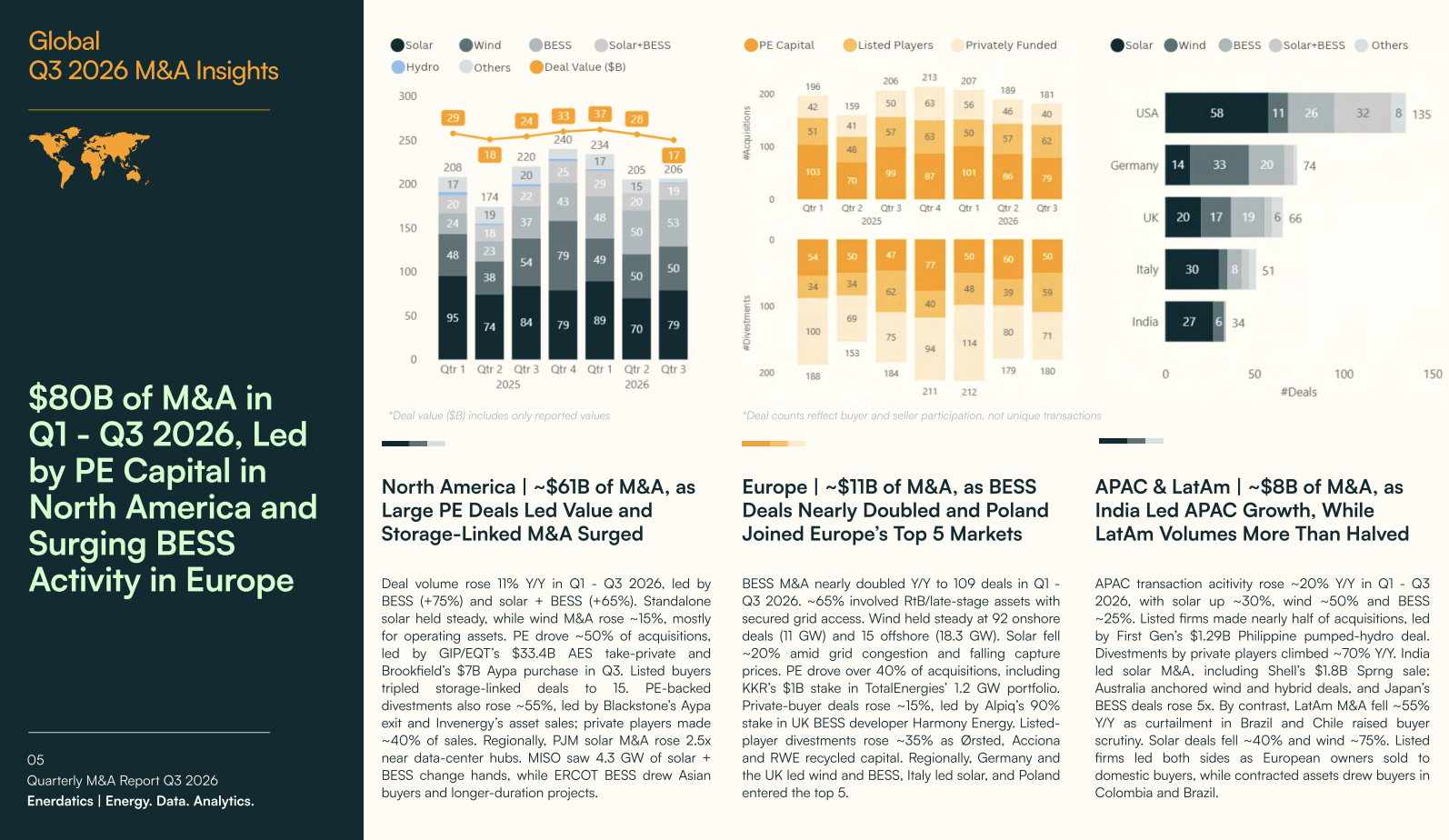
Global renewables M&A reached about $80 billion in the first nine months of 2026, up roughly 15 percent on the same period last year. The number of transactions rose about 7 percent. Our new nine-month review sets out where the extra money went, and it did not spread evenly. Three quarters of it landed in one region, and one asset class turned up in almost every large deal.
Key takeaways
- Global renewables M&A reached about $80 billion between January and September 2026, up roughly 15 percent year on year, while transaction count rose about 7 percent. Enerdatics' figures are based on disclosed deal values.
- North America accounted for about $61 billion of the global total, roughly three quarters of it, with private equity behind about half of all acquisitions in the region.
- Storage featured in 95 percent of North American corporate and platform power transactions in the period, up from 71 percent a year earlier. Battery storage deals in the region rose 75 percent and solar-plus-storage rose 65 percent, while standalone solar was broadly steady.
- European battery storage transactions nearly doubled to 109, led by the United Kingdom and Germany, while European solar activity fell about 20 percent and wind was broadly steady.
- Asia-Pacific activity rose about 20 percent, led by India, while Latin American activity fell about 55 percent, which the review attributes to curtailment in Brazil and Chile making buyers more selective.
What does $80 billion across nine months actually tell you?
That deals got bigger rather than more numerous. Value rose about 15 percent while count rose about 7 percent, which means the average transaction carried more money than it did a year earlier. Growth in this market is not coming from more buyers doing more deals. It is coming from larger cheques written by a narrower group.
The geography says the same thing. North America took about $61 billion of the $80 billion, and private equity sat behind roughly half of the acquisitions there. A region holding three quarters of global value, with half of its activity driven by one class of buyer, is a concentrated market rather than a broad one.
One caveat belongs on the headline figure. These totals rest on disclosed deal values, and a large share of renewable transactions close without a price attached. The $80 billion is therefore a floor on what changed hands, not a measure of it. That matters most in the markets where disclosure is thinnest, which tend to be the development-stage ones.
Why has storage stopped being a separate line item?
Because buyers have stopped acquiring it separately. The sharpest figure in the review is the North American one: storage featured in 95 percent of corporate and platform power transactions, against 71 percent a year earlier. A corporate or platform transaction is the purchase of a company or an operating business rather than a single project, so this is a statement about what a power platform now has to contain to be sellable at all.
The asset-level numbers point the same way. Battery storage deals in North America rose 75 percent and solar-plus-storage rose 65 percent, while standalone solar was broadly steady. Growth is concentrated entirely in the configurations that include a battery. Portland General Electric's agreement to take on two Oregon projects, where 449 MW of four-hour storage arrived alongside 399 MW of solar, is the shape most of that growth takes.
Europe moved in the same direction from a smaller base. Battery storage transactions there nearly doubled to 109, led by the United Kingdom and Germany. Two of the larger European examples this autumn show the two routes in: a developer building and selling, as Greenvolt did with its 400 MW Polish portfolio, and a financial buyer taking a stake in an operating platform, as Ares did with Statera's UK batteries. Both appear in the count. They are not the same transaction type.
What are buyers paying differently for?
Contracted revenue, and the right to withhold payment. Two findings in the review put numbers on that. In Europe, contracted onshore wind assets commanded a valuation premium of about 45 percent over merchant-exposed assets, on the review's reading of disclosed terms. Merchant exposure means a project sells its output at prevailing wholesale prices with no contract setting the level, so its revenue moves with the market.
The second finding is about structure rather than price. Contingent payments appeared in 67 percent of development-stage deals with disclosed terms, up from 35 percent a year earlier. A contingent payment is consideration that falls due only when the project reaches an agreed milestone, such as a permit, a grid connection or ready-to-build status. At two thirds of priced development deals, it has become the normal way to buy a project that does not yet exist, which also means headline considerations in this part of the market increasingly describe a payment that may never be made in full.
The two findings also connect back to the storage numbers. A contract is one way to make output deliverable. A battery is the other. An asset that can choose when to sell is less exposed to the hours when prices collapse, which is the same problem a contract solves from the revenue side. Part of why storage keeps appearing inside platform deals is that it buys the same quality the premium is paid for.
Read together, the findings describe buyers pricing deliverability rather than capacity. A megawatt with a contract behind it is worth materially more than the same megawatt without one, and a megawatt that is still a plan is paid for in instalments tied to proof.
Enerdatics records the regional split behind the $80 billion as sharply uneven. Asia-Pacific activity rose about 20 percent, led by India, with Australian wind and storage also contributing. Latin America fell about 55 percent, which the review attributes to curtailment in Brazil and Chile. Curtailment is the forced reduction of a project's output when the grid cannot absorb it, and where it is routine it cuts straight into the revenue a buyer is underwriting. European solar fell about 20 percent over the same period. The $80 billion is a global total holding one region growing strongly, two holding steady and one contracting by more than half.
What does the nine-month data signal for 2027?
That storage is likely to remain the main acquisition driver across every region, rather than a North American phenomenon that others are catching up with. The European count nearly doubling, and storage appearing in almost every North American platform deal, are two readings of the same shift. A platform without flexibility is becoming harder to sell, and that is a procurement constraint rather than a sentiment one.
Asia-Pacific is the second growth engine, and a quieter one. Activity there rose about 20 percent, led by India, with Australian wind and storage also contributing. That is growth from a different driver than North America's, closer to demand and build-out than to private equity consolidating platforms. Whether the storage share of deals in those markets follows the North American path is one of the things the next review will show.
Latin America is the region to watch for a turn. Brazil's first battery storage auctions are slated for December 2026, which would give buyers in a market that contracted by more than half this year a contracted revenue line to underwrite. Whether that is enough to offset the curtailment risk that drove the contraction is the open question in the review.
Kshitij N R, a partner at Enerdatics, frames the common thread across the regions as buyers concentrating on "what makes a portfolio deliverable." The nine-month numbers are consistent with that: a premium for contracted output, instalments for unproven development, and storage in nearly every platform that sold.
Frequently asked questions
How large was global renewables M&A in the first nine months of 2026?About $80 billion, up roughly 15 percent year on year, with transaction count up about 7 percent. The figures are based on disclosed deal values, so they represent a floor rather than total market activity.
Which region led the activity?North America, with about $61 billion of the $80 billion global total, roughly three quarters. Private equity was behind about half of the acquisitions in the region.
How much did battery storage activity grow?Battery storage deals rose 75 percent in North America and nearly doubled to 109 transactions in Europe. Storage featured in 95 percent of North American corporate and platform power deals, up from 71 percent a year earlier.
The full nine-month review covers each region in detail, alongside the valuation benchmarks, contract structures and buyer activity behind every figure above. Get your copy of the report to see the transaction data underneath them.