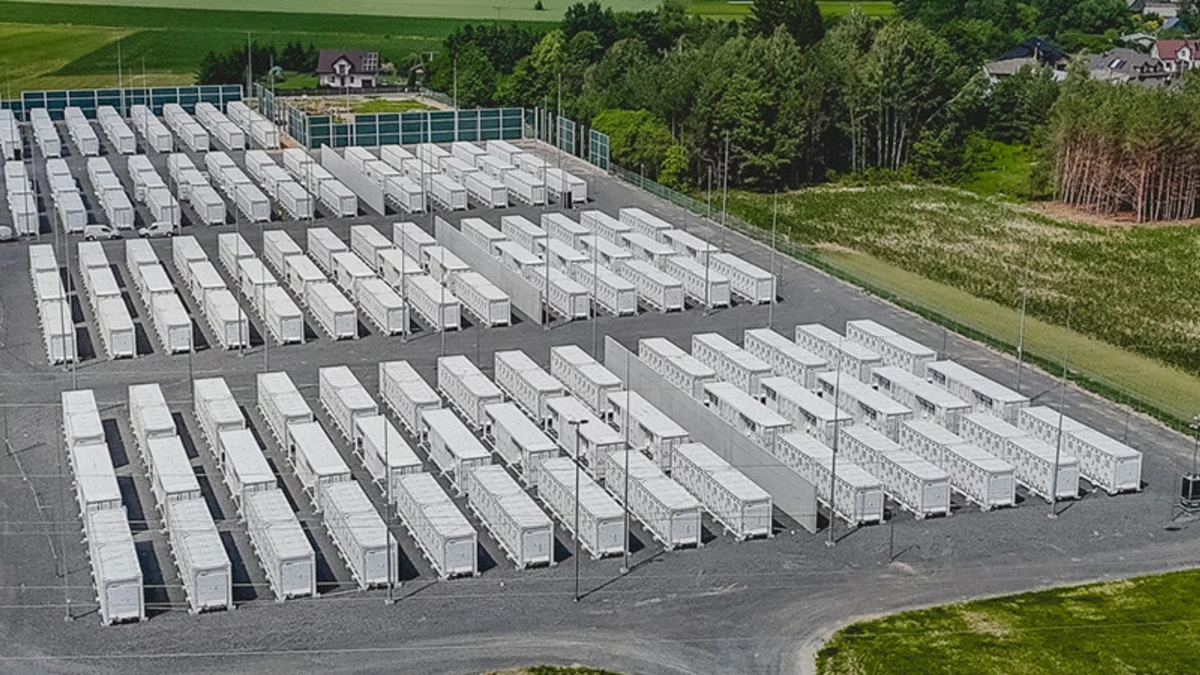
Greenvolt finished building two Polish batteries in the third quarter of 2026. It arranged 218 million euros of bank facilities against them in August. In October it agreed to sell both. The sequence is the strategy, and the undisclosed consideration is the least interesting number in it.
Key takeaways
- A&R Investments has agreed to acquire the 400 MW and 1,600 MWh Elk and Turosn Koscielna battery storage portfolio in Poland from KKR-owned Greenvolt Group, announced on 23 October 2026 with no disclosed consideration and completion expected by the end of 2026.
- Both projects were completed with permits for use in the third quarter of 2026, Turosn Koscielna in July and Elk in September, roughly three and a half years after their environmental decisions in March and April 2023.
- Each 200 MW and 800 MWh project holds a 17-year Polish capacity market contract commencing in 2028, with a contracted obligation of 170 MW, or 85 percent of rated capacity, at PLN 244,900 per MW per year, about $62,902 per MW per year, awarded in the December 2023 auction.
- Greenvolt secured a 218 million euro package from UniCredit in August 2026 covering both projects, comprising 153 million euros of bridge facilities and a 65 million euro guarantee facility, about two months before agreeing to sell them.
- Enerdatics records 27 Polish battery storage transactions since the start of 2024, of which exactly two carry a disclosed value, and Greenvolt set one of them selling the 112 MW Kozienice project to DTEK for $29.73 million, or $0.265 million per MW, in September 2025.
Why would a developer finance an asset it is about to sell?
Because of what kind of debt it raised. A bridge facility is a short-term loan taken out against a defined future event that repays it, not against the long-run cash flows of what it funds. Greenvolt's August 2026 package was 153 million euros of bridge facilities plus a 65 million euro guarantee, and neither is shaped like a 17-year project loan matched to a 17-year capacity contract.
That tells you the disposal was the plan when the money was drawn. Greenvolt rotates roughly 70 to 80 percent of the assets it develops internally and retains 20 to 30 percent. The facilities carried two finished batteries from commissioning to signature, and the sale retires them.
Two longer-dated lenders were circling and do not appear to have landed. Enerdatics recorded in January 2026 that the International Finance Corporation was considering an A-loan of up to 75 million euros for the two project companies, and the European Bank for Reconstruction and Development a senior secured loan of up to 60 million euros. Neither is recorded as drawn, and a seller expecting to exit within the year has little reason to wait for development bank credit approval. Appetite for battery capital was never the constraint, as Greenvolt's 173 million dollar boost from KKR showed.
What does an 85 percent capacity obligation tell you about these batteries?
That they are long enough to be treated almost as firm capacity. A capacity market agreement is a contract under which a generator or storage asset receives a fixed payment per kilowatt of contracted capacity per year in return for being available when the system operator calls on it. Poland awards these years ahead of the delivery period and derates storage by how long the unit can sustain output, so the volume an asset holds under contract normally sits below its equipment rating.
Elk and Turosn Koscielna each pair 200 MW of power with 800 MWh of energy, which is four hours of duration. Four hours is what buys a high derating factor in Poland, and it is why each project holds 170 MW under contract rather than a small fraction of nameplate. Even Tauron's Jawor battery, at roughly 4.2 hours, holds a contract whose volume the record does not state.
Put the two contracted figures together and the fixed revenue line emerges. Across both projects, 340 MW of obligation at PLN 244,900 per MW per year is on the order of 21 million dollars a year for 17 years, before anything the assets earn in the wholesale or balancing markets. That is the floor a buyer underwrites, and it is why duration was the most expensive decision Greenvolt made on these sites.
What fills the gap between completion and 2028?
A tolling agreement with Statkraft. A toll is a contract under which a third party pays a fixed fee for the right to operate a battery and keep its trading margin, converting uncertain market revenue into a known one for the owner. Greenvolt Power signed a 10-year toll with Statkraft in September 2026 covering the remaining power from both projects.
The timing is what makes it load-bearing. The capacity contracts begin in 2028 and the batteries were energised in July and September 2026, leaving roughly fifteen months in which the capacity market pays nothing. Polish battery deals have repeatedly left that stub open for the buyer. Here the seller closed it before going to market, so A&R is acquiring an asset whose merchant years and contracted years are both already sold to someone else.
Enerdatics records 27 Polish battery storage transactions since the start of 2024, and exactly two carry a disclosed value: the 133 MW Trzebinia project at $32.08 million, or $0.241 million per MW, in March 2024, and the 112 MW Kozienice project at $29.73 million, or $0.265 million per MW, in September 2025, a figure Enerdatics identified despite no disclosure by either party. Both assets were unbuilt when they changed hands. There is no priced operational Polish battery in the record at all, so the two prints the market relies on describe a different product, and Greenvolt itself set the more recent one.
What does the deal signal for Polish storage?
It signals that the Polish build-to-sell model now runs the full length of the asset. Environmental decision, capacity auction award, construction, bank bridge, toll, sale. Greenvolt has closed that loop three times in thirteen months in one country: 112 MW to DTEK in September 2025, 300 MW to Northland Power in November 2025, and now 400 MW to A&R. That is 812 MW rotated by one developer.
It also signals that the risk being traded has moved. The first two disposals handed buyers construction work. This one hands over finished plant with both revenue layers contracted, turning the question from whether the asset can be built into whether Statkraft and the capacity market pay as promised. What has not moved is price discovery. A deal this size, fully built and fully contracted, would have told the market more than any Polish battery transaction in two years. It closes without a number.
Frequently asked questions
How much is A&R Investments paying for Greenvolt's Polish battery portfolio?The consideration was not disclosed. Enerdatics records only two priced Polish battery transactions since the start of 2024, at $0.241 million per MW for Trzebinia and $0.265 million per MW for Kozienice, and both assets were unbuilt when they sold.
When do the Elk and Turosn Koscielna capacity market contracts start paying?Both 17-year agreements commence in 2028, at PLN 244,900 per MW per year awarded in the December 2023 auction. The batteries were completed in July and September 2026, so a 10-year Statkraft toll covers the intervening period.
How much of the 400 MW is actually under capacity contract?Each 200 MW project carries an obligation of 170 MW, which is 85 percent of rated capacity and 340 MW across the portfolio. The four-hour duration on both sites is what supports a derating that high.
Ready to get deal-ready answers in seconds? Try Enerdatics Leap AI and access verified intelligence across M&A, financings, PPAs, projects, and energy market developments through natural language.