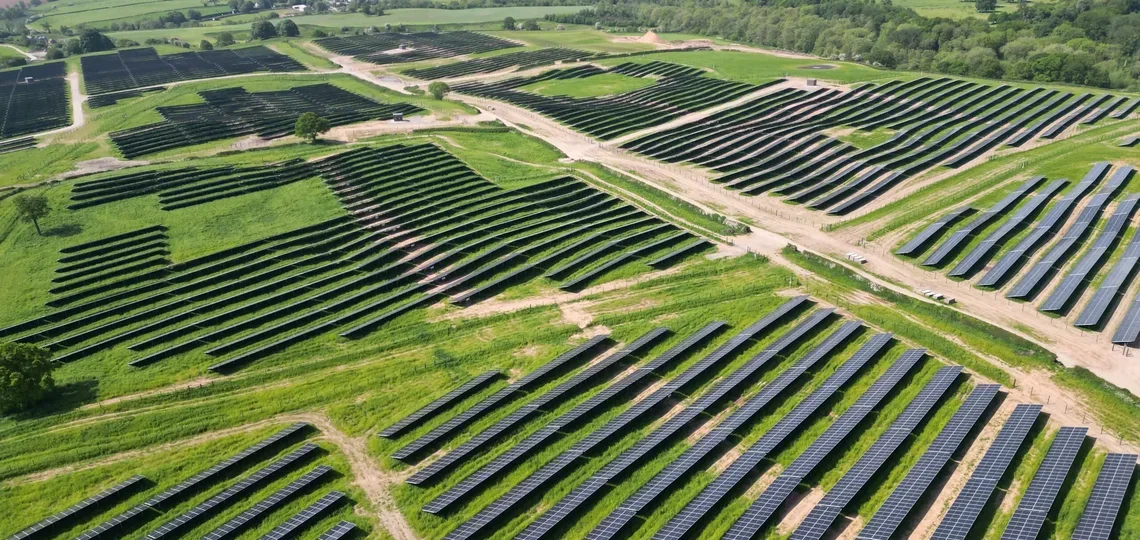
Orsted is paying GBP 15 million for the half of Gunfleet Sands it does not already own. The two wind farms sit 7 km off the Essex coast, carry 172.8 MW and have run since July 2009. Divide the price by the capacity and you get a number so far below every other operational UK offshore wind deal on record that the arithmetic looks broken. It is not broken. It is the wrong sum.
Key takeaways
- Orsted has agreed to acquire the remaining 49.9 percent of the 172.8 MW Gunfleet Sands 1 and 2 offshore wind farms in the UK from the Development Bank of Japan and JERA Nex bp for GBP 15 million, equal to $19.84 million, with completion expected in November 2026.
- The consideration implies an enterprise value of roughly $39.8 million for 100 percent of the asset, or about $0.230 million per MW against a nameplate capacity of 172.8 MW.
- Gunfleet Sands 1 is 108 MW across 30 Siemens 3.6 MW turbines and Gunfleet Sands 2 is 64.8 MW across 18 of the same machines. Both reached commercial operation on 24 July 2009.
- The wind farms receive 1.5 Renewables Obligation Certificates per MWh of eligible generation under the UK Renewables Obligation, with that support scheduled to expire in 2029.
- Enerdatics records nine operational UK offshore wind transactions since the start of 2024, of which eight carry a disclosed value. Excluding Gunfleet Sands, those priced deals run from $3.31 million to $7.56 million per MW on a grossed-up basis.
Why does dividing the price by the capacity give the wrong answer?
Because the money does not buy the wind farm. It buys 49.9 percent of it. Take the $19.84 million consideration straight to the 172.8 MW nameplate and you get about $0.115 million per MW, which is the price of the whole asset only if the whole asset changed hands. It did not.
The correction is the step most often skipped. Gross the consideration up to a 100 percent basis first, then divide. That puts the implied enterprise value at roughly $39.8 million and the price at about $0.230 million per MW. Here the error is a factor of two. On a 10 percent stake it would be a factor of ten, and that is how a routine minority trade ends up quoted as a market-low print.
Even corrected, the number is startling. The cheapest of the seven other priced operational UK offshore comparables since the start of 2024 is Macquarie's purchase of 39.25 percent of the 194 MW Lynn and Inner Dowsing wind farms, implying about $3.31 million per MW. That asset is a close cousin of this one. Similar vintage, similar scale, same subsidy regime, bought out to full ownership the same way. It priced about fourteen times higher per megawatt.
What is Orsted actually exercising?
A buyback right, which is a contractual option agreed when a stake is sold that lets the original owner reacquire it later on terms fixed in advance. That single fact removes most of the price signal. No competitive process ran and no second bidder set a floor, so the number reflects a formula negotiated years ago rather than what the market would pay this week.
Orsted says it will evaluate similar buyback rights case by case on the merits of each asset. That runs against the direction of travel elsewhere, since the company sold its entire European onshore wind, solar and battery business to Copenhagen Infrastructure Partners for EUR 1.44 billion this year to concentrate capital on offshore.
What the money buys is control. Full ownership lets Orsted capture the whole value of the asset and decide its future alone, including whether to extend its operating life. That decision, involving inspection, component replacement and recertification across 48 turbines, is one a 50.1 and 49.9 split is badly built to take quickly.
Why is an operating offshore wind farm worth so little per megawatt?
Because the revenue behind it has a visible end date. The Renewables Obligation is the UK support scheme that preceded Contracts for Difference, paying generators tradable certificates for each MWh produced rather than topping their output up to a fixed strike price. Gunfleet Sands earns 1.5 of those certificates per MWh, and that entitlement is scheduled to expire in 2029.
Three years of supported revenue is not a long runway for an asset that has already run for seventeen. Enerdatics reads the implied valuation of about $0.230 million per MW as relatively low for an operational offshore wind asset, reflecting the mature operating profile and the limited remaining duration of Renewables Obligation support, with advanced operating age and declining visibility of subsidised revenues constraining cash flow potential. That is an assessment rather than a disclosed rationale.
The pattern is not confined to the UK. The same clock ran out in Germany last week, when Macquarie's Ocean Breeze Energy agreed to buy the 60 MW alpha ventus wind farm in the year its tariff fell from EUR 154 per MWh to EUR 39 per MWh. In both cases the turbines are unchanged and the thing that paid for them is not.
Enerdatics records nine operational UK offshore wind transactions since the start of 2024, eight of them with a disclosed value. Grossed up to a 100 percent basis, the seven other than Gunfleet Sands sit between $3.31 million per MW for Lynn and Inner Dowsing and $7.56 million per MW for Schroders Greencoat's 2 percent of Hornsea 1, with a median near $5.75 million per MW. Gunfleet Sands prints at roughly one twenty-fifth of that median. Each of the seven is either a Contract for Difference asset or still well inside its support period, which is why the ladder describes the market without pricing this deal.
What does the deal signal for UK offshore wind?
It signals that the first generation of British offshore wind is about to be repriced, and severely. Projects commissioned between 2009 and 2013 were financed on Renewables Obligation certificates that run out in the back half of this decade. What remains after that is an ageing fleet selling into wholesale prices with rising maintenance costs and a decommissioning liability at the end. The per-megawatt figures investors quote for operating UK offshore wind were set by assets with contracted revenue, and they will not survive contact with assets that have none.
The second signal is about who holds them. A fund buying for yield has little use for a wind farm whose yield expires in 2029. An operator that already runs the site has a great deal of use for it. Expect more of these positions to consolidate into single hands at numbers that look like mistakes until you check what was bought.
Frequently asked questions
How much is Orsted paying for Gunfleet Sands?GBP 15 million, equal to $19.84 million, for the remaining 49.9 percent stake held by the Development Bank of Japan and JERA Nex bp. That implies an enterprise value of roughly $39.8 million for the full 172.8 MW asset, or about $0.230 million per MW.
Why is the implied price so far below other UK offshore wind deals?Two reasons. The asset has generated since July 2009 and its Renewables Obligation support expires in 2029, leaving little subsidised revenue ahead of it. It is also the exercise of a pre-agreed buyback right rather than a competitive sale, so no second bidder set the price.
What happens to Gunfleet Sands after 2029?That has not been decided. Orsted says full ownership gives it flexibility over the asset's future, including evaluating a lifetime extension, which would mean keeping the existing turbines generating past their design life rather than replacing them.
Ready to get deal-ready answers in seconds? Try Enerdatics Leap AI and access verified intelligence across M&A, financings, PPAs, projects, and energy market developments through natural language.