Why a Reserve Gas Generator's First Solar Project Is the Opposite of Everything Else It Owns
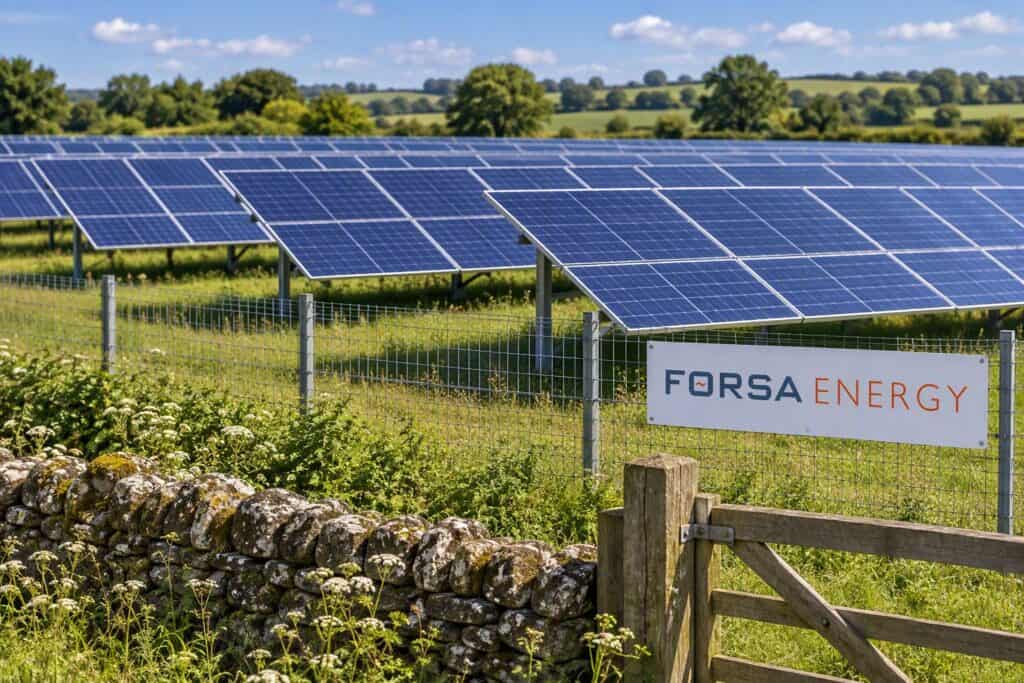
Forsa Energy owns 298 MW of reserve gas generation in the UK, plants that earn by being available when the grid is short. It has just bought its first ready-to-build solar project, Wormald Green in North Yorkshire, from Harmony Energy. That one will earn a fixed indexed price from a government contract whether the grid is short or not. One business is paid for scarcity, the other for certainty.
Key takeaways
- Tiger Infrastructure's Forsa Energy has acquired the Wormald Green solar project in North Yorkshire, UK, from Harmony Energy. Terms were not disclosed. BDO, Shepherd and Wedderburn and Locogen advised Forsa Energy on the financial, legal and technical workstreams.
- The project is rated 59.3 MW on a direct current basis and 43 MW on an alternating current basis, a ratio of about 1.38 to 1, so roughly 16 MW of panel capacity can never reach the grid in the same instant.
- Wormald Green secured a Contract for Difference in February 2026 under the UK's Allocation Round 7a at a 2024 strike price of GBP 65.23 per MWh, equal to $86.30 per MWh, with a delivery year of 2027/28.
- The project received planning permission from North Yorkshire Council in July 2025 and sits at ready-to-build stage, with construction expected in Q4 2026, operations targeted for Q4 2027 and annual output of about 57 GWh.
- Enerdatics records 95 UK solar transactions since the start of 2024, of which 23 carry a disclosed value. Four priced development-stage asset deals run from $0.079 million to $0.285 million per MW, against nine priced operational deals at $0.91 million to $1.73 million per MW.
Why does one solar project have two capacity figures?
Because the panels and the grid connection are sized separately, and only one is a limit. The direct current rating counts the modules on the ground. The alternating current rating is what the inverters and the export connection let out. Wormald Green has 59.3 MW of modules behind a 43 MW export point.
Overbuilding the panel side is deliberate. Solar modules reach their rated output for only a handful of hours in a UK year, so an array sized exactly to the connection leaves the inverters half-loaded most of the time. More panels fill more of those hours, at the cost of clipping the summer midday peak at 43 MW. That is cheaper than leaving the connection underused all year.
So the number that earns money is 43, not 59.3. The expected 57 GWh a year is a load factor of roughly 11 percent against the module rating and about 15 percent against the export rating, and it is metered export that the revenue contract settles against. A buyer here models 43 MW with a 59.3 MW generator behind it, which is a different asset from a 59 MW solar farm.
What does the Contract for Difference actually guarantee?
A price, not a volume. A Contract for Difference fixes what a generator receives for each unit it exports, with the counterparty paying the difference when the wholesale price falls below the strike and the generator paying back when it rises above. It removes price risk entirely and leaves generation risk untouched.
Wormald Green won one in February 2026 under Allocation Round 7a at a 2024 strike price of GBP 65.23 per MWh, equal to $86.30 per MWh, for a 2027/28 delivery year. That is indexed, government-backed revenue, not a corporate contract with a counterparty that can be downgraded. For a buyer whose fleet lives on volatile scarcity pricing, it is the most predictable cash flow in the UK power market.
The round matters as much as the price. Enerdatics records the identical 2024 strike price on the 72 MWdc Pilmoor project in the same county, which Liberty Global's egg Power acquired at ready-to-build stage in July 2026 with its Allocation Round 7a contract intact. Earlier rounds cleared lower: four UK projects in the Cero Generation portfolio hold a 15-year contract awarded in September 2024 at GBP 50.07 per MWh, covered in Enerdatics' analysis of Qualitas Energy's purchase of that platform from Macquarie. Strike prices are quoted in a base year and indexed from there, so the two are not directly comparable.
Why does a reserve gas business want contracted solar?
Because the two revenue shapes do not overlap, which is the whole attraction. Reserve gas generation earns from availability and from the hours when the system is tight, so its income is lumpy and hard to forecast year by year. A Contract for Difference pays a fixed indexed price on every megawatt hour exported. Holding both smooths the platform's cash flow without either asset competing for the same conditions.
The operating fit helps too. Forsa has in-house operations and maintenance built for its reserve gas fleet, so a 43 MW export point adds little overhead. With its recent wind acquisitions the transaction takes acquired capacity to around 86 MW, a renewable platform assembled next to a thermal one rather than replacing it.
Enerdatics records 95 UK solar transactions since the start of 2024, of which 23 carry a disclosed value, so roughly one deal in four is priced in public. Within that priced set the ladder by stage is steep. Four development-stage asset deals run from $0.079 million per MW for the 42.4 MWp Hanningfield project up to $0.285 million per MW for the 30 MW Steeraway project. Nine priced operational deals run from $0.91 million per MW, where the Metlen and Atrato portfolios sit, to $1.73 million per MW for the 513.5 MWp Toucan Energy portfolio. The gap between a consented UK megawatt and an operating one is close to tenfold, and ready-to-build with a contract attached is the last rung before the step up.
What does the deal signal for UK solar?
The deal signals that the buyer pool for ready-to-build UK solar has widened past funds and utilities to industrial operators with their own reasons to want contracted power. A fund prices the yield. An operator prices the yield plus whatever the asset does to the rest of its portfolio, and will sometimes pay more for it. More bidders of the second kind supports pricing for exactly the work developers do, which is clearing planning and winning the contract.
On the sell side the signal points the other way. Harmony Energy's record is in grid-scale batteries rather than solar, and Enerdatics records Alpiq acquiring a 90 percent stake in Harmony Energy in July 2026 alongside a pipeline of more than 12 GW. A consented solar project with a won contract is the cleanest thing such a developer can sell, because the buyer needs no belief in the seller's future delivery. Expect more single-asset UK solar sales at exactly this point in a project's life.
Frequently asked questions
How much did Forsa Energy pay for Wormald Green?Terms were not disclosed. Enerdatics records 95 UK solar transactions since the start of 2024 with 23 carrying a disclosed value, and the four priced development-stage asset comparables in that set run from $0.079 million to $0.285 million per MW.
Is Wormald Green a 59 MW or a 43 MW solar project?Both are correct and they measure different things: 59.3 MW of modules on a direct current basis behind a 43 MW export limit on an alternating current basis. Revenue settles against metered export, so 43 MW determines what it earns.
What strike price did Wormald Green secure?The project secured a Contract for Difference in February 2026 under Allocation Round 7a at a 2024 strike price of GBP 65.23 per MWh, equal to $86.30 per MWh, with a delivery year of 2027/28.
Ready to get deal-ready answers in seconds? Try Enerdatics Leap AI and access verified intelligence across M&A, financings, PPAs, projects, and energy market developments through natural language.