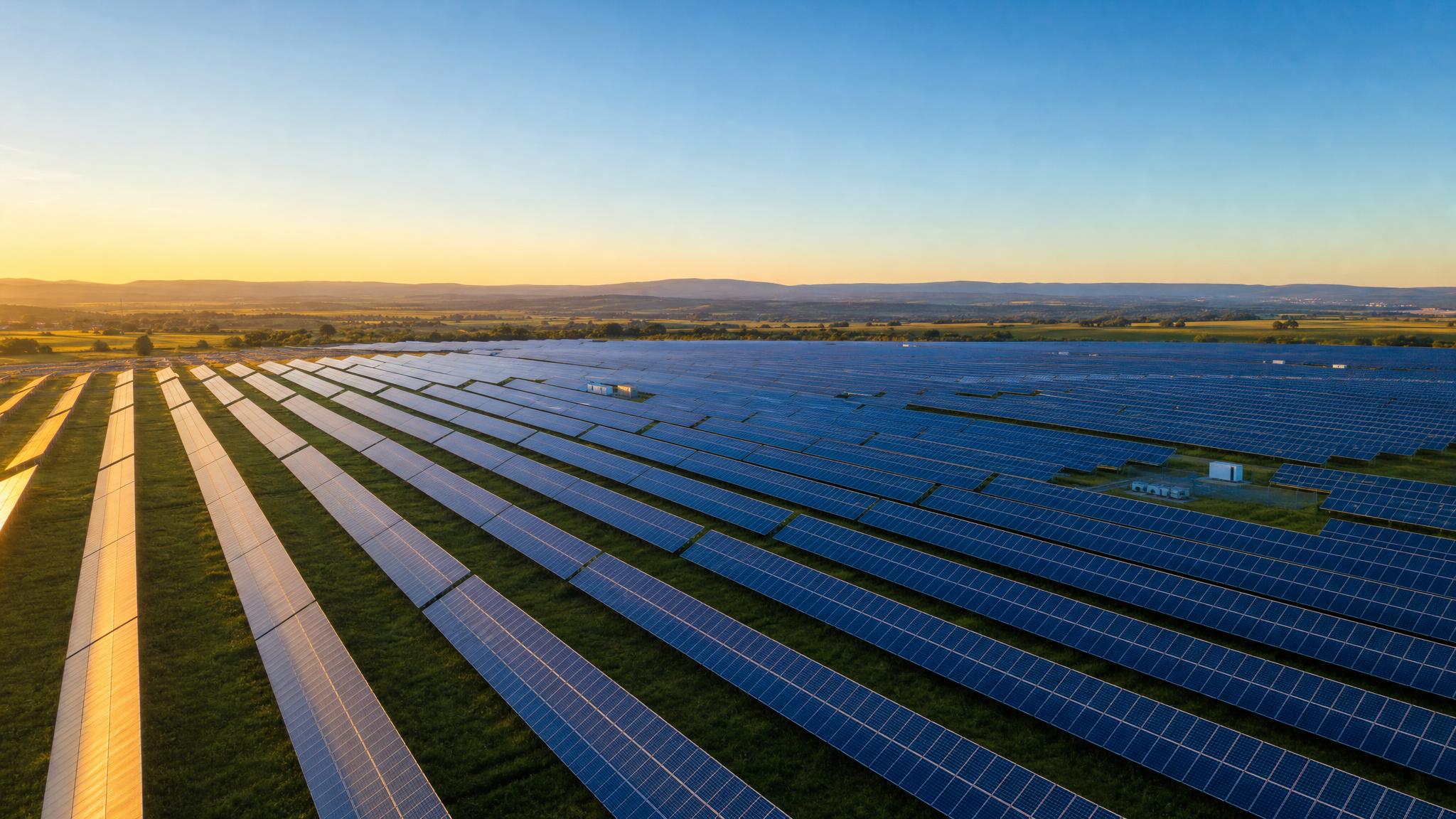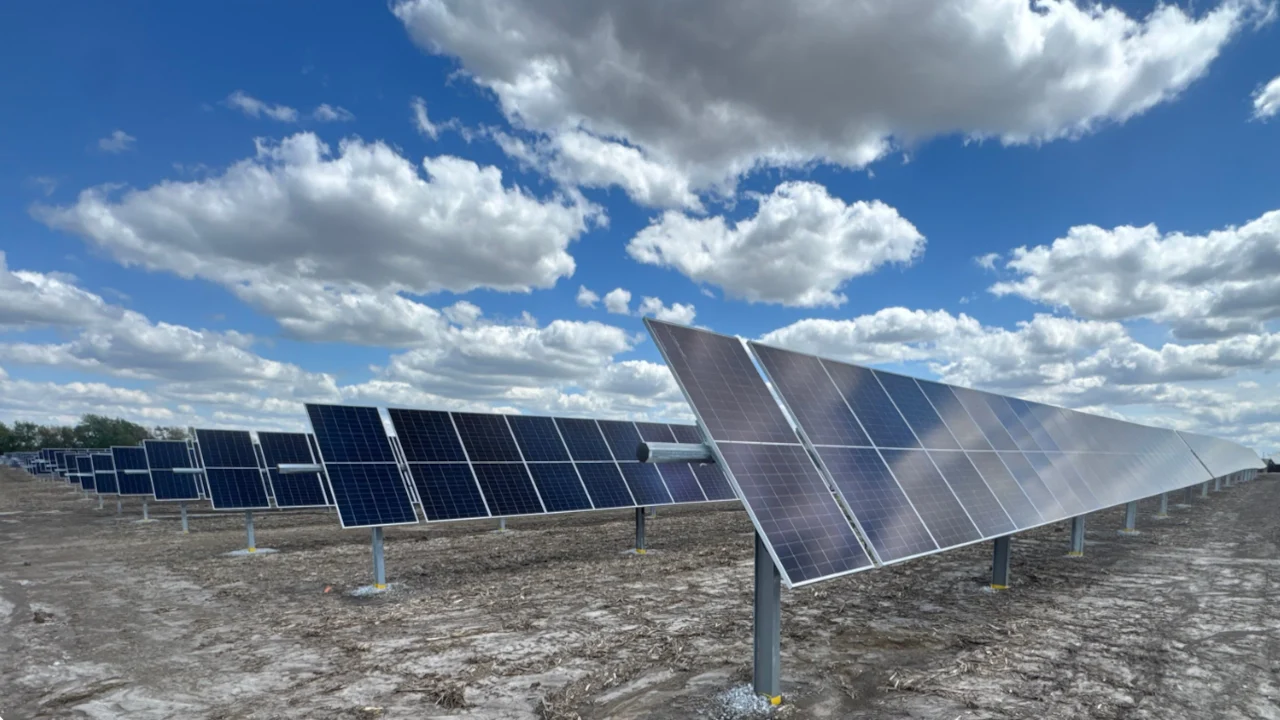
Aligned Climate Capital has closed $387 million to build 20 community solar projects. Eighteen of them are in Illinois and two are in Maryland. Those two states run different incentive programmes, the projects sit in four separate utility territories, and the debt is written so that none of it needs refinancing when the projects switch on.
Key takeaways
- Aligned Climate Capital secured a $387 million construction-to-permanent debt facility on 15 October 2026 from a bank syndicate led by Apterra Infrastructure Capital, an affiliate of Apollo Global Management.
- The facility funds 20 community solar projects totalling 126 MWdc, comprising 115 MWdc across 18 Illinois projects and 11 MWdc across two Maryland projects, expected to generate about 225 GWh a year.
- The Illinois projects sit in the Ameren and Commonwealth Edison service territories, and the Maryland projects in the Delmarva Power and Potomac Edison territories, so one facility spans four utilities.
- Under Maryland's Community Solar Program, at least 40 percent of the two Maryland projects' capacity is reserved for low- and moderate-income subscribers, while some Illinois projects earn revenue through the Illinois Shines renewable energy credit programme.
- Enerdatics records Apterra Infrastructure Capital in six US financings since the start of January 2024, five of them distributed solar, including a $260 million community solar facility for 38 Degrees North one month before this one.
What does construction-to-permanent actually change?
It removes a financing event. In the standard route, a portfolio raises short-term construction debt, reaches commercial operation, and then refinances into long-term debt, which means a second credit process, a second set of fees and a window in which the sponsor carries refinancing risk. A construction-to-permanent facility writes both stages into one agreement: funding drawn to build each project converts into permanent debt as that project reaches commercial operation.
For a portfolio of 20 small projects, that is worth more than it would be for one large plant. Twenty projects do not finish together. They finish across months, each with its own utility inspection, interconnection sign-off and subscriber enrolment, and under the standard route each completion either waits for a portfolio-wide refinancing or triggers its own. Converting project by project inside a single facility means the capital structure keeps pace with construction instead of lagging it.
The supporting roles in the syndicate are shaped around that. BankUnited acts as depository agent and swap provider alongside Stifel, which fixes the interest rate as debt converts to its permanent form, and Banco de Credito e Inversiones provides the letter of credit facility. Amalgamated Bank, Siemens Bank, Farmer Mac and BTG Pactual complete the group. Clifford Chance advised Aligned Climate Capital and Norton Rose Fulbright advised the lenders.
Why is this an Illinois portfolio with a Maryland footnote?
Because the capacity is not distributed the way the project count suggests. Eighteen of the 20 projects are in Illinois, which sounds like a nine-to-one split. Measured in megawatts it is tighter than that in one direction and wider in the other: 115 MWdc of the 126 MWdc total is in Illinois, or about 91 percent, and the two Maryland projects carry 11 MWdc between them.
The average project in the portfolio is 6.3 MWdc, which is the size community solar programmes are generally capped at and the reason these portfolios are built in bulk. It also means the Maryland exposure is roughly one and a half average projects, included for a reason other than scale.
That reason is programme diversity. Illinois pays through Illinois Shines, which buys renewable energy credits from qualifying projects, so part of the revenue is a credit purchase rather than a power sale. Maryland pays through its Community Solar Program, which carries a social obligation instead: at least 40 percent of capacity must serve low- and moderate-income subscribers. A lender underwriting both is underwriting two different revenue mechanisms and two different subscriber-credit profiles in one facility, which is the harder part of the diligence and the reason four utility territories appear in a single document.
Is $387 million a lot for 126 MWdc?
It is $3.07 million per MWdc, and in community solar that is ordinary rather than remarkable. The figure is roughly double what utility-scale solar costs to build, which is why dividing a facility size by a capacity number tends to mislead in this part of the market. The same arithmetic produced more than $3 million per MW on 38 Degrees North's facility in September 2026, also arranged by Apterra.
The reason is structural. These facilities fund construction and permanent debt together, include letters of credit and hedges, and carry the per-project overhead of interconnection, utility programme enrolment and subscriber acquisition across dozens of sites rather than one. None of that is capex in the sense a utility-scale comparison assumes.
Enerdatics records six US distributed solar financings since the start of 2024 that disclose both an amount and a capacity. Ranked by capital per MW they run from Radial Power's $355 million across 214 MW, at $1.66 million per MW, through Soltage at $2.02 million, Dimension Energy's December 2024 facility at $2.33 million, this transaction at $3.07 million, Dimension's June 2025 facility at $3.21 million, and Dimension's April 2026 package at $4.92 million per MW. The median of those six is $2.70 million per MW, which puts Aligned just above the middle of a very wide range.
What does the deal signal for US community solar?
That one arranger is becoming the default route to portfolio debt in this market. Apterra appears in six US financings Enerdatics records since the start of 2024, five of them distributed solar: Aypa Power's $1.55 billion debt package, Nautilus Solar's $275 million, both of Solar Landscape's 2026 facilities, 38 Degrees North's $260 million and now this. A sponsor assembling a community solar portfolio is increasingly negotiating with the same lead bank its competitors used.
It also shows what Aligned is building. Aligned's acquisition of the 7.3 MWdc Armoracia project in Illinois earlier in 2026 was a single asset bought to prove a technology could be financed. This facility is the other half of the same strategy: standing debt capacity behind Aligned Solar Partners' plan to acquire, finance, own and operate distributed assets, rather than funding one project at a time. Solar Landscape's preferred tax equity deal with Nuveen covered a portfolio spanning the same two states, which suggests Illinois and Maryland are where the programmes are currently bankable.
Frequently asked questions
What does Aligned Climate Capital's $387 million facility fund? It funds the construction of 20 community solar projects totalling 126 MWdc, with 115 MWdc across 18 projects in Illinois and 11 MWdc across two projects in Maryland. The portfolio is expected to generate about 225 GWh a year.
What is a construction-to-permanent facility? It is a single debt agreement in which funding drawn to build a project converts into long-term permanent debt as that project reaches commercial operation, removing the need for a separate refinancing once construction is complete.
Who provided the financing? A syndicate led by Apterra Infrastructure Capital, an affiliate of Apollo Global Management, with BankUnited as depository agent and swap provider alongside Stifel, Banco de Credito e Inversiones providing the letter of credit facility, and Amalgamated Bank, Siemens Bank, Farmer Mac and BTG Pactual participating.
Ready to get deal-ready answers in seconds? Try Enerdatics Leap AI and access verified intelligence across M&A, financings, PPAs, projects, and energy market developments through natural language.