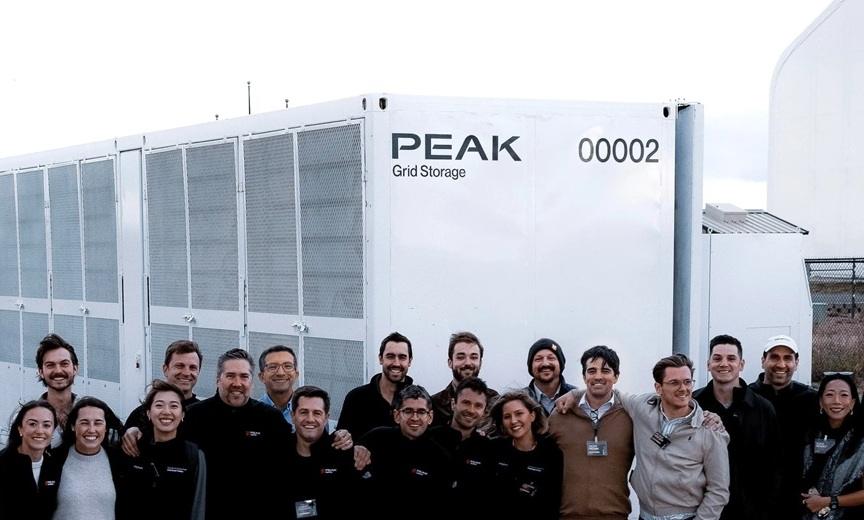
Peak Energy has raised $108 million in a Series B led by General Motors Ventures. The company was founded in 2023 and has now raised $173 million in total across three rounds. It is carrying more than $1 billion in customer orders, which is close to six times everything it has ever raised.
Key takeaways
- Peak Energy raised $108 million in an oversubscribed Series B round announced on 21 October 2026, led by General Motors Ventures with Xora Innovation, LG Technology Ventures, Eclipse, Maverick Silicon and Infinite Capital participating.
- The round follows $10 million raised in October 2023 and a $55 million Series A in July 2024, bringing Peak Energy's total equity raised to $173 million since the company was founded in 2023.
- Peak Energy has been awarded more than $1 billion in commercial contracts by customers including Jupiter Power, RWE and Energy Vault, and the proceeds are intended to support fulfilment of those orders.
- The company builds passively cooled grid-scale sodium-ion batteries, which dispense with the active thermal management that lithium-ion systems require, and was founded by people who previously worked at Tesla, Northvolt and Enovix.
- Enerdatics records 13 US battery manufacturing financings since the start of January 2024 worth $10.24 billion, of which a single $7.54 billion US Department of Energy loan to StarPlus Energy accounts for nearly three quarters.
What does sodium-ion give up, and what does it buy?
It gives up energy density and buys tolerance. A sodium-ion battery stores charge by shuttling sodium ions between electrodes rather than lithium ions. Sodium is abundant and cheap, and the chemistry handles a wider temperature range, but it holds less energy for a given weight and volume, so the same megawatt-hour takes up more space.
In a car that trade is usually fatal. On a grid-scale site it is often irrelevant, because land is cheaper than it is in a vehicle and nobody is carrying the battery around. What the temperature tolerance buys is the thing Peak Energy actually sells: passive cooling. Lithium-ion grid batteries need active thermal management, which means compressors, pumps or fans, a parasitic electrical load that reduces net output, and a set of moving parts that need servicing for twenty years.
Strip that out and the pitch is lower operating cost and lower system complexity rather than lower capital cost per kilowatt-hour. That is a different argument from the one most new battery chemistries make, and it is aimed at owners who have already discovered what maintenance on a large lithium fleet costs. A four-hour project like Deriva's 1,208 MWh Frontier battery shows the scale at which those operating costs start to matter.
Why is a $1 billion order book the number to watch?
Because it is an obligation, not revenue. More than $1 billion in commercial contracts from Jupiter Power, RWE and Energy Vault, which has been building out its own US storage platform, means customers have committed to buy. It does not mean Peak Energy has been paid, and it does not mean the cells exist.
Set the two figures side by side and the purpose of the round becomes clear. The order book is more than $1 billion. Total equity raised across three rounds is $173 million. A manufacturer has to buy materials, tool a line and build inventory well before a customer pays on delivery, so an order book that is roughly six times cumulative equity is a working capital problem rather than a demand problem. The stated use of proceeds says exactly that: scaling domestic manufacturing and supporting fulfilment of the orders.
It also tells you what the investors are underwriting. GM Ventures is not betting on whether anyone wants the product. That question has been answered by three named utility-scale customers. It is betting on whether a company three years old can manufacture at the rate those contracts require, which is the stage at which battery start-ups most often fail.
How does $108 million compare with the rest of the sector?
It is modest against the raises that make headlines, and that is the point of a Series B. Form Energy raised $405 million in a single Series F in October 2024 for iron-air batteries. Sila raised $375 million for silicon anode production in June 2024. Eos Energy took about $316 million from Cerberus for zinc-based manufacturing in the same month. Peak Energy's entire three-round history is less than half of Form Energy's one round.
The sector-level numbers are distorted by a single transaction. Enerdatics records 13 US battery manufacturing financings since the start of January 2024 totalling $10.24 billion, but $7.54 billion of that is one Department of Energy loan to StarPlus Energy, the Stellantis and Samsung joint venture, for two lithium-ion plants. Strip it out and 2024 raised about $1.16 billion across five transactions, 2025 raised $550 million across two, and 2026 has raised $995 million across five so far. Peak Energy's $108 million is about a ninth of this year's total.
Read that way, private battery manufacturing capital in the US has been roughly flat for three years once government lending is removed, while the number of transactions has stayed in single digits annually. In a market that thin, a $108 million round led by a strategic investor is a meaningful share of the year's activity rather than a rounding error.
What does the deal signal for US energy storage?
That chemistry diversification is now being funded by buyers rather than by generalist venture capital. GM Ventures and LG Technology Ventures are both corporate arms attached to companies that know cell manufacturing from the inside. Their participation is a judgement on the production problem, not on the concept, and it arrives alongside an order book already signed by utility-scale developers.
The second signal is where the demand is pointing. Peak Energy is entering the data centre power market alongside its utility and independent power producer customers, which is a segment that cares about footprint and uptime more than about dollars per kilowatt-hour. A passively cooled battery with no compressors to fail is an easier sell to a site operator measuring availability than to a developer optimising an arbitrage spread. Whether sodium-ion wins on cost is still unproven. Whether it wins on simplicity is the argument this round is funding.
Frequently asked questions
How much has Peak Energy raised in total? Peak Energy has raised $173 million across three rounds: $10 million in October 2023, a $55 million Series A in July 2024, and a $108 million Series B announced in October 2026.
Who led Peak Energy's Series B? General Motors Ventures led the oversubscribed round, with participation from Xora Innovation, LG Technology Ventures, Eclipse, Maverick Silicon and Infinite Capital. Five of the investors were new to the company.
What is a sodium-ion battery? It is a battery that stores charge by moving sodium ions between electrodes instead of lithium ions. Sodium is cheap and abundant and the chemistry tolerates a wider temperature range, which allows passive cooling, but it stores less energy per unit of weight and volume than lithium-ion.
Ready to get deal-ready answers in seconds? Try Enerdatics Leap AI and access verified intelligence across M&A, financings, PPAs, projects, and energy market developments through natural language.