Seven international banks have lent GIGA Storage $291.29 million to build one battery in Lower Saxony. Seven is an unusual number of lenders for a facility that size. No other German battery financing on Enerdatics' record since the start of 2024 names more than three, and most name one. The syndicate is the story, not the amount.
Key takeaways
- GIGA Storage secured a $291.29 million debt facility from a consortium of seven international banks for the Albatross battery project near Neuenkirchen in Lower Saxony, Germany, announced on 26 October 2026.
- The seven lenders are ABN AMRO, Hamburg Commercial Bank, ING Group, Rabobank, Siemens Bank, Sumitomo Mitsui Banking Corporation and Societe Generale. ING also acted as financial adviser, Clifford Chance advised GIGA Storage and White & Case advised the lending consortium.
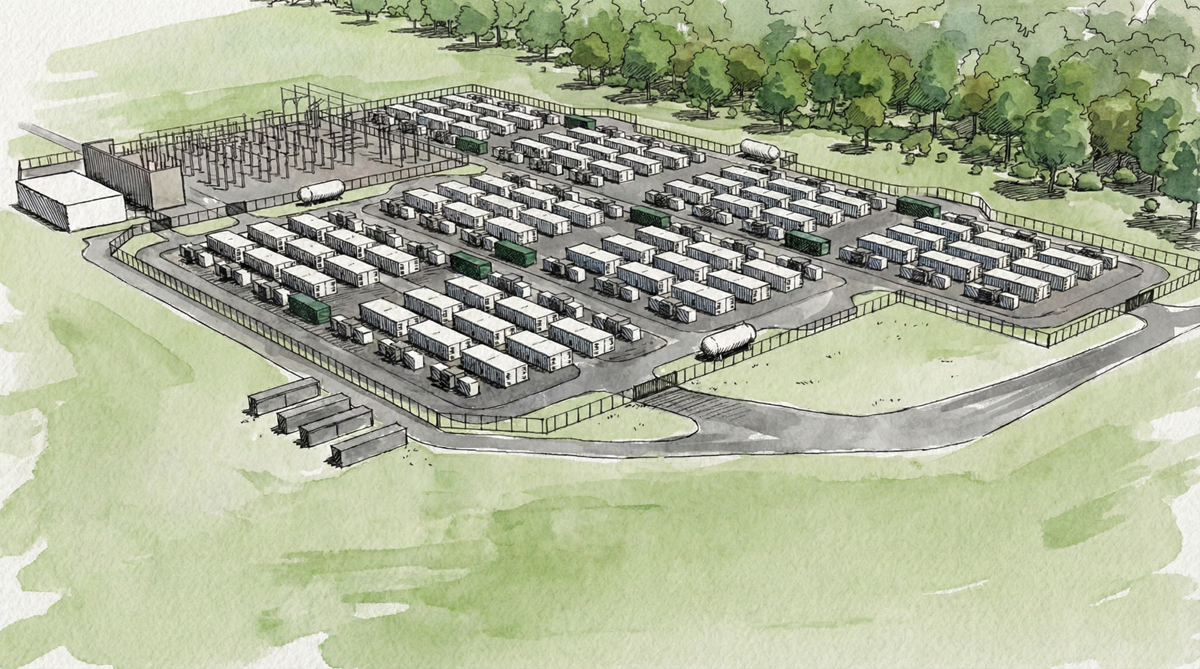
- Albatross is a 350 MW and 1,400 MWh facility, giving it exactly four hours of duration, built from 264 battery containers, 96 medium-voltage transformers and 2 high-voltage transformers, with CATL engineering, constructing and maintaining it alongside European subcontractors.
- The facility works out at about $0.83 million per MW, or roughly $208 per kWh of energy capacity, and construction is scheduled to begin in early 2027 with commercial operations expected in early 2029.
- A grid connection agreement linking the site directly to Amprion's 380 kV network via the nearby Merzen substation was signed on 14 October 2026, twelve days before the financing was announced.
Why does a $291 million loan need seven banks?
Because the lenders are sizing their exposure to the risk, not to the loan. A syndicated facility spreads one loan across a group of banks under common terms, so no single lender carries the whole amount. Seven banks on $291.29 million averages about $42 million each, which is a small ticket for institutions of this size. They are not constrained by capacity. They are choosing to hold less.
What they are lending against explains why. Leap records no contracted offtake for Albatross. A German battery with no tolling agreement or capacity contract on record earns from the spread between hours and from balancing services, both of which are forecasts rather than contracts. Against merchant revenue, a bank that would happily hold $150 million of a contracted wind farm will hold $42 million of a battery.
The composition carries a second signal. Four of the seven have already lent to German batteries on Enerdatics' record: ABN AMRO to Terralayr in January 2026, Hamburg Commercial Bank to ju:niz Energy in November 2025, ING to Aquila Capital's Wetzen project in June 2026, and Rabobank to the Reichmuth-led consortium at Arzberg in July 2026. Siemens Bank, Sumitomo Mitsui Banking Corporation and Societe Generale are new to that set. A syndicate that mixes four repeat lenders with three newcomers is how a market widens its funding base.
What does the grid connection agreement twelve days earlier tell you?
That it was the last item on the list. A grid connection agreement fixes the point, voltage and timing at which a project may export to the network, and without one a battery cannot be built or financed. Albatross connects directly to Amprion's 380 kV transmission network through the Merzen substation, which is the transmission level rather than distribution, meaning fewer intermediate constraints between the battery and the wider grid.
The sequence matters more than the gap. GIGA Storage acquired the project from Isenau Projects in June 2025 and had secured permits, land agreements and supplier contracts before financial close. The connection agreement signed on 14 October completed the set, and the debt was announced on 26 October. Lenders did not fund a project and wait for its connection. They waited for the connection and then funded the project.
That is the same logic that governs where large German batteries get built at all. BW ESS broke ground on the 1,000 MW Klostermansfeld project in Saxony-Anhalt precisely because of its position on the network, a transaction Enerdatics read as Germany's shift from accumulating storage pipeline to owning grid-critical construction. Substation access is the scarce input, and the financing follows it.
Is $0.83 million per MW cheap for a four-hour battery?
The figure is almost meaningless without knowing who owns the asset at completion, and here the owner is the borrower. Deriva Energy raised $280 million for the 302 MW and 1,208 MWh Frontier battery in Oklahoma in October 2026, about $0.93 million per MW at an almost identical four-hour duration. The two numbers look like a match and describe opposite situations. Frontier is financed under a build transfer agreement that hands the finished battery to Oklahoma Gas and Electric, so the loan is repaid from sale proceeds and the lender's exposure ends at completion.
GIGA Storage intends to keep Albatross. Its debt has to be serviced from the battery's own merchant earnings for years after commercial operations, which is a materially harder credit at the same price per MW. Read that way, $0.83 million per MW against a retained merchant asset is the more aggressive of the two figures, not the cheaper one.
Enerdatics records 20 German battery financings since the start of January 2024, of which 14 are debt. Only seven of those 14 carry a disclosed amount, so half the German battery debt market prices in private. Among the ones that do, GIGA's $291.29 million is the largest single-project facility on record, behind only the $502.13 million TotalEnergies and Allianz Global Investors raised in July 2026 against a portfolio rather than one site.
What does the deal signal for German battery storage?
That four hours has become the financeable specification in Germany, and that banks will fund it without a contract. Albatross holds the same duration as the Nordic assets now clearing at the ready-to-build stage, including the 100 MW and 400 MWh Nivala battery Foresight bought in Finland in October. A four-hour configuration is built to move bulk energy between cheap and expensive hours rather than to stand ready for reserve calls, and seven banks have now underwritten that view for more than two years before the asset switches on.
The second signal is the contractor. CATL is engineering, constructing and maintaining the facility alongside European subcontractors, which puts the cell manufacturer on the hook for long-term performance rather than only for supply. For a lender holding merchant risk, a maintenance obligation from the party that built the cells is worth something, and it is the kind of term that does more to get a syndicate of seven to financial close than any single covenant.
Frequently asked questions
Who is lending to GIGA Storage for the Albatross project?Seven international banks: ABN AMRO, Hamburg Commercial Bank, ING Group, Rabobank, Siemens Bank, Sumitomo Mitsui Banking Corporation and Societe Generale. ING also acted as financial adviser on the transaction.
How large is the Albatross battery and when will it operate?350 MW and 1,400 MWh, or four hours of duration, near Neuenkirchen in Lower Saxony. Construction is scheduled to begin in early 2027 with commercial operations expected in early 2029.
Does Albatross have a power contract?Leap records no contracted offtake for the project. Without a tolling or capacity contract on record it earns from wholesale price spreads and balancing services, which is merchant revenue rather than contracted revenue.
Ready to get deal-ready answers in seconds? Try Enerdatics Leap AI and access verified intelligence across M&A, financings, PPAs, projects and energy market developments through natural language.