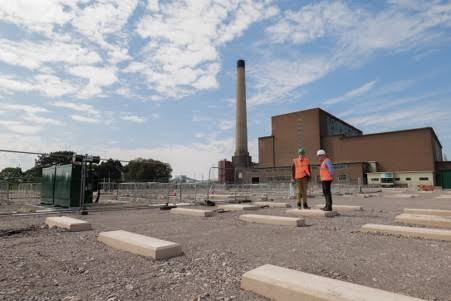
Ampeak Energy has sold a 24.7 percent stake in the Afon Wysg 1 battery project in Wales to JBR Energy Holdings for £7.8 million, around $10.56 million. AW1 is a 120 MW/240 MWh system at the Uskmouth Sustainable Energy Park near Newport, which reached financial close in August 2025, began construction the following month and is due to reach commercial operations in Q1 2027. JBR Energy Holdings is a special purpose vehicle owned by directors of Jones Bros. Ruthin, the civil engineering firm holding the balance of plant contract for the project. The buyer is building the asset it has just bought into.
How is the £7.8 million split?
The consideration divides evenly. £3.9 million buys equity in AW1 Storage Holdings, the project SPV, and £3.9 million purchases a shareholder loan to AW1 Energy Storage Limited. That structure matters for reading the price. The equity half alone implies a whole-project equity value of about £15.8 million, or £131,600 per MW, while the full consideration grossed up to 100 percent gives roughly £31.6 million, or £263,000 per MW. Ampeak states a portfolio valuation of £260,000 per MW, equivalent to $352,152 per MW. The transaction lands within about one percent of the company's own stated carrying value, which is presumably the point of disclosing both.
Why does the headline dollar-per-MW figure mislead?
Because the consideration buys a quarter of the project while the megawatt figure describes all of it. Dividing $10.56 million by 120 MW gives $0.09 million per MW, which would place this among the cheapest UK battery transactions on record. On a 100 percent basis the same deal prices at roughly $0.36 million per MW. The difference is four-fold and entirely an artefact of comparing a minority consideration against full nameplate capacity. Any minority-stake transaction needs grossing up before it sits alongside whole-asset comparables, and this one sits comfortably mid-range once that is done.
Why would the construction contractor take equity?
Because it aligns the two parties whose interests usually diverge during a build. Jones Bros holds the balance of plant contract and has prior experience at the Uskmouth site, so its directors are underwriting delivery risk they already control. For Ampeak, selling to the contractor raises capital without introducing a counterparty that needs to learn the asset. There is a condition attached: as part of its loan arrangement with Cardiff Capital Region, Ampeak has committed to ringfence half the proceeds for the AW1 expansion, which will take the site from 240 MWh to 480 MWh. The sale funds the next phase of the same project.
Enerdatics' data shows where this sits against the UK market. Across 55 UK battery transactions recorded since the start of 2024, only eleven carry a disclosed value, and the priced range is unusually wide. Operating assets have cleared around $1.04 million to $1.13 million per MW in the three Harmony Energy Income Trust transactions during 2025. In-construction assets have priced lower, with AIP Management paying $0.61 million per MW for 700 MW from BW Group in September 2025 and E.ON paying $0.40 million per MW for 230 MW from Quinbrook in March 2024. Development-stage positions run from $0.01 million to $0.80 million per MW depending on consent status. AW1 at roughly $0.36 million per MW on a grossed-up basis prices as a construction-stage asset, slightly below the two in-construction comparables, which is consistent with a minority stake carrying no control.
What does the deal signal for UK storage?
The deal signals that developers are selling projects down in slices rather than whole, and keeping bare control while they do it. This is the second identical 24.7 percent disposal in AW1: Ampeak sold the same proportion to Electric Land in August 2025, and JBR Energy Holdings and BESS Investment UK now each hold 24.7 percent against Ampeak's remaining 50.6 percent. Selling twice at the same percentage leaves the seller with a majority by a margin of six-tenths of a percentage point, which looks deliberate rather than incidental. Expect more of these paired minority disposals from developers who need construction capital but are unwilling to give up consolidation.
The revenue structure explains why the asset is financeable at this stage. AW1 has a 12-year floored revenue optimisation agreement with EDF Energy Customers, under which EDF manages electricity sales and provides a guaranteed revenue floor, and the project is forecast to generate average revenue of £13 million and average EBITDA of £9 million a year across its first five full years. Nord/LB provided £45.3 million of non-recourse project finance within £67.4 million of total funding, and Canadian Solar is supplying the batteries under a 15-year service agreement. A revenue floor, a bankable warranty and non-recourse debt together are what let a civil engineering contractor's directors write an equity cheque into a merchant-exposed asset class.
Key takeaways
- Ampeak Energy sold a 24.7 percent stake in the 120 MW/240 MWh Afon Wysg 1 BESS project in Wales to JBR Energy Holdings for £7.8 million, split evenly between equity in the project SPV and the purchase of a shareholder loan.
- JBR Energy Holdings is owned by directors of Jones Bros. Ruthin, the civil engineering firm holding the balance of plant contract for the project.
- Grossed up to 100 percent the consideration implies roughly £263,000 per MW, within about one percent of Ampeak's stated portfolio valuation of £260,000 per MW, or $352,152 per MW.
- This is the second 24.7 percent disposal in AW1 after a matching sale to Electric Land in August 2025, leaving Ampeak with 50.6 percent, and half the proceeds are ringfenced for the expansion from 240 MWh to 480 MWh under a Cardiff Capital Region loan condition.
- Enerdatics records 55 UK battery transactions since the start of 2024, of which only eleven are priced, with in-construction comparables at $0.61 million per MW (AIP Management, September 2025) and $0.40 million per MW (E.ON, March 2024).
Frequently asked questions
How much did JBR Energy Holdings pay for the AW1 stake?£7.8 million, around $10.56 million, comprising £3.9 million for equity in AW1 Storage Holdings and £3.9 million for a shareholder loan to AW1 Energy Storage Limited, in exchange for 24.7 percent of the project.
Who owns the Afon Wysg 1 project now?Ampeak Energy retains 50.6 percent, while JBR Energy Holdings and BESS Investment UK Limited each hold 24.7 percent following two matching minority disposals.
What revenue arrangement does AW1 have?A 12-year floored revenue optimisation agreement with EDF Energy Customers Limited, under which EDF manages the sale of electricity and provides a guaranteed revenue floor. The project is forecast to generate average revenue of £13 million and average EBITDA of £9 million a year during its first five full years of operation.
Ready to get deal-ready answers in seconds? Try Enerdatics Leap AI and access verified intelligence across M&A, financings, PPAs, projects, and energy market developments through natural language.