
Why MPCES's Colombia Exit Shows What Happens When a Contracted Solar Farm Underproduces
.png)
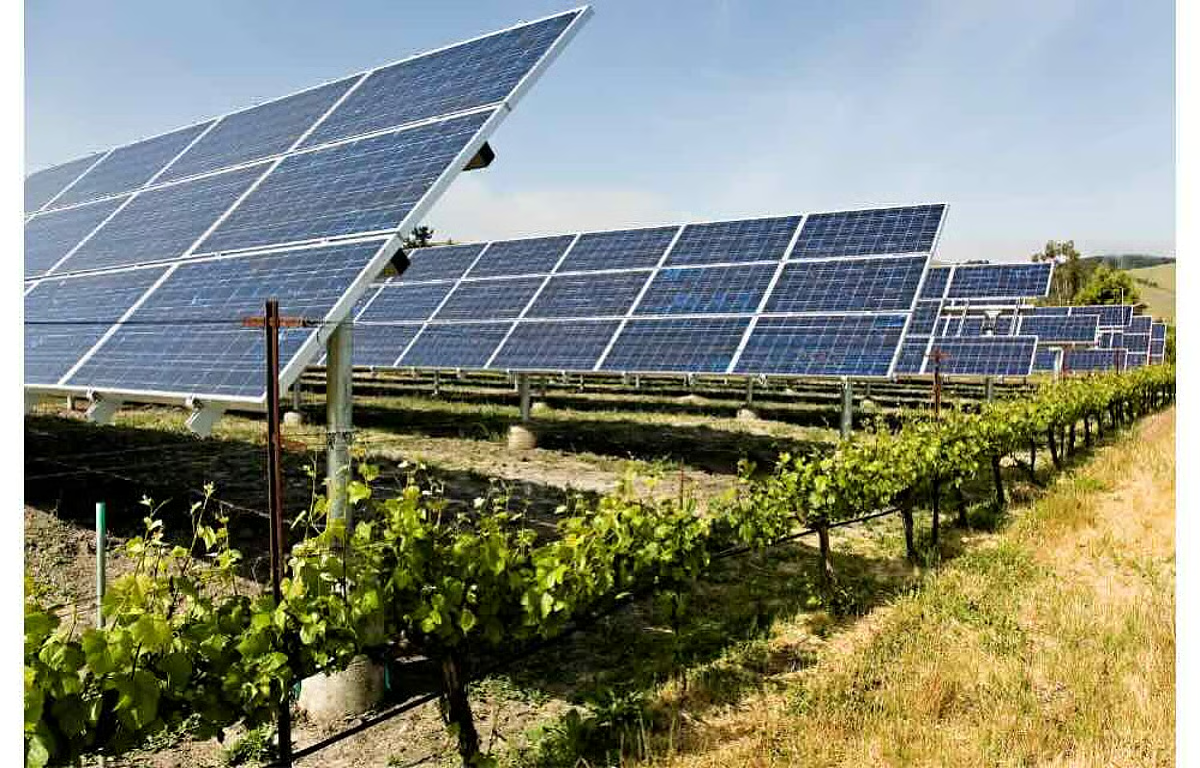
MPC Energy Solutions has agreed to sell the 12.3 MWp Los Girasoles solar farm in Colombia, completing its exit from the country. The buyer was not identified and financial terms were withheld by mutual agreement, with closing expected within days. MPCES developed and built the plant itself and brought it into commercial operation in mid-2023, and it was among the assets held at the company's initial public offering. The sale follows the earlier disposal of its 50 percent stake in the Planeta Rica solar farm to Colombian fuels distributor Terpel. Chief financial officer Stefan Meichsner has given an unusually direct explanation of why the asset had to go.
What is MPCES selling, and what is left?
MPCES is selling Los Girasoles, a 12.3 MWp solar farm operating since mid-2023, and will hold no further assets in Colombia once the transaction closes. Terms were not disclosed. The company recently completed sales of solar farms in Guatemala and El Salvador for US$28.3 million, so the remaining portfolio consists of cash, a 15.8 MWp solar farm in Mexico and a 7 percent equity stake in a US micro-grid developer. Meichsner has said MPCES would like to sell both remaining holdings but expects them to stay on the balance sheet beyond the end of 2026, with Mexico's regulatory situation deterring buyers and the search for a purchaser of the micro-grid stake still under way. What began as a Latin American renewables platform is ending as a cash balance with two residual positions.
What happens when a contracted solar plant underproduces?
A solar plant selling under a power purchase agreement commits to deliver a defined volume of electricity at a fixed price. If irradiation, availability or degradation leave generation short of that commitment, the obligation does not shrink with output. The shortfall has to be covered by buying electricity in the wholesale spot market at whatever price prevails, and that purchase price is uncorrelated with the contract price the plant receives. Meichsner described exactly this at Los Girasoles, saying lower production forced the project to buy more energy on the spot market than it would like and calling it a great cost burden. The effect is that a contracted asset flips from a hedge into a short position: the PPA that was supposed to remove price risk becomes the mechanism that imports it.
Why does this matter more in Colombia than elsewhere?
Because Colombian power prices are driven by hydrology rather than by fuel. The system depends heavily on reservoir hydro, so spot prices move sharply with rainfall and El Niño conditions, and a dry period can lift prices at precisely the moment a solar plant is also underperforming. A generator forced to buy cover in that market faces the worst combination available: short volume and high prices at the same time. Meichsner noted that Los Girasoles produced less year on year while revenue and EBITDA rose in absolute terms on currency movements, which is a revealing pair of facts. The reported earnings improved for reasons unconnected to the plant's performance, while the underlying operating problem worsened.
Enerdatics' data shows how little visibility exists over pricing in this market. Across the 12 Colombian solar transactions recorded since the start of 2023, only one carries both a value and a capacity figure, with total disclosed value across the entire slice amounting to $16.33 million. That is not enough to construct a benchmark, which is part of why terms here were withheld by mutual agreement rather than published. The wider Latin American picture is similarly fragmented: Enerdatics records 53 regional solar transactions since the start of 2024, and no buyer has completed more than three, with the largest counts held by Ardian Infrastructure, Brasol, Empresas Copec, Terpel and TotalEnergies on two apiece. Terpel, which bought the Planeta Rica stake from MPCES, is one of the few repeat acquirers in the region.
What does the deal signal for Latin American solar?
The deal signals that operating risk, not development risk, is what has caught out the listed platforms in Latin America. Los Girasoles was built by its owner, commissioned successfully and ran for three years, and it is still being sold because the contract structure could not absorb a production shortfall. That is a different failure mode from the permitting and interconnection problems that dominate discussion of the segment, and it is harder to diligence, because it only becomes visible after several years of operating data. Expect buyers of contracted Latin American solar to look much more closely at the volume commitment in the PPA and at what happens when it is missed.
For MPCES the sequence is close to a full wind-down. The company has exited El Salvador, Guatemala and now Colombia within a short period, and has stated its intention to sell what remains. Selling assets into a market with almost no disclosed pricing and no deep buyer pool is a difficult way to finish, and the Mexican plant's regulatory obstacle suggests the last positions may take considerably longer to clear than the first ones did.
Key takeaways
- MPC Energy Solutions agreed to sell the 12.3 MWp Los Girasoles solar farm in Colombia, its last asset in the country. The buyer was not identified and terms were withheld by mutual agreement.
- Chief financial officer Stefan Meichsner said lower production forced the project to buy energy on the spot market to cover its obligations, describing it as a significant cost burden.
- Remaining assets after closing consist of cash, a 15.8 MWp solar farm in Mexico and a 7 percent stake in a US micro-grid developer, both of which MPCES expects to hold beyond the end of 2026.
- Enerdatics records 12 Colombian solar transactions since the start of 2023 with just $16.33 million of disclosed value across the whole slice, and only one carrying both value and capacity.
- Enerdatics records 53 Latin American solar transactions since the start of 2024, with no buyer completing more than three, and Terpel among the few repeat acquirers after buying MPCES's Planeta Rica stake.
Frequently asked questions
How much did MPCES sell Los Girasoles for?Financial terms were not disclosed, by mutual agreement between the parties. Colombian solar pricing is largely unobservable: Enerdatics records 12 Colombian solar transactions since the start of 2023 carrying $16.33 million of disclosed value in total, with only one providing both a value and a capacity figure.
Why would a solar farm have to buy electricity?A plant selling under a power purchase agreement commits to deliver a set volume at a fixed price. If generation falls short, the obligation remains, so the shortfall must be covered by buying electricity in the spot market at prevailing prices. That converts a contracted asset into a short position when output disappoints.
What assets does MPCES have left?After the Los Girasoles sale closes, MPCES will hold cash, a 15.8 MWp solar farm in Mexico and a 7 percent equity stake in a US micro-grid developer. The company has said it would like to sell both holdings but expects them to remain on the balance sheet beyond the end of 2026.
Ready to get deal-ready answers in seconds? Try Enerdatics Leap AI and access verified intelligence across M&A, financings, PPAs, projects, and energy market developments through natural language.
.jpeg)


