
Why European Energy's Cerano Solar Exit Lands Where Italy's Coal Transition Has Stalled
.png)
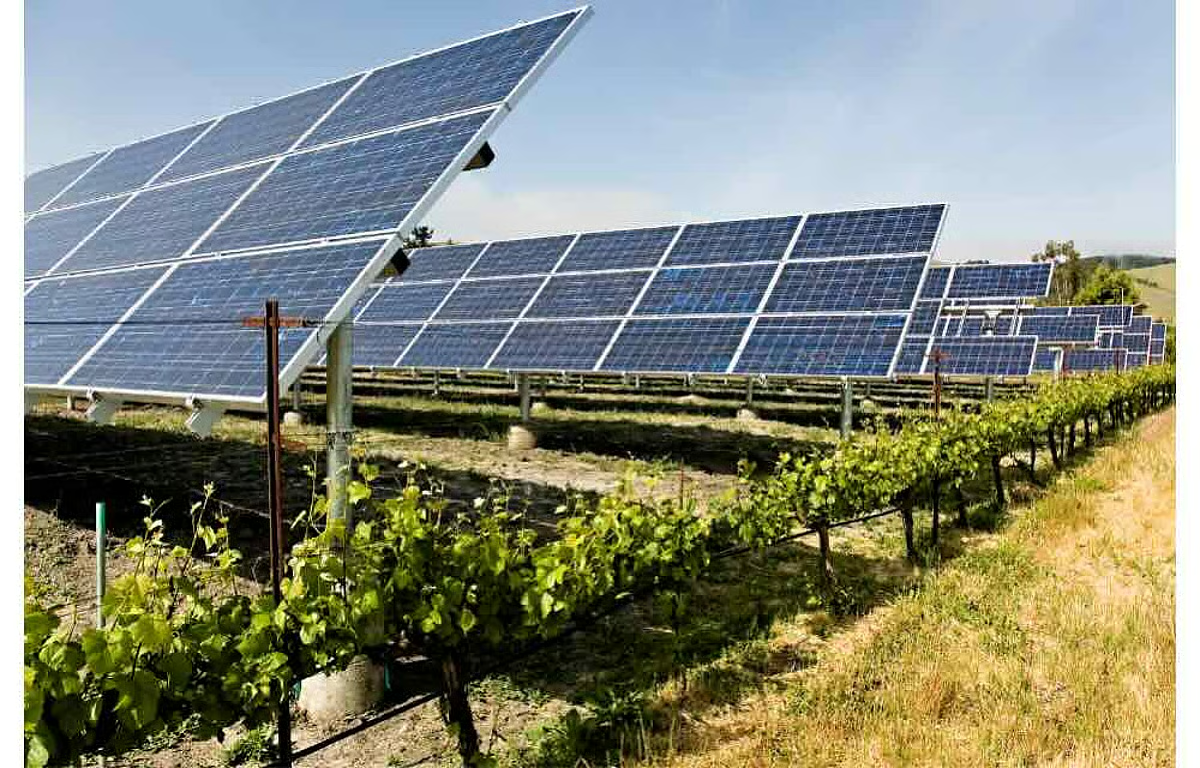
European Energy has completed the divestment of Cerano Energreen, a fully permitted 90 MW solar project at Brindisi in Puglia, southern Italy. The transaction closed on 6 August 2026. The buyer was not named and terms were not disclosed. The project holds all construction and grid connection permits, carries a 20-year contract for difference awarded under Italy's FerX auction scheme, and uses tracker technology, with expected output of roughly 160,000 MWh a year. European Energy developed it on already-industrialised land beside an existing industrial zone. That location is not incidental, because Cerano is where Italy's largest coal plant stands.
What did European Energy sell at Brindisi?
European Energy sold Cerano Energreen in full, a 90 MW single-asset solar project that has obtained every permit required for construction and grid connection. The 20-year FerX contract for difference is the commercial core of the asset, fixing the price for output over two decades and removing exposure to Italian capture prices. Expected generation of around 160,000 MWh a year implies a load factor near 20 percent, consistent with tracker-mounted panels in Puglia. Terms were not disclosed. European Energy, founded in 2004 and based in Copenhagen, runs a development pipeline of roughly 65 GW across more than 20 countries and is separately building the 250 MW Vizzini agrivoltaic project in Sicily.
Where is Cerano, and why does the location matter?
Cerano is the locality in the Brindisi countryside where Enel's Federico II power station sits, a coal-fired plant of 2,640 MW installed capacity across four units, commissioned in the early 1990s on roughly 270 hectares. It is the largest coal plant in Italy and among the largest in Europe, and it has ranked among the continent's heaviest emitters. Italy set a coal phase-out target of 2025, and Brindisi has been idle since 2024 with its environmental authorisations expiring at the end of 2025. In March 2026, however, the lower house of the Italian parliament passed a bill that would push permanent retirement of the country's remaining coal plants to 2038. A 90 MW solar park has therefore just changed hands on industrial land next to a coal station whose closure has been deferred by thirteen years.
Why does a contract for difference matter more here than the megawatts?
Because the FerX contract is what makes this asset financeable in a region with an unresolved generation future. A contract for difference fixes the price received for output over the contract term, with the counterparty paying the difference when market prices fall below the strike and receiving it when they rise above. For a project in Puglia, where solar penetration is high and midday capture prices are under pressure, twenty years of price certainty is the difference between a bankable asset and a merchant bet. It also insulates the buyer from whatever happens to the coal site next door, since neither a gas conversion nor a prolonged coal extension changes what this plant is paid. Permits, grid connection and a two-decade contract together are the package, and the 90 MW is simply the unit those attach to.
Enerdatics' data shows the scale gap this transaction sits inside. Cerano Energreen's 90 MW is about 3 percent of Federico II's 2,640 MW of installed coal capacity, and its expected 160,000 MWh a year is roughly 1 percent of the 13 TWh that plant generated in 2022 when the government maximised coal output during the gas crisis. Replacing a single large thermal station with contracted solar at this rate would require dozens of comparable projects. European Energy is itself an active seller in this mode, ranking among the more frequent European disposers in Enerdatics' records with nine wind divestments since the start of 2024 carrying $236.81 million of disclosed value, alongside its solar activity. The develop, permit and sell model is running at pace, but the arithmetic against retiring thermal capacity is not close.
What does the deal signal for Italian solar?
The deal signals that the land and grid infrastructure around Italy's fossil sites is becoming the preferred place to build, well before those sites actually close. Developing on already-industrialised ground limits new land consumption, eases local consent in a province long defined by heavy generation, and places projects near existing network capacity. That is a repeatable template, and it does not depend on the coal plant retiring on schedule. Expect more permitted solar to be sold on this footing in Puglia and Sardinia, and expect buyers to treat proximity to legacy generation infrastructure as an asset rather than a complication.
The wider point concerns what "energy transition" means in a place like Brindisi. The province is not swapping coal for solar in any direct sense: the coal plant is idle but legally alive to 2038, a gas conversion has been proposed, reduced and contested, and the renewable capacity arriving alongside is a fraction of what is being displaced. What has changed is who is investing. European Energy built and sold a contracted asset in three steps, and an infrastructure buyer now owns twenty years of fixed-price revenue on the same ground. That is a smaller claim than a transition, but it is a real one.
Key takeaways
- European Energy completed the sale of Cerano Energreen, a fully permitted 90 MW solar project at Brindisi in Puglia, on 6 August 2026. The buyer was not named and terms were not disclosed.
- The project holds all construction and grid permits and a 20-year contract for difference under Italy's FerX scheme, with expected output of roughly 160,000 MWh a year, implying a load factor near 20 percent.
- Cerano is the site of Enel's Federico II coal plant, 2,640 MW across four units on around 270 hectares, Italy's largest and among Europe's heaviest-emitting.
- Brindisi's coal units have been idle since 2024 and their environmental authorisations expired at the end of 2025, but a bill passed by Italy's lower house in March 2026 would defer permanent coal retirement to 2038.
- The solar park's 90 MW is about 3 percent of Federico II's installed capacity, and its expected annual output is roughly 1 percent of the 13 TWh the coal plant produced in 2022.
Frequently asked questions
How much did European Energy sell the Cerano solar park for?Terms were not disclosed and the buyer was not named. European Energy said the level of interest confirmed the attractiveness of well-developed Italian renewable projects, and the transaction closed on 6 August 2026.
What is a FerX contract for difference?FerX is Italy's renewable support scheme, under which projects are awarded a contract fixing the price received for their output over a defined term, here 20 years. The counterparty pays the difference when market prices fall below the strike price and receives it when prices rise above, so the plant's revenue is insulated from wholesale movements.
What is the Federico II power plant at Cerano?Federico II is Enel's coal-fired power station at Cerano near Brindisi, with 2,640 MW of installed capacity across four units on roughly 270 hectares, commissioned in the early 1990s. It is Italy's largest coal plant, has been idle since 2024, and its permanent retirement may be deferred to 2038 under legislation passed by Italy's lower house in March 2026.
Ready to get deal-ready answers in seconds? Try Enerdatics Leap AI and access verified intelligence across M&A, financings, PPAs, projects, and energy market developments through natural language.
.jpeg)


