PNE Hands Over a 153 MW Polish Wind Project It Must Still Develop
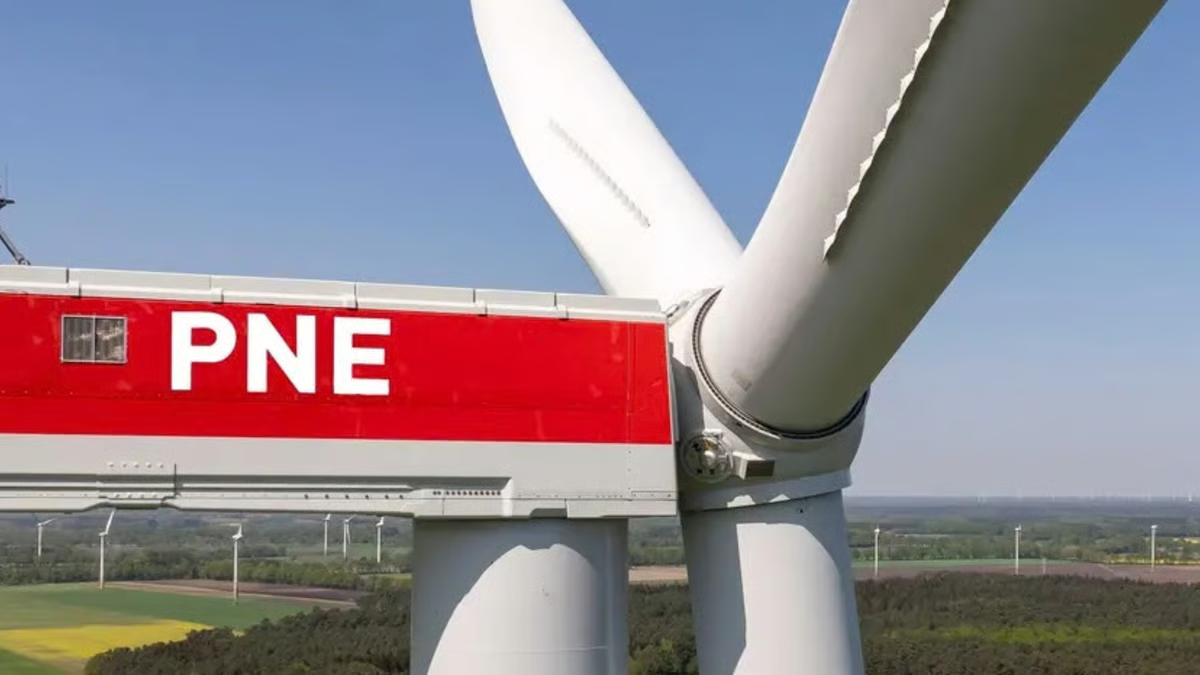
PNE Group has sold the 153 MW Karolew wind project in southwest Poland to a global energy utility. Twenty-one turbines, a secured site, a buyer willing to sign now. The project will not reach Ready-to-Build status until 2029 and will not generate power until 2031. The party that has to get it there is the one that just sold it.
Key takeaways
- PNE Group, through its Polish subsidiary PNE Polska, has sold the 153 MW Karolew onshore wind project in southwest Poland to an unnamed global energy utility. The transaction was announced on 29 September 2026 and the consideration was not disclosed.
- The Karolew project comprises 21 wind turbines and is scheduled to reach Ready-to-Build status in 2029, with commissioning planned for 2031, roughly five years after the sale.
- PNE Polska will continue to develop Karolew after the sale until the project reaches Ready-to-Build, so ownership has transferred years ahead of development responsibility.
- Karolew is PNE Polska's third project sale in Poland during 2026, and Dentons acted as legal advisor to PNE Group on the transaction.
- Enerdatics records 23 Polish wind transactions since the start of 2024, of which 11 carry a disclosed value, and priced development-stage deals among them range from roughly $0.24 million per MW to roughly $2.59 million per MW.
What did the buyer actually acquire at Karolew?
It acquired a position, not a power plant, and not the team that will build one. Karolew is an early-stage development project of 153 MW across 21 turbines in southwest Poland. Ready-to-Build status, the point at which every permit and grid right is in place and construction can begin, is not expected until 2029. Commissioning is planned for 2031.
That leaves a gap of about five years between the signature and the first megawatt hour. During that gap the development work stays with PNE Polska, which will carry the project through to Ready-to-Build on the new owner's behalf. The buyer is recorded only as a global energy utility, with no name disclosed.
So the asset changing hands is a claim on a site, a turbine layout and a development programme someone else is running. What the buyer removes from its own to-do list is origination. What it takes on is time.
Why would a utility buy a project it cannot build until 2029?
Because in Polish onshore wind the binding constraint is not capital, it is a site that will eventually clear permitting and grid connection. A utility that waits until projects are buildable competes for them against everyone else who waited. One that signs at early stage is buying scarcity before the scarcity is visible in the price.
The Enerdatics record shows this is ordinary behaviour in this market rather than an outlier. Of the 23 Polish wind transactions since the start of 2024, 12 involved assets still under development, nine were operational and two were in construction. More than half of recorded Polish wind dealmaking happens before the asset exists. What makes Karolew unusual is not that it sold early but how early: a 2029 Ready-to-Build date is at the far end of that distribution.
The structure is also one PNE has used before in this exact market. The company sold the 72 MW Legnica wind project in Poland on the same basis in March 2026, exiting ahead of Ready-to-Build while keeping the development work. The seller recycles capital years earlier than a conventional exit would allow, and defends the price by staying on the hook for delivery.
What does the price range for development-stage Polish wind tell us?
That there is no single number, which is the most likely reason this one went undisclosed. Among the priced development-stage Polish wind deals Enerdatics records since the start of 2024, the ZE PAK and Cyfrowy Polsat purchase of the roughly 500 MW Opole wind farm in June 2024 works out at about $0.24 million per MW. Energa's purchase of the 37.4 MW Szybowice wind farm in March 2024 and Unimot's purchase of the 34.2 MW Gostynin project in June 2026 both land near $0.39 million per MW. Tauron's acquisition of the 190.8 MW Miejska Gorka wind farm in September 2024 sits at about $2.59 million per MW.
That is a spread of almost eleven times within one country, one technology and one lifecycle label. The label is doing very little work. "Under development" covers a project five years from Ready-to-Build and a project a few months from it, and the price gap between those two states is most of the value in the asset. Karolew sits at the early end of that ladder, which is the part of the range where disclosure helps a seller least.
It is also consistent with how PNE transacts generally. The company sold two German repowering wind farms to private investors in August 2026 without disclosing terms either. Across 12 European wind divestments by PNE since the start of 2024, covering 1,509.5 MW, just $10 million of value has been disclosed.
Enerdatics records a sharper contrast on the operational side of the same Polish market. Enea's purchase of an 86.15 MW wind and solar portfolio from European Energy in March 2025 priced at about $2.75 million per MW, its 83.2 MW Pelplin acquisition in April 2025 at about $2.43 million per MW, and PPC Group's 277.3 MW purchase from EDP Renewables in July 2026 at about $1.04 million per MW. Operating Polish wind therefore clears in a band of roughly $1 million to $2.75 million per MW, while development-stage assets start near a quarter of a million. The five years PNE has agreed to work through are the years in which that difference is earned.
What does the deal signal for Polish wind?
It signals that the Polish market now prices developer retention as part of the asset. A buyer taking a 2031 commissioning date is underwriting a development programme more than a project, and the credibility of that programme rests on who is running it. PNE staying in place until Ready-to-Build is what makes a five-year runway financeable rather than speculative.
For developers, the implication is that an early exit no longer has to mean an early-stage discount, provided the seller is willing to keep delivering after closing. For utilities, it means the queue for buildable Polish wind can be joined years upstream, at a price that the Enerdatics range suggests is a fraction of the ready-to-build level. Expect more Polish wind to trade at this end of the curve, and expect the development agreement attached to it to carry more of the negotiation than the megawatts do.
Frequently asked questions
How much did the buyer pay for the Karolew wind project?The consideration was not disclosed. That is common at this stage of the Polish market: Enerdatics records 23 Polish wind transactions since the start of 2024, and among the priced development-stage deals the range runs from roughly $0.24 million per MW to roughly $2.59 million per MW, so a single benchmark figure would be misleading.
What does Ready-to-Build mean in wind development?Ready-to-Build is the stage at which a project holds the permits, grid connection rights and approvals it needs for construction to start. Karolew is scheduled to reach that point in 2029, with commissioning planned for 2031, which is why the sale transfers a development programme rather than a buildable asset.
Who will develop Karolew now that it has been sold?PNE Polska will continue to develop the project after the sale until it reaches Ready-to-Build status. Ownership has passed to the buyer, an unnamed global energy utility, while the development work and the delivery milestones remain with PNE.
Ready to get deal-ready answers in seconds? Try Enerdatics Leap AI and access verified intelligence across M&A, financings, PPAs, projects, and energy market developments through natural language.