Macquarie Capital is taking a minority stake in two Scottish batteries totalling 600 MW. Both are under construction, both have senior debt closed, and both have a contract that pays them a minimum regardless of what the market does. Whatever Macquarie is buying, it is not what most people think a UK battery investor buys.
Key takeaways
- Macquarie Group, through Macquarie Capital, agreed on 16 November 2026 to acquire a minority stake in a 600 MW and 1,200 MWh UK battery portfolio from Carlyle-backed Revera Energy, with no consideration disclosed and Revera retaining majority ownership and control of construction and operations.
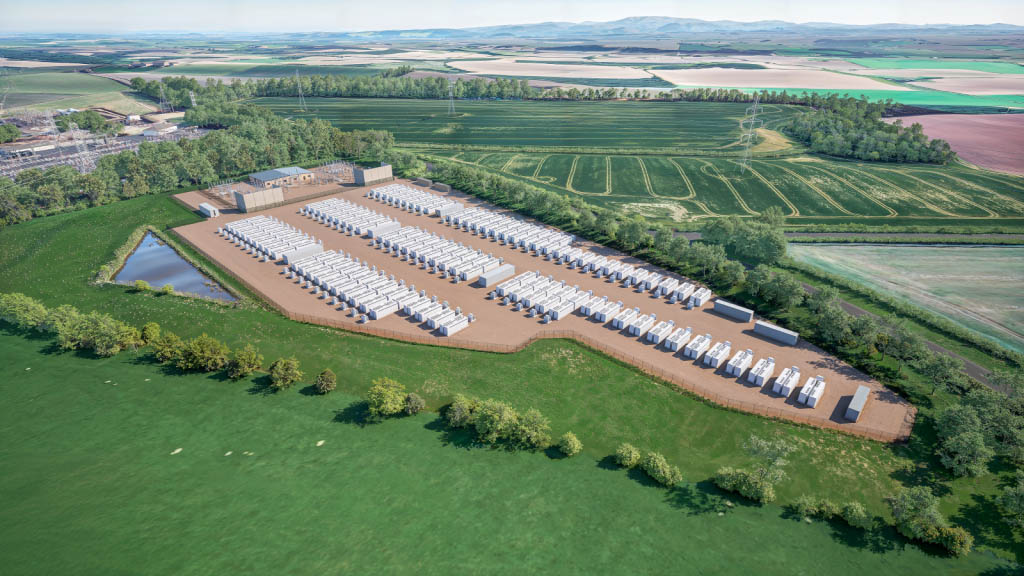
- The portfolio is two transmission-connected Scottish projects: the 200 MW and 400 MWh Windyhill battery at Bearsden near Glasgow, and the 400 MW and 800 MWh Hunterston battery in North Ayrshire beside the decommissioned Hunterston nuclear plants.
- Windyhill holds a 10-year trading and optimisation agreement with Danske Commodities that includes a revenue floor covering 100 percent of project capacity, and Hunterston holds a long-term revenue floor with Danske Commodities alongside a long-term tolling arrangement with bp.
- Both projects secured 15-year Capacity Market agreements in the UK 2026/27 T-4 auction, with de-rated capacities of 45.860 MW for Windyhill and 91.720 MW for Hunterston, together 137.58 MW or about 22.9 percent of the 600 MW nameplate.
- Enerdatics records 61 UK battery storage M&A transactions since the start of 2024 covering about 57.7 GW, of which 15 carry a disclosed value.
What is a revenue floor, and why does one change the risk on a battery?
A revenue floor is a contractual minimum: an optimiser or trading counterparty agrees that the project will earn no less than an agreed amount over a period, whatever the battery actually makes in the wholesale and balancing markets. The optimiser keeps or shares the upside in exchange. It is the difference between owning a merchant asset and owning something closer to a contracted one.
UK batteries have historically been bought as merchant bets. Revenue comes from arbitrage, balancing services and the Capacity Market, and the first two are volatile enough that the standard underwriting exercise is a view on future price spreads. A floor removes most of that exercise. Windyhill's floor covers 100 percent of project capacity for 10 years, so a buyer of equity there is not primarily taking a spread view. Hunterston goes further, pairing a long-term floor with a tolling arrangement under which bp effectively rents the battery's capacity. Both assets were substantially de-risked before Macquarie arrived.
How much of the 600 MW does the Capacity Market actually pay for?
Less than a quarter of it, and that is the system working as designed rather than a shortfall. The UK Capacity Market pays for firm capacity available at times of system stress, and it de-rates storage by how long the asset can sustain output. A two-hour battery receives credit for a fraction of its power rating because it cannot hold that output through a long stress event. Both projects are two-hour units: 200 MW over 400 MWh, and 400 MW over 800 MWh.
The de-rated figures follow from that. Windyhill holds a 15-year agreement for 45.860 MW and Hunterston for 91.720 MW, a combined 137.58 MW against 600 MW of nameplate, or about 22.9 percent. The 2026/27 T-4 auction cleared at 63.00 pounds per kW per year, adjusted for inflation to 76.29 pounds for the 2026/27 delivery year. Applied to the combined de-rated capacity that is roughly 10.5 million pounds a year, indexed and running for 15 years. It is a floor beneath the floor rather than the main event, and it is why capacity pricing has become the thing UK battery buyers watch: the same mechanism produced two near-identical Scottish batteries clearing at less than half each other's price in consecutive auctions.
What does a minority stake with no disclosed price leave visible?
The debt, which is disclosed, and very little else. Hunterston closed 200 million pounds, about $267.1 million, of non-recourse senior debt in September 2026 from Santander, Barclays, Commonwealth Bank of Australia and NatWest. That is about 0.5 million pounds per MW of nameplate on a project that took final investment decision in June 2026 and targets operation in the third quarter of 2028. Windyhill closed non-recourse senior debt from Santander in February 2026 at an undisclosed amount, reached notice to proceed the same month and started construction in August 2026 for operation in the fourth quarter of 2027.
What the transaction does not show is the equity price, and the structure makes that harder to infer than usual. Revera keeps majority ownership and continues to run construction and operations, so Macquarie is buying a minority position in assets it does not control, with scope to invest further across Revera's UK portfolio including the 400 MW Kincardine project. A minority stake has to be grossed up to a 100 percent basis before it can be compared against nameplate capacity, and without a percentage that calculation cannot be done. Consideration here is also frequently structured rather than paid in cash, as Econergy's purchase of 106 MW of English batteries through a shareholder loan repayment showed in October 2026.
Enerdatics records 61 UK battery storage M&A transactions since the start of 2024, representing about 57.7 GW, of which 15 carry a disclosed value. Among the closest comparables, UK lithium-ion battery deals in the 450 to 750 MW range announced since November 2024, Enerdatics lists nine transactions and exactly one is priced: AIP Management's acquisition of a 700 MW portfolio from BW Group in September 2025 at about $429.1 million, or $0.61 million per MW. Nine transactions and one price is the benchmark problem in this market, and it is why contract structure rather than the comparable set tells you how a deal was underwritten.
What does the deal signal for UK battery storage?
It signals that institutional capital is entering UK storage through contracted structures rather than merchant exposure. A floor covering 100 percent of capacity, a tolling arrangement with an oil major and a 15-year indexed Capacity Market agreement together describe an asset bought for cash flow certainty. That is the profile infrastructure funds and bank lenders can underwrite, and it is why four banks wrote 200 million pounds of non-recourse debt against Hunterston before it operates.
The second signal is capital recycling. Revera acquired these projects as part of its purchase of Amp Energy's UK and Australian businesses in 2025, and selling a minority stake in assets under construction lets it move capital into new development without giving up control or operational fees. Its holding-company credit facility went from $150 million in February 2026 to $300 million in October 2026, with Santander and Barclays joining Nomura. Partial sell-downs at construction stage, rather than exits at commercial operation, look like how platforms of this size will fund their next tranche of pipeline.
Frequently asked questions
What did Macquarie buy from Revera Energy?A minority stake in a 600 MW and 1,200 MWh UK battery portfolio, structured as a strategic joint venture and announced on 16 November 2026. The assets are the 200 MW Windyhill and 400 MW Hunterston projects in Scotland, both under construction. No consideration was disclosed and Revera retains majority ownership.
How much Capacity Market revenue do the projects earn?Both hold 15-year agreements from the 2026/27 T-4 auction, with de-rated capacities of 45.860 MW and 91.720 MW. The auction cleared at 63.00 pounds per kW per year, inflation-adjusted to 76.29 pounds, which is roughly 10.5 million pounds a year across the two.
What do UK battery portfolios sell for per MW?Disclosed prices are scarce. Enerdatics records 61 UK battery M&A transactions since the start of 2024 with 15 disclosed values. The one priced comparable in the 450 to 750 MW range since November 2024 is AIP Management's 700 MW purchase from BW Group at about $0.61 million per MW.
Ready to get deal-ready answers in seconds? Try Enerdatics Leap AI and access verified intelligence across M&A, financings, PPAs, projects and energy market developments through natural language.