Inside the Motorway Rule That Shapes RP Global's German Solar Deal
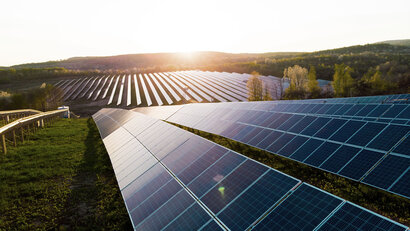
RP Global has bought a 22.2 MW solar project in Rhineland-Palatinate from the developer GAIA. It is not one solar farm. It is three neighbouring plots in three different municipalities, totalling 17.9 hectares, strung along the A6 motorway between Kaiserslautern and Mannheim. Fragmented land on a noisy verge looks like the compromise in this deal. It is the reason the deal exists.
Key takeaways
- RP Global has acquired the 22.2 MW A6 Leiningerland solar project in Rhineland-Palatinate, Germany, from developer GAIA mbH. The transaction was announced on 29 September 2026 and the consideration was not disclosed.
- The project is made up of three neighbouring sites in the municipalities of Hettenleidelheim, Tiefenthal and Neuleiningen, spanning 17.9 hectares along the A6 motorway corridor between Kaiserslautern and Mannheim.
- A6 Leiningerland is at Ready-to-Build stage with all key permits secured, with construction scheduled to begin in early 2027 and commissioning planned for the second half of 2027.
- The project is expected to receive remuneration under Germany's Renewable Energy Sources Act because its position alongside the A6 motorway qualifies as a privileged location, a category of land the EEG treats as eligible for ground-mount solar support.
- Enerdatics records 66 German solar transactions since the start of 2024, of which only six carry a disclosed value, and every disclosed asset-level price among them belongs to a single seller, Orron Energy, in a band of roughly $61,000 to $72,000 per MW.
What makes a strip of land beside a motorway worth building on?
Eligibility, not sunshine. A privileged location under the German Renewable Energy Sources Act, the EEG, is land that the statute designates as suitable for ground-mount solar support, which not all land is. Verges and corridors alongside motorways and railways fall into that category. An ordinary field a kilometre inland, with identical irradiation and a shorter cable run, may not.
That inverts the usual order of inputs. Developers are accustomed to screening for irradiation first, then grid, then land. In Germany the screen that eliminates the most sites is the legal status of the ground. Once that is the binding constraint, the asset being traded is not really a solar farm. It is a parcel of qualifying land with a permit attached, and the generating equipment is the easy part.
It also explains why RP Global is buying rather than originating. GAIA carried A6 Leiningerland from early planning through permitting to Ready-to-Build, the stage at which every consent needed for construction is in place. Finding the qualifying strip and proving it out is the scarce skill. GAIA will stay involved after the handover to support further optimisation of the project.
Why is a 22 MW project split across three municipalities?
Because qualifying land comes in strips, and a strip is not large enough. Hettenleidelheim, Tiefenthal and Neuleiningen are adjacent, and the corridor runs through all three. To assemble 22.2 MW along it, the developer had to deal with three sets of local approvals rather than one.
The arithmetic shows how tightly the land is used. On 17.9 hectares, 22.2 MW works out at roughly 1.2 MW a hectare. Corridor sites do not offer the option of spreading out, so the layout has to be compact, and the trade-off a developer would normally make between density and yield is partly made for them by the shape of the plot.
The fragmentation is also why the permitting work is the value. Three municipalities mean three planning processes, three councils and three timelines, any one of which could have stalled the whole project. A buyer stepping in at Ready-to-Build acquires the outcome of that process without having run it. RP Global and GAIA say they intend to add a battery storage system to the site, both to handle periods of grid congestion and with an eye to future changes in the EEG, though that addition is an intention at this stage rather than a committed build.
What does Germany's disclosure record say about what this cost?
Almost nothing, and the emptiness is the finding. Enerdatics records 66 German solar transactions since the start of 2024. Six of them carry a disclosed value. Two of those six are corporate deals at a completely different scale, the $5.15 billion KKR and Viessmann acquisition of Encavis and BlackRock's $200 million purchase of ENVIRIA. One is a European platform sale. That leaves three disclosed single-asset prices in nearly three years of German solar dealmaking.
All three belong to Orron Energy. Its 234 MW sale to Gulermak Renewables in December 2025 prices at about $70,000 per MW, its 91 MW sale to the same buyer in April 2026 at about $72,000 per MW, and its 76 MW sale to Saxovent Renewables in July 2025 at about $61,000 per MW. A market this large with one seller supplying the entire visible price curve is not a benchmark. It is a single data point repeated three times.
Enerdatics' data shows the pattern is structural rather than a gap in one year's records. Across those 66 German solar transactions, disclosure sits below one in ten, and the undisclosed majority spans everything from 3.5 MW municipal parks to 2 GW developer platforms. Against that, Germany's nearest useful reference points are revenue structures rather than prices: a 70.4 MWp Brandenburg park carrying a 20-year EEG feed-in tariff, and a 24.4 MWp park combining EEG revenue with a pay-as-produced PPA. What the market discloses is how a project earns, not what it sold for. Orron Energy's German solar disposals are the exception that proves it.
What does the deal signal for German solar?
It signals that German solar M&A is increasingly a land-eligibility trade dressed as a generation trade. A buyer underwriting A6 Leiningerland is underwriting the durability of a statutory land category and the permits that flow from it, not a view on irradiation or power prices. That favours buyers who can read German planning law and sellers who can find qualifying ground, and it pushes the value in a project upstream of anything physical.
RP Global is assembling at exactly that level. Enerdatics records three German solar acquisitions by the company in 2026: the 15 MW Schontal and Widdern projects from Vattenfall in March, the 50 MW Harbke project in April, and now 22.2 MW at A6 Leiningerland in September. That is 87.2 MW in six months, built from projects of 15 to 50 MW rather than one large site. Expect that shape to persist. Where the constraint is eligible land, portfolios grow by accumulating small permitted parcels, and the developers who can source them keep a seat at the table after the sale.
Frequently asked questions
What is a privileged location under the German EEG?It is a category of land that Germany's Renewable Energy Sources Act treats as eligible for ground-mount solar remuneration, including verges and corridors alongside motorways and railways. A6 Leiningerland is expected to benefit from EEG remuneration because its position along the A6 motorway falls into that category.
How much did RP Global pay for A6 Leiningerland?The consideration was not disclosed. Disclosure is rare in this market: Enerdatics records 66 German solar transactions since the start of 2024 and only six carry a disclosed value, of which just three are single-asset prices, all from Orron Energy at roughly $61,000 to $72,000 per MW.
When will the A6 Leiningerland solar project be built?Construction is scheduled to begin in early 2027, with commissioning planned for the second half of 2027. The project is already at Ready-to-Build stage with all key permits secured, having been developed to that point by GAIA before the sale.
Ready to get deal-ready answers in seconds? Try Enerdatics Leap AI and access verified intelligence across M&A, financings, PPAs, projects, and energy market developments through natural language.