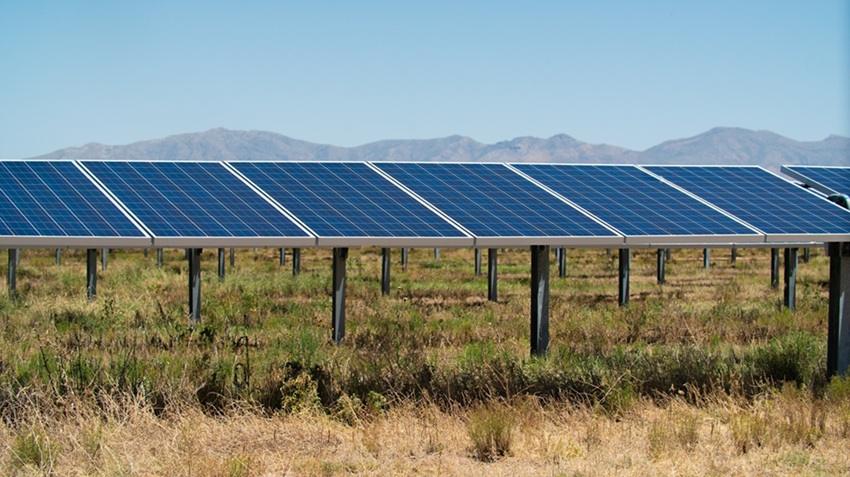
Ellomay Capital has contracted most of the output of a small solar project in Limestone County, Texas. The company puts the effective price at about $110 per MWh, well above what ERCOT solar normally clears. The figure includes something that is not electricity.
Key takeaways
- Ellomay Capital signed power purchase agreements announced on 23 November 2026 covering roughly 70 percent of the generation of the Mexia solar project, an 11 MWdc and 8 MWac plant in Limestone County, Texas.
- The contracts run for six years from the commercial operation date of the offtaker's facility, and the offtaker can extend them by up to three further five-year periods, giving a maximum term of 21 years.
- Ellomay puts the effective price at about $110 per MWh, a figure the company states includes ground lease revenue alongside the energy payment, with no split disclosed between the two.
- The agreements cover energy only, and Ellomay retains the renewable energy certificates the project produces.
- Roughly 30 percent of Mexia's output is left to be sold into the ERCOT wholesale market, and the offtaker is not named.
Why does a six-year solar contract count as short?
A power purchase agreement, or PPA, is a contract under which a generator sells electricity at an agreed price for an agreed period. For utility-scale solar that period is usually long, because the lenders who fund construction want contracted revenue across most of the debt term. Fifteen years is the common shape in Texas and twenty is not unusual.
Six years does not cover a standard project debt tenor, and that changes what the contract is for. It is not the instrument that makes a plant financeable for its whole life. It is a bridge across the first years of operation, after which Ellomay has to recontract or run the project merchant. Measured against the market the term sits at the far edge of the distribution: of the ERCOT solar contracts since the start of 2024 that state a duration, only three are six years or shorter.
The extension options change the picture without removing the risk. Three further five-year periods would carry the arrangement to 21 years, longer than most of the market. But those options sit with the offtaker, not with Ellomay. The generator has secured six years of certainty and accepted fifteen further years of someone else's discretion.
What does an effective price of about $110 per MWh actually pay for?
Ellomay describes the figure as an effective price and states that it includes ground lease revenue as well as the payment for energy. Those are two different revenue lines. One is paid for electricity delivered and rises and falls with generation. The other is rent, and it does not.
The arithmetic consequence is worth stating plainly. If a blended figure of about $110 per MWh contains rent, the price paid for energy alone is below $110 per MWh. Ellomay does not break the two apart, so how far below is not known from the disclosure. Anyone setting $110 against other Texas solar contracts would be comparing a blended number with energy-only numbers, and would read this project as expensive when the energy component may not be.
The energy price is fixed per MWh with annual fixed updates, which means it steps up on a set schedule rather than tracking inflation or the wholesale market. That shape is favourable to the generator when power prices fall and costly when they rise.
Who carries the price risk on the rest of the output?
Ellomay does. The contracts cover about 70 percent of Mexia's generation and the balance goes into the ERCOT wholesale market at whatever that market sets, hour by hour. For a plant of 8 MWac the absolute exposure is small. The proportion is not.
The certificates are a separate matter. The agreements convey energy only, and Ellomay keeps the renewable energy certificates, which are the tradable proof that a MWh was generated from a renewable source. That is the reverse of the structure under which Treaty Oak contracted the environmental attributes of two Louisiana solar projects to Meta. An offtaker that wants a clean-energy claim needs the certificates. This one is buying electricity.
One term shifts timing risk rather than price risk, and it is easy to miss. The six years run from the commercial operation date of the offtaker's facility, not from Mexia's own. If the offtaker's plant is late, the contract starts late, and the project sells into the wholesale market in the meantime.
Enerdatics records 106 solar PPAs in ERCOT since the start of 2024. Thirty-four of them state a contract duration, and 15 of those run for 15 years or longer. Only three run for six years or less, and the Mexia agreements are among them; the other two are five-year contracts on a single project, Impact solar. Across the 60 most recent of the 106, not one carries a disclosed tariff, which is why Ellomay's own figure deserves reading carefully rather than taking as a market price.
What does the deal signal for ERCOT solar offtake?
It shows what a small project does when the long contracts are not available to it. The large ERCOT solar PPAs of the past two years have been signed by hyperscale technology buyers and industrial groups taking hundreds of megawatts at a time, and they run fifteen years because the counterparties are large enough to promise that. An 8 MWac plant in Limestone County is not in that queue. What it can reach is a shorter contract with a single local counterparty, priced in a way that bundles whatever else the site can earn.
That has a consequence for how these assets should be valued. A blended revenue figure with rent inside it does not transfer to a buyer the way an energy tariff does, and a six-year term with options held by the offtaker is a weaker asset than a six-year term with options held by the owner. Texas remains the deepest solar market in the United States, and the gap between how the largest projects contract and how the smallest ones do is widening. The same market that produced the largest solar construction package Enerdatics records on one site in ERCOT is also producing six-year contracts on 8 MWac plants, and the two tell different stories about where offtake risk is settling.
Frequently asked questions
How long is the Mexia solar PPA?Six years, running from the commercial operation date of the offtaker's facility rather than from the solar project's own. The offtaker holds options to extend by up to three further five-year periods, which would give a maximum term of 21 years.
Does the $110 per MWh figure represent the energy price?No. Ellomay describes it as an effective price that includes ground lease revenue alongside the energy payment. The company does not disclose the split, so the energy-only price is lower than $110 per MWh by an undisclosed margin.
Who buys the power from the Mexia solar project?The offtaker is not disclosed. What is known is that the contracts cover roughly 70 percent of generation, convey energy only, and leave the renewable energy certificates with Ellomay, which retains them.
Enerdatics tracks every renewable energy PPA, financing and acquisition across the United States and Europe, with contract terms, tariffs where disclosed and the comparables that put a single deal in context. See how Enerdatics covers the market.