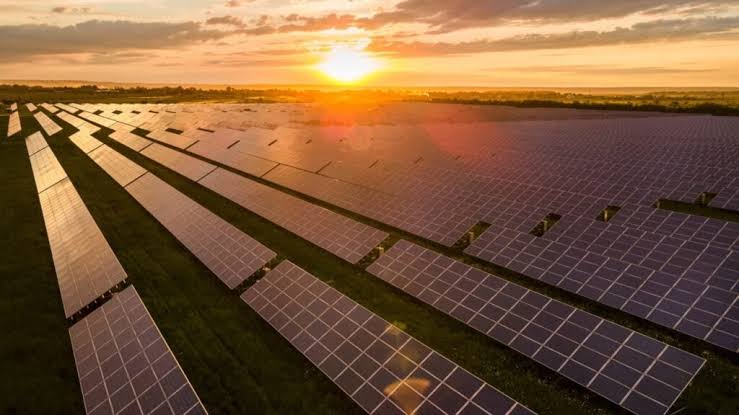
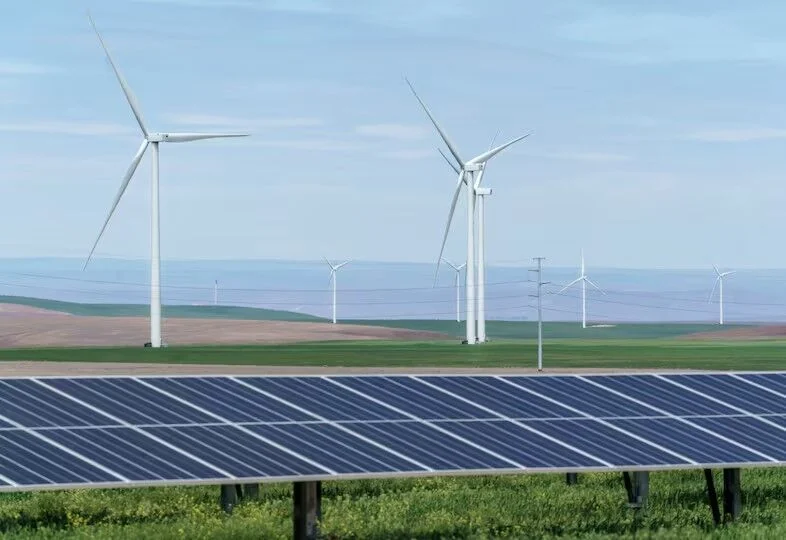
EDF Renewables has signed two 20-year contracts with the Southern California Public Power Authority for its Bonanza project in Nevada, one for solar and one for a battery. Both serve the same two city utilities and run for the same term. Only one of them comes with a price. It is not the one selling electricity.
Key takeaways
- EDF Renewables North America signed a 20-year power purchase agreement with the Southern California Public Power Authority (SCPPA) in February 2024 for 125 MWac from the 300 MWac Bonanza solar project in Clark County, Nevada, delivering 303.5 GWh a year with PCC1 renewable energy credits.
- Pasadena Water & Power takes 105 MW and Azusa Light & Water 20 MW of the Bonanza solar contract, with delivery guaranteed by 31 December 2028.
- A separate 20-year resource adequacy agreement covers 65 MW of the co-located 195 MW, four-hour Bonanza battery at $16.84 per kW-month, split 55 MW to Pasadena Water & Power and 10 MW to Azusa Light & Water.
- At $16.84 per kW-month, the 65 MW Bonanza battery contract is worth about $13.1 million a year to EDF, while the price of the 125 MW solar contract has not been disclosed.
- Enerdatics records eight power purchase agreements signed by SCPPA, four of them with EDF as supplier, and only two of the eight disclose a price.
Why is the battery priced per kilowatt rather than per megawatt-hour?
Because the utilities are not buying its energy. A resource adequacy agreement pays a resource for being available to supply power at peak demand. California load-serving entities must show they hold enough of this capacity to cover their peak, plus a margin. A four-hour battery qualifies because it can discharge at full power through the evening peak, when solar output falls away.
So the payment is fixed per kilowatt of capacity per month, whatever the battery actually does. On 65 MW at $16.84 per kW-month, that comes to about $13.1 million a year. Over 20 years, and if the rate stays flat, it is a little over $260 million. The record does not say whether the price escalates. Either way, it is revenue EDF can count on regardless of how often the battery cycles or what power costs in the evening.
What do the two utilities actually get from Bonanza?
A matched pair. Pasadena takes 105 MW of solar and 55 MW of battery capacity, about 84 and 85 percent of each contract. Azusa takes 20 MW of solar and 10 MW of storage. The split is almost identical across both technologies, which tells you the contracts were designed as one supply arrangement and sold as two.
The solar half delivers volume. 303.5 GWh a year from 125 MWac works out at a capacity factor of about 28 percent. It also carries PCC1 credits, the top category of renewable energy credit in California, which count toward a utility's renewable target. The battery half covers the hours the solar cannot. Together, they let two small municipal utilities buy something close to a firm renewable supply without owning or operating any of it.
Buying through SCPPA matters for the same reason. Pasadena and Azusa together take 125 MW of a 300 MW solar project, far less than the whole. A joint buyer can sign the contract, allocate the volume between members in proportion to their needs and give the developer a single creditworthy counterparty. Both Bonanza contracts follow that template, and they share one delivery deadline.
How much of Bonanza is still uncontracted?
Most of it, on the solar side. SCPPA's 125 MWac is about 42 percent of the project's 300 MWac. Its 65 MW of battery capacity is a third of the 195 MW battery. At four hours of duration, that share corresponds to about 260 MWh of the battery's roughly 780 MWh of storage. That leaves 175 MWac of solar and 130 MW of storage for EDF to sell to other buyers or into the market. The battery was expected to be operational by December 2027, ahead of the solar delivery deadline at the end of 2028.
Enerdatics records eight power purchase agreements signed by SCPPA between 2019 and 2026. EDF is the supplier on four of them: a 117 MW solar contract in March 2023, the two Bonanza contracts and a 400 MW, 30-year contract for the Utah 1 solar project in March 2026. Term lengths have moved around: the 2019 Eland contracts ran 25 years, the Bonanza pair 20, and Utah 1 30. Only two of the eight carry a price. One is the Bonanza battery at $16.84 per kW-month. The other is Arevon's 25 MW Eland 1 solar and battery contract from 2019 at $32.97 per MWh. The two are in different units and cannot be compared directly, which is itself the point: pricing for SCPPA's solar energy has stayed private, and the only recent number is for capacity.
What does the deal signal for Southwest solar and storage?
That public power buyers can contract capacity and energy separately, even from the same site and the same developer. The battery contract is the more standardised product, because resource adequacy has a defined unit and a known role in California's planning rules. That may be why its price appears in the record while the solar price does not.
It also confirms how SCPPA builds its portfolio. It buys repeatedly from a few large developers and allocates each contract across member utilities. Arevon's Eland 2 solar and battery project also sells under a long-term PPA with SCPPA. EDF's 400 MW Utah 1 contract two years later shows the relationship growing. For developers, the lesson from Bonanza is that a battery beside a solar farm can sell a different product, priced on capacity rather than energy, to the same customer.
Frequently asked questions
How much does SCPPA pay for the Bonanza battery? The resource adequacy agreement prices 65 MW of the Bonanza battery at $16.84 per kW-month for 20 years, about $13.1 million a year. The price of the solar contract has not been disclosed.
Which utilities buy power from Bonanza? Pasadena Water & Power and Azusa Light & Water, both SCPPA members. Pasadena takes 105 MW of solar and 55 MW of storage; Azusa takes 20 MW of solar and 10 MW of storage.
Where is the Bonanza project and how big is it? Bonanza is in Clark County, Nevada, and combines 300 MWac of solar PV with a co-located 195 MW, four-hour battery. It is expected to create about 500 jobs at peak construction.
Ready to get deal-ready answers in seconds? Try Enerdatics Leap AI and access verified intelligence across M&A, financings, PPAs, projects, and energy market developments through natural language.