Doral Renewables has raised $114 million from HSBC to build Great Bend, a 48 MW solar farm in southeast Ohio. Measured per megawatt, that is a lot of money for a small project. Most of it is not the kind of debt the headline suggests. And three months later, Doral itself was the subject of a far larger deal.
Key takeaways
- Doral Renewables secured a $114 million financing package from HSBC, announced on 21 March 2024, for the 48 MW Great Bend solar project in Meigs County, Ohio, with HSBC acting as sole lender.
- The Great Bend financing comprises a $36 million construction-to-term loan facility, a $57 million tax equity bridge loan and a $21 million letter of credit facility.
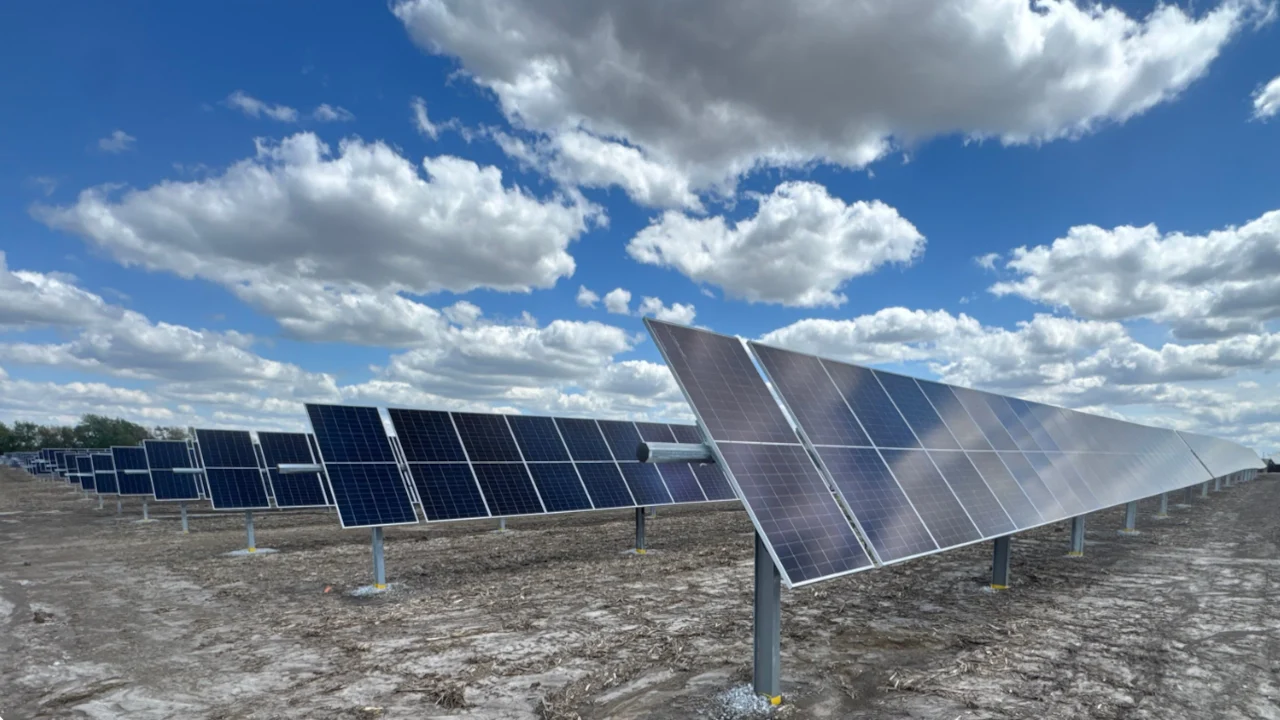
- Great Bend is a ground-mounted, single-axis tracking PV project expected to begin commercial operation by the end of 2025, earning energy and renewable energy certificate revenue under a long-term power purchase agreement.
- At $114 million for 48 MW, the Great Bend package equals about $2.38 million per MW, above the $1.05 million to $1.81 million per MW range of three comparable single-project US solar construction loans Enerdatics records in early 2024.
- In June 2024, three months after the Great Bend financing, Dutch pension manager APG agreed to invest $400 million in Doral Renewables and became its largest individual shareholder.
What is in the $114 million package?
Three separate facilities that do three different jobs. Only one of them is long-term project debt. The $36 million construction-to-term loan funds building work and then converts into a loan repaid from the project's revenue once it operates. That is about 32 percent of the package.
The largest piece, $57 million, is a tax equity bridge loan. Exactly half the headline is therefore a short-term loan designed to be repaid by someone else. The remaining $21 million is a letter of credit facility, which is a different instrument again.
All three come from the same bank. HSBC acted as sole lender across all three, so a single bank carries the construction risk, the bridge to tax equity and the guarantees.
What is a tax equity bridge loan?
It is short-term debt that stands in for a tax equity investor's money until that investor is ready to fund. Tax equity is the investment US renewable projects raise from investors who want the project's federal tax benefits. Those investors typically put their money in when a project is completed and operating, not during construction.
A bridge loan fills the gap. The bank lends against the tax equity commitment during construction, and the loan is repaid when the tax equity investor funds. For Great Bend, that means $57 million of the package is expected to be outstanding only until the project is running, scheduled for the end of 2025.
This structure was not unique to Doral in early 2024. Two months earlier, the owners of the 272 MWdc Sunray solar project in Texas secured a $144 million tax equity bridge loan upsize from Nomura.
What does the letter of credit facility do?
It provides guarantees rather than cash. A letter of credit is a bank's promise to pay a third party if the project owner fails to meet an obligation. Solar projects post them as security to counterparties such as power buyers and grid operators during development and construction.
A letter of credit is usually not drawn at all. It counts toward the $114 million headline, but in the normal course it never pays for panels, trackers or labour. Taking it out leaves $93 million of funded facilities, or about $1.94 million per MW.
How large is the package per megawatt?
Large on the headline, small on the term debt. The full $114 million equals about $2.38 million per MW of Great Bend's 48 MW. The construction-to-term loan alone equals about $0.75 million per MW.
Enerdatics records several single-project US solar loans in the first four months of 2024, and three comparable construction loans with disclosed capacity show the range. Sabanci's $243 million for the 232 MW Oriana project in Texas equals about $1.05 million per MW. Recurrent Energy's $160 million loan for Bayou Galion, a 98 MWac project in Louisiana, equals about $1.63 million per MW. Origis Energy's $136 million for the 75 MW Rice Creek project in Florida equals about $1.81 million per MW. Great Bend's headline sits above all three. Its term loan sits well below all of them. The difference is the bridge and the letter of credit, not the cost of the plant.
What does the deal signal for Doral and for US solar finance?
For Doral, Great Bend was one financing on the way to a much bigger capital raise. In June 2024 APG, acting for the Dutch pension fund ABP, agreed to invest $400 million in Doral Renewables, with up to a further $185 million over time. At that point Doral had a portfolio of about 12 GWac across 20 states, 1.3 GW under construction, and $600 million raised in project financing. The deal completed in September 2024.
Great Bend is small within that book. Doral's portfolio at the time included the 400 MW Mammoth North solar project under construction and, in development, 4.2 GW of solar, 5.5 GW of solar plus storage and 775 MW of battery storage. A 48 MW project financed with a single bank is the kind of asset that builds a track record before larger raises.
For US solar finance, the Great Bend package shows how far headline figures can drift from the long-term debt underneath them. Bridges to tax equity and to tax credit sales now sit inside many of these packages, as with Primergy's Ash Creek loan. Comparing packages on headline per megawatt mixes those bridges with term debt. The question for Great Bend is who the tax equity investor will be, because the record does not name one.
Frequently asked questions
How much financing did Doral secure for Great Bend? Doral Renewables secured a $114 million financing package from HSBC for the 48 MW Great Bend solar project, made up of a $36 million construction-to-term loan, a $57 million tax equity bridge loan and a $21 million letter of credit facility.
Where is the Great Bend solar project? The Great Bend solar project is in Meigs County, Ohio. It uses ground-mounted single-axis trackers, is expected to start commercial operation by the end of 2025 and is expected to power about 9,000 homes.
Who invested in Doral Renewables after the Great Bend financing? In June 2024, APG agreed to invest $400 million in Doral Renewables on behalf of the Dutch pension fund ABP, with up to $185 million more over time, becoming Doral's largest individual shareholder.
Ready to get deal-ready answers in seconds? Try Enerdatics Leap AI and access verified intelligence across M&A, financings, PPAs, projects, and energy market developments through natural language.