True Green Capital’s UK Solar Deal Shows Private Funds Are Repricing Mature FiT Assets Around Repowering Upside
.png)
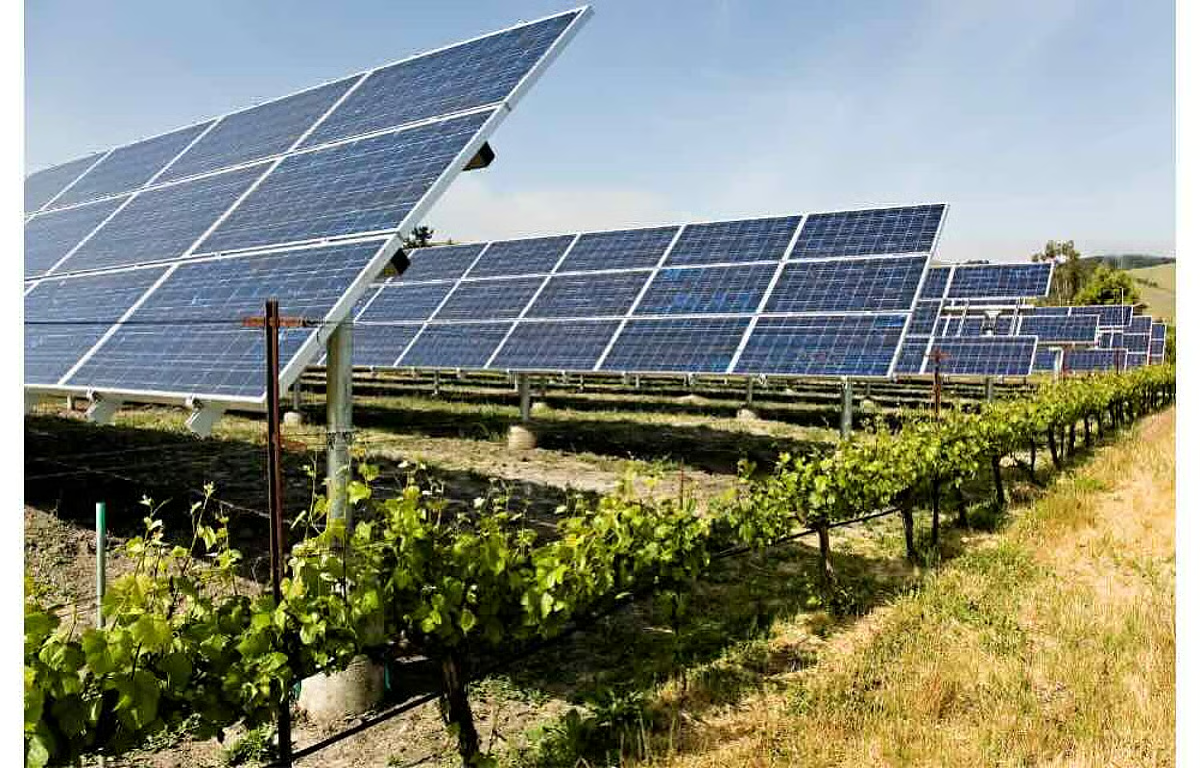
UK solar M&A is shifting toward mature operating portfolios where private infrastructure funds can combine contracted legacy revenues with technical upside from asset management and repowering. True Green Capital Management’s acquisition of 20.3 MWdc of operating solar assets from Gresham House Renewable Energy VCT 1 PLC and VCT 2 PLC shows this change clearly: buyers are not simply paying for old FiT cash flows, but for the ability to extend value from assets that have already operated for more than a decade.
The portfolio includes six solar projects across the United Kingdom, each operational since 2011. The assets benefit from 25-year Feed-in Tariff contracts running through 2036, short-term PPAs with established UK energy retailers, and Renewable Energy Guarantees of Origin. That revenue mix gives TGC a contracted base through the FiT while leaving room to optimize power sales, certificates, and operating performance over the remaining life of the assets.
The seller profile is important. Gresham House Renewable Energy VCT 1 and VCT 2 are UK-listed vehicles, and TGC described the transaction as its second take-private of UK-listed assets. That matters commercially because listed renewable vehicles in Europe have faced persistent valuation discounts, liquidity pressure, and portfolio rationalization needs. Private funds with longer hold periods can step in where public-market vehicles may be under pressure to simplify, return capital, or crystallize value.
For TGC, the deal fits a specialist distributed-generation strategy rather than a utility-scale growth move. The 20.3 MWdc portfolio is small by utility-scale standards, but it is highly relevant for infrastructure funds seeking predictable, distributed solar cash flows with operational control. TGC has already invested more than $2.3 billion into distributed solar and storage assets across the US, UK, and France, giving it the in-house base to manage fragmented, sub-utility-scale portfolios rather than rely purely on third-party operators.
The commercial logic is different from development-stage solar M&A. In early-stage solar deals, value is created by securing land, grid, permits, and offtake. In this transaction, the development risk is gone. The assets have been operating since 2011, and the core question for the buyer is how much incremental value can be extracted from performance optimization, repowering, merchant exposure management, and operating cost discipline before and beyond the 2036 FiT period.
That is why TGC’s comments around in-house asset management and repowering capabilities are central to the deal. Mature UK solar assets increasingly require specialist technical underwriting. Performance degradation, inverter replacement, module efficiency, land arrangements, O&M contracts, and grid export rights all become valuation levers. A passive financial buyer may see a declining-yield legacy portfolio. A specialist operator may see a cash-flowing base with measurable upside.
Enerdatics data points to the same broader European shift. In Q3 2025, Europe recorded around $7 billion of renewable energy M&A, with investors showing strong appetite for grid-connected BESS and solar assets. Enerdatics also noted that operational utility-scale solar assets in Europe traded in a broad $0.8 million–$1.7 million/MW range, reaching up to $2.3 million/MW in select cases, while older operating assets without clear repowering plans can face valuation discounts.
The True Green-Gresham House deal sits directly inside that valuation tension. The assets are old enough to require operational scrutiny, but they also carry long-dated FiT support through 2036. That combination can create a pricing gap between public-market holders and specialist private buyers. Sellers may value the portfolio as a legacy income asset. Buyers like TGC may underwrite it as a contracted platform with technical upside and optionality around repowering.
The PPA structure also matters. The projects have short-term PPAs rather than a single long-term corporate offtake arrangement. For some investors, that introduces re-contracting risk. For an asset manager with energy-market experience, it can create flexibility. As UK power prices remain volatile and renewable certificates retain commercial value, short-duration offtake can allow the buyer to reset terms, optimize route-to-market strategy, and capture upside not available under fully locked-in long-term contracts.
For sellers, the implication is clear: mature FiT-backed portfolios remain transactable, but buyers will price them around operational condition, remaining subsidy life, and repowering potential rather than headline capacity. Smaller listed or semi-liquid vehicles holding older distributed solar portfolios may find that specialist infrastructure funds are the most natural buyers, especially when portfolio scale is too small for large utility buyers but cash flows are too stable for opportunistic capital.
For buyers, the deal shows that the UK operating solar market is becoming more capability-driven. Capital alone is not enough. The winning buyer needs technical diligence, asset-management infrastructure, power-market access, and confidence in end-of-life or life-extension strategy. This favors specialist distributed-generation investors over generalist financial buyers that rely mainly on contracted yield.
The forward-looking signal is that UK-listed renewable asset take-privates and portfolio carve-outs may continue where public-market pricing fails to reflect private-market operating value. TGC’s acquisition is small in capacity, but commercially important because it shows how private funds are targeting overlooked, mature solar portfolios with stable subsidy revenues and embedded optimization upside. The next phase of UK solar M&A is likely to reward buyers that can price not just megawatts, but controllable performance improvements inside aging contracted assets.
Ready to get deal-ready answers in seconds? Try Enerdatics Leap AI and access verified intelligence across M&A, financings, PPAs, projects, and energy market developments through natural language.