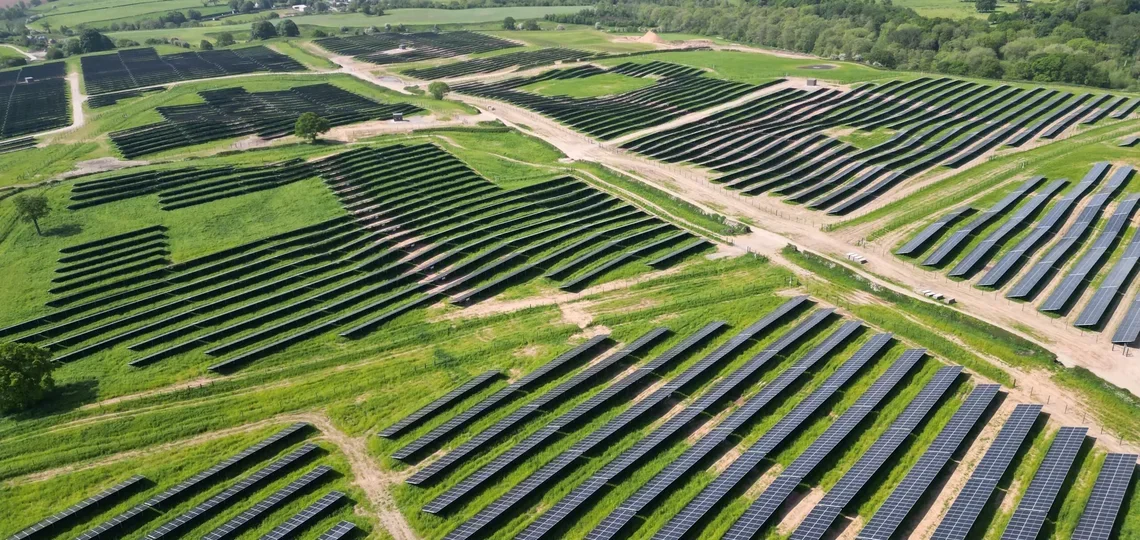
Origis Energy has closed a $136 million loan from MUFG for Rice Creek, a 75 MW solar farm in Putnam County, Florida. On its own that is an ordinary construction loan for a mid-sized project. What makes it bankable sits on the other side of the contract: a buyer that is not one utility but an agency acting for a group of city-owned ones.
Key takeaways
- Origis Energy and MUFG closed a $136 million construction financing facility for the 75 MW Rice Creek solar project in Putnam County, Florida, announced on 16 April 2024, with the facility converting to a term loan from MUFG.
- Rice Creek Solar is contracted by the Florida Municipal Power Agency, which acts as project coordinator for the member-owners that will buy power from the facility.
- The $136 million MUFG loan works out at about $1.81 million per MW of Rice Creek's 75 MW capacity.
- Origis expects Rice Creek to qualify for the Energy Community Adder to the Investment Tax Credit, and in August 2024 it raised a further $71 million of tax equity for the project from U.S. Bancorp Impact Finance.
- Enerdatics records 97 US solar debt financings announced in 2024, totalling $21.45 billion, and Rice Creek is the only one whose record refers to Florida.
Who is actually buying Rice Creek's power?
The buyer is the Florida Municipal Power Agency, but the power is not for the agency itself. FMPA signs as project coordinator for its member-owners, the municipal utilities that will purchase the output from the facility. In practice the agency pools demand from several city-owned systems into one contract that a developer can sign and a lender can underwrite.
That structure matters for the loan. A lender to a solar farm is lending against the revenue the plant will earn. A single small municipal utility might struggle to commit to the whole output of a 75 MW plant, and a lender would weigh its credit alone. An agency that aggregates several members spreads that commitment across a wider base. The record does not disclose the length of the contract or its price, so the strength of the arrangement has to be read from who signed it rather than from its terms.
Leap tags the project's power market as Independent. Florida sits outside the organised wholesale markets that run across much of the US, so there is no regional market price to fall back on if a contract fails. That makes the identity and creditworthiness of the buyer the main thing a lender is relying on.
What does $1.81 million per MW of debt tell you?
It tells you the loan is sized to carry most of the construction cost, but not all of the capital stack. The facility is described as construction financing that converts to a term loan. A construction loan is drawn as the plant is built and is usually the most expensive phase to fund. Conversion means the same lender stays in once the plant is running, so Origis does not have to refinance at completion.
The record does not give a total project cost, so it is not possible to say what share of the build the debt covers. What Leap does show is that debt was not the only source. In August 2024, four months after the MUFG loan, Origis raised $71 million in tax equity for Rice Creek from U.S. Bancorp Impact Finance. Tax equity is investment from a party that can use the project's federal tax credits against its own tax bill, in return for a share of those credits and of the project's cash. Taken together, the two Rice Creek financings Leap records add up to $207 million, or about $2.76 million per MW.
Why does the Energy Community Adder matter here?
Because it raises the value of the tax credits that the tax equity investor is buying. The Energy Community Adder is a bonus on top of the Investment Tax Credit for projects sited in areas defined as energy communities under US tax rules, typically places with historic ties to fossil fuel jobs or closed coal facilities. Origis says Rice Creek is expected to qualify.
The word expected is doing work in that sentence. Qualification depends on meeting the definition at the relevant time, and the record presents it as an expectation rather than a confirmed status. A larger credit means a larger tax equity investment for the same project, which in turn reduces how much of the build the debt must carry. That is one reason a mid-sized solar farm can arrive at financial close with both a bank loan and a tax equity cheque behind it.
How does Rice Creek fit Origis' borrowing pattern?
It fits a pattern of returning to the same lender. MUFG lent Origis $344 million for the Golden Triangle I solar project in December 2023, then the $136 million for Rice Creek, and in December 2024 it led a $533 million facility for two more Origis solar projects. Rice Creek is the smallest of the three.
Origis also raised $317 million of tax equity from J.P. Morgan in January 2024 for two other solar projects, so Rice Creek's tax equity raise was not Origis' first that year.
The record also names the advisers. Latham & Watkins represented Origis, with Akerman as local counsel. Milbank acted for MUFG, with Greenberg Traurig as local counsel.
Enerdatics' data shows 181 US solar financings announced in 2024, worth a combined $44.94 billion. Debt is the largest group, at 97 transactions and $21.45 billion, which works out at an average of about $221 million per debt financing. Rice Creek's $136 million sits well below that average, which is consistent with a single 75 MW plant rather than a portfolio. Tax equity is the next largest category, with 25 transactions worth $4.24 billion. Rice Creek is the only 2024 US solar debt financing in Leap whose record mentions Florida.
What does the deal signal for Florida solar?
It signals that pooled municipal demand can carry a third-party solar project to financial close in Florida. FMPA's role as a coordinator is the mechanism. It turns several smaller public buyers into one counterparty that a developer and a bank can contract with.
It also shows the template US lenders have been using for contracted solar: construction debt sized against a buyer already in place, followed by tax equity once the credit position is clear. Rice Creek followed that order, debt in April and tax equity in August.
The open question is price. Neither the contract tariff nor its length is disclosed, so the loan cannot yet be read against the revenue it depends on. For a market with few disclosed municipal solar contracts, that leaves Rice Creek's financing as one of the clearer public signals of what such a contract can support.
Frequently asked questions
How much did Origis Energy raise for Rice Creek Solar? Origis closed a $136 million construction financing facility from MUFG, announced on 16 April 2024, which converts to a term loan. In August 2024 it raised a further $71 million of tax equity for the project from U.S. Bancorp Impact Finance.
Who buys the power from Rice Creek Solar? The Florida Municipal Power Agency has contracted the project and acts as project coordinator for its member-owners, the municipal utilities that will purchase power from the facility.
How big is Rice Creek Solar and where is it? Rice Creek is a 75 MW solar PV facility in Putnam County, Florida. It is expected to power the equivalent of 14,000 homes and avoid 74,000 metric tons of CO2 emissions a year.
Ready to get deal-ready answers in seconds? Try Enerdatics Leap AI and access verified intelligence across M&A, financings, PPAs, projects, and energy market developments through natural language.