Copenhagen Infrastructure Partners has bought Macquarie's 25 percent of Five Estuaries, a consented 1.08 GW offshore wind project off the Essex and Suffolk coast. No price was given. The project has a 3.5 billion pound budget, no revenue contract, and will not generate a megawatt hour before 2030. It is also the second quarter of its cap table to change hands in five days.
Key takeaways
- Copenhagen Infrastructure Partners has acquired a 25 percent stake in the 1,080 MW Five Estuaries offshore wind project in the UK from a Macquarie-led consortium, executed through Copenhagen Infrastructure V. The consideration was not disclosed.
- Ownership now comprises CIP at 25 percent, EDF Power Solutions at 33.33 percent, ESB at 20.83 percent and Sumitomo Corporation at 20.83 percent. EDF bought RWE's entire 33.33 percent and the lead developer role five days earlier, on 8 October 2026.
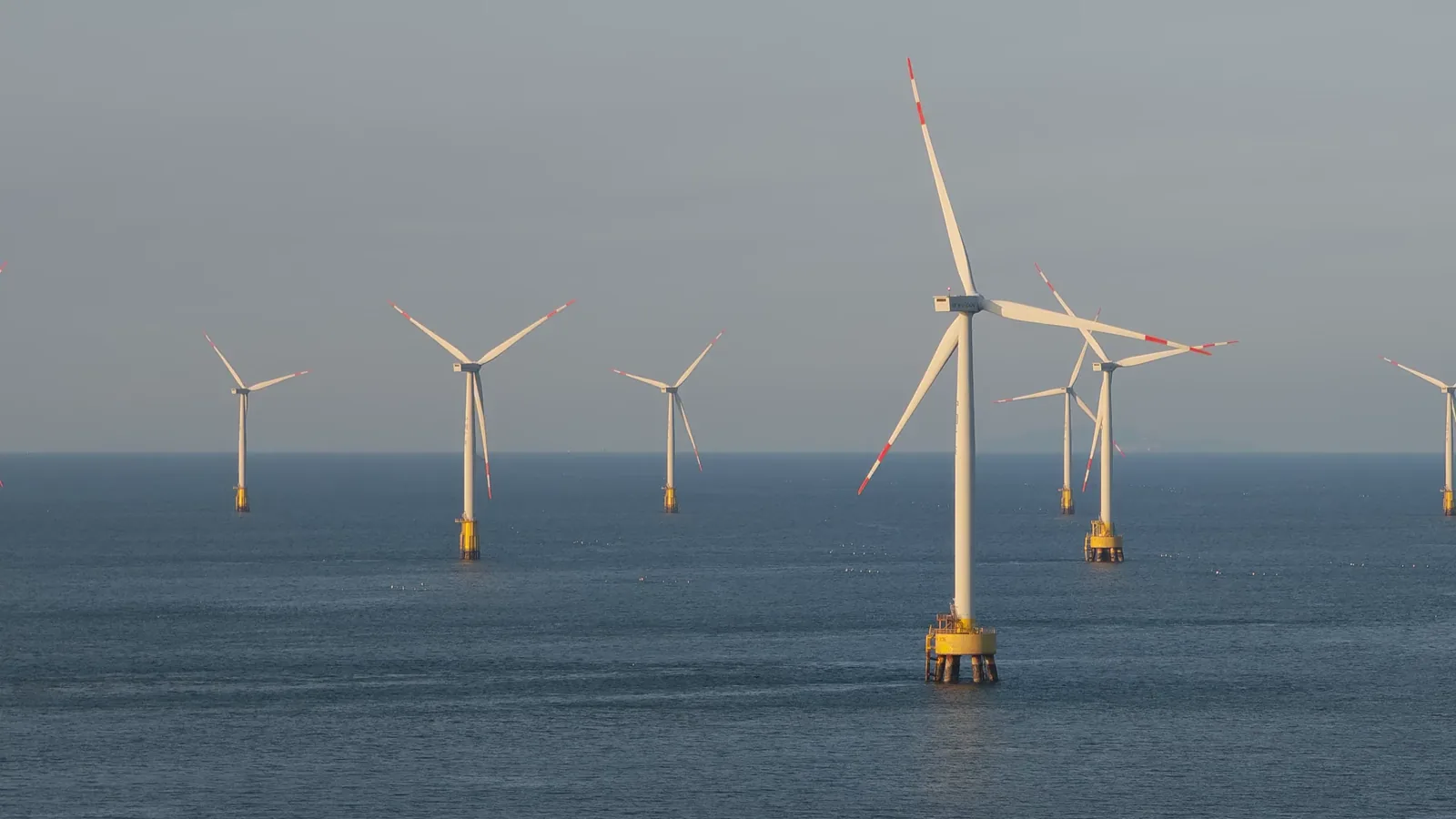
- The project received Development Consent Order approval from the UK Secretary of State in December 2025, covering up to 79 turbines with a maximum blade tip height of 370 metres across two array areas around 40 km offshore.
- Total estimated project cost is about 3.5 billion pounds, or $4.47 billion, which works out at $4.14 million per MW of consented capacity. Sister project Galloper, 353 MW commissioned nearby, was built for 1.5 billion pounds, or $5.61 million per MW.
- Five Estuaries has no power contract. It is expected to bid into a UK Contract for Difference auction as it progresses toward a final investment decision, with construction expected to begin in 2028 and generation after 2030.
What is CIP buying before a CfD exists?
A consent, a seabed position and the right to fund what comes next. A Contract for Difference is the UK's support mechanism for large renewables: the government auctions them, and winners receive a fixed strike price for their output, with the difference against the wholesale price paid to them or clawed back from them. Five Estuaries has not been through one, and is expected to bid as it approaches a final investment decision.
What it does have is the part that cannot be acquired later. The Development Consent Order granted in December 2025 authorises construction, operation, maintenance and decommissioning of up to 79 turbines, two offshore substation platforms, two subsea export cables and the onshore works to land them. The project took its Ofgem generation licence in April 2021 and filed the DCO application in March 2024, so the consent took twenty-one months to award and years to assemble. Consent risk is now resolved and price risk is not, which is the point in an offshore wind project's life when its owners most want to change.
Why has a quarter of the project changed hands twice in a week?
Because the close of consenting is the exit window, and two of the five original owners used it within five days of each other. On 8 October 2026 EDF Power Solutions took RWE's entire 33.33 percent and with it responsibility for leading development. On 13 October CIP took the Macquarie-led consortium's 25 percent, a holding split between MEIF5 Infrastructure Ventures FE Limited at half and two others at a quarter each.
The project now has a different character. Five Estuaries was developed by a consortium of RWE at 25 percent, Siemens Financial Services at 25 percent, a Macquarie-led group at 25 percent, and ESB and Sumitomo at 12.5 percent each. Of those five only ESB and Sumitomo remain, and both now sit at 20.83 percent rather than 12.5. The lead developer and the infrastructure fund are both gone inside a week.
What replaced them is a different kind of owner. EDF Power Solutions and CIP develop, build and operate offshore wind on their own account, and the holding CIP took came from an infrastructure fund. That rotation is ordinary for a project heading into construction in 2028. What is unusual is that it happened in five days.
What does a 3.5 billion pound budget say about the price?
It caps what a pre-FID stake can reasonably be worth, because the buyer's main obligation is to fund it. The 3.5 billion pound estimate, about $4.47 billion, covers construction, development, financing, land and operating costs, and amounts to $4.14 million per MW of consented capacity. A 25 percent holder is signing up for roughly $1.1 billion of it.
Galloper makes that figure legible. Five Estuaries is its sister extension in the same waters, and Galloper's 353 MW was built for 1.5 billion pounds, about $1.98 billion, or $5.61 million per MW. Five Estuaries is budgeted 26 percent below that per megawatt a decade later, which is what larger turbines and a shared coastline should deliver.
Set the budget beside what UK offshore wind trades for and it looks like the market rather than a discount to it. Two priced deals on assets already in construction disclose a stake size that allows a gross-up to 100 percent: Masdar's 50 percent of the 1.4 GW East Anglia 3, implying $4.21 million per MW, and Apollo and La Caisse's 50 percent of the 2.9 GW Hornsea 3, implying $4.06 million per MW. Five Estuaries expects to spend $4.14 million per MW to build it. Building costs what finished projects change hands for, so most of what the equity is worth has to come from the CfD, and the CfD has not been auctioned.
Enerdatics records 30 UK offshore wind transactions since the start of 2024. Eleven carry a disclosed value, every one of them an asset already operating or in construction. Eighteen of the thirty are stakes in projects still under development, and not one of those eighteen carries a price, including both Five Estuaries trades this month. The priced end of the market runs from $3.31 million to $7.56 million per MW on a grossed-up basis, and its cheapest print is an end-of-life asset whose Renewables Obligation support expires in 2029. Steel in the water gets a number. Consent does not.
What does the deal signal for UK offshore wind?
It signals that the pre-FID stake has become the liquid instrument in UK offshore wind, and that it trades without a visible price. Eighteen development-stage transactions in under three years is not a thin market but an active one that reports nothing. Buyers take positions on consented projects ahead of the auction that decides whether those projects get built.
The second signal is about the shape of the buyer. CIP has been assembling consented pre-revenue assets rather than operating ones. Its Elgin Energy platform bought a 198.9 MWp Irish solar project whose value depends on an auction that has not been held, and Copenhagen Infrastructure Partners has been buying permitted capacity elsewhere in Europe, including a 21 MW forest wind farm through Perigus Energy. The common feature is a consent in hand and a price still to be set. Expect the next Five Estuaries trade to go undisclosed too.
Frequently asked questions
How much did CIP pay for its 25 percent of Five Estuaries?The consideration was not disclosed. Enerdatics records 18 development-stage UK offshore wind transactions since the start of 2024 and none carries a disclosed value, so there is no pre-FID comparable to benchmark against.
Does Five Estuaries have a Contract for Difference?No. It is expected to bid into a UK Contract for Difference auction as it progresses toward a final investment decision. Construction is expected to begin in 2028 and generation after 2030.
How much will Five Estuaries cost to build?About 3.5 billion pounds, or $4.47 billion, covering construction, development, financing, land and operating costs. That is $4.14 million per MW across its 1,080 MW of consented capacity.
Ready to get deal-ready answers in seconds? Try Enerdatics Leap AI and access verified intelligence across M&A, financings, PPAs, projects, and energy market developments through natural language.