Short answer: EPCs find solar developers who need them by tracking projects that are approaching notice to proceed, because that is when developers pick a builder. In practice that means watching late-stage permits, signed interconnection agreements, offtake contracts, tax equity and debt raises, and project sales. EPC teams track these signals in project intelligence platforms such as Enerdatics, which records about 168 GW of US utility-scale solar at late-stage or ready-to-build, the pool where EPC decisions are made.
How Enerdatics solves this
Reach your next client first: Enerdatics tracks renewable projects, deals and financings across the US and Europe, so you can see who is likely to sell, build or transact next. Filter project pipelines by stage, market and owner to spot developers before they go to market. Every record links back to its source document. Enerdatics flags late-stage projects before the EPC is chosen, so your business development team can call the developer before your competitors know the job exists.
Enerdatics tracks 1,313 late-stage and 16 ready-to-build US utility-scale solar projects, together about 168 GW. Available through CoreData, Stack dashboards, Leap AI and API.
Key takeaways
- An EPC is usually chosen in the months before notice to proceed, so late-stage and ready-to-build projects are the best targets.
- Enerdatics records about 165 GW of late-stage and 2.6 GW of ready-to-build US utility-scale solar.
- NextEra Energy Resources, EDF, TotalEnergies and Invenergy each hold more than 4 GW of late-stage US solar in Enerdatics data.
- SOLV Energy, Blattner Energy, McCarthy and Mortenson are the most active EPCs on US solar projects now in construction.
- Financings, PPAs and project sales are the clearest signals that a project is about to need a builder.
What does a solar EPC do, and when is it hired?
A solar EPC is the contractor that handles engineering, procurement and construction for a project under one contract. It designs the plant, buys or manages the equipment, and builds it to a fixed price and schedule.
Developers usually select the EPC late in development. The key milestone is notice to proceed (NTP), the formal instruction that lets the contractor start work. Lenders and tax equity investors want a signed EPC contract before they commit, so the EPC choice tends to land just before financial close.
Timing pressure is high right now. Under IRS Notice 2025-42, solar projects that begin construction after July 4, 2026 must be placed in service by the end of 2027 to claim the 48E or 45Y tax credits. Physical work of a significant nature now counts as the start of construction, which puts the EPC on the critical path.
Which projects are most likely to need an EPC?
Late-stage and ready-to-build projects. Late-stage means the project holds key permits but has not started work. Ready-to-build means it has everything needed to start construction.
Enerdatics records 1,313 late-stage US utility-scale solar projects totalling about 165 GW, and 16 ready-to-build projects totalling about 2.6 GW. By comparison, 377 projects with about 56 GW are already in construction, where the EPC is normally fixed.
Not every late-stage project will be built. Lawrence Berkeley National Laboratory found that only 13% of capacity requested in interconnection queues from 2000 to 2020 had reached commercial operation by the end of 2025. EPCs need to filter for projects with a signed interconnection agreement, an offtaker and a funded owner.
Which developers hold the most late-stage solar?
The biggest owners of late-stage US solar in Enerdatics data are NextEra Energy Resources at about 8.4 GW, EDF at about 4.6 GW, TotalEnergies at about 4.5 GW and Invenergy at about 4.4 GW. Intersect Power, Doral Energy, AES, Terra-Gen, RWE and EDP Renewables each hold between 2.1 GW and 3.1 GW.
Some of these firms self-perform or run long frame agreements with a few contractors, so a large pipeline does not always mean an open tender. Mid-sized developers with a handful of late-stage projects often run competitive EPC processes for each project and are easier to win.
Ownership also changes before construction. Late-stage projects are often sold to long-term owners, who then appoint their own EPC. The Chrysalis purchase of de-risked Arizona solar from Hanwha shows how a buyer can arrive just before NTP.
What signals show a project is about to pick an EPC?
Five signals matter most. First, a signed interconnection agreement, which fixes when and where the project connects to the grid. Enerdatics covered how this plays out across ISOs in M&A signals from the queue.
Second, an offtake contract such as a power purchase agreement (PPA), a long-term contract to sell the project's power at an agreed price. Third, a construction loan or tax equity commitment, which usually requires a signed EPC contract. Fourth, a project sale to a new owner. Fifth, an equipment order, such as modules or trackers, tied to a named site.
Each signal is public somewhere, in state permit dockets, ISO queue files, utility filings, press releases or financing announcements. The work is collecting them in one place and linking them to the same project.
Which EPCs are building the most US solar?
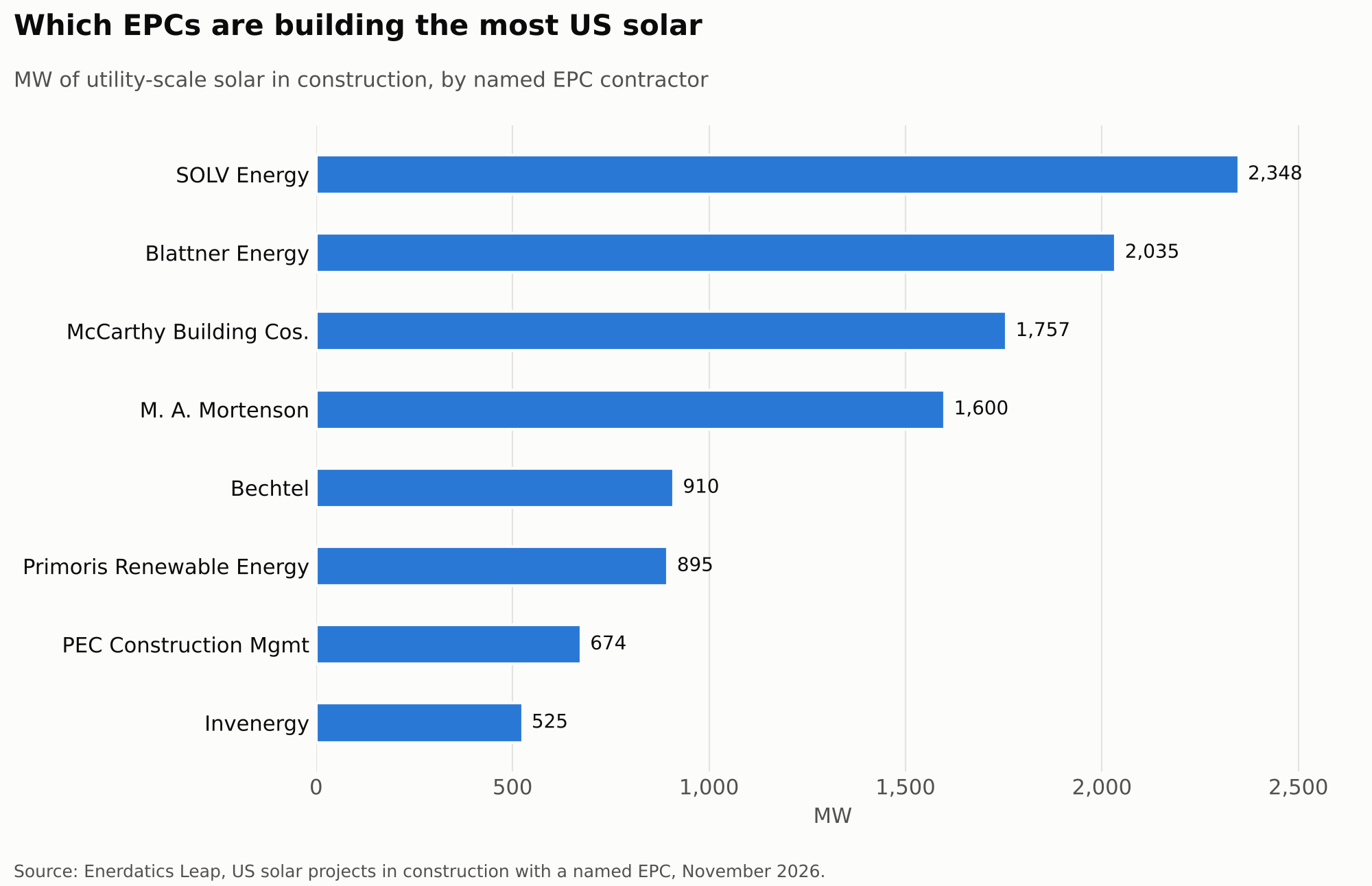
Enerdatics names an EPC on 134 US solar projects now in construction. SOLV Energy, Blattner Energy, McCarthy Building Companies and M. A. Mortenson Company lead that ranking, followed by Bechtel and Primoris Renewable Energy.
Demand is still high. The US Energy Information Administration expects a record 43.4 GW of utility-scale solar to come online in 2026, with Texas accounting for about 40%.
| EPC contractor | Solar projects in construction | MW in construction |
|---|---|---|
| SOLV Energy | 7 | 2,348 |
| Blattner Energy | 6 | 2,035 |
| McCarthy Building Companies | 8 | 1,757 |
| M. A. Mortenson Company | 4 | 1,600 |
| Bechtel | 2 | 910 |
| Primoris Renewable Energy | 3 | 895 |
| PEC Construction Management | 1 | 674 |
| Invenergy | 2 | 525 |
Source: Enerdatics Leap, US utility-scale solar projects in construction with a named EPC contractor, as of November 2026.
Enerdatics records about 22.8 GW of US solar in construction with a named EPC, out of about 56 GW in construction in total. Knowing which competitor holds which job tells an EPC where its rivals are stretched and which developers may want a second contractor.
Frequently asked questions
When do solar developers hire an EPC? Usually in the months before notice to proceed and financial close. Lenders and tax equity investors normally require a signed EPC contract before they commit funds.
How many US solar projects are close to construction? Enerdatics records 1,313 late-stage and 16 ready-to-build US utility-scale solar projects, together about 168 GW. Only part of that will be built.
Who are the largest solar EPCs in the US? SOLV Energy, Blattner Energy, McCarthy Building Companies and Mortenson lead Enerdatics' ranking of solar projects in construction. Bechtel and Primoris Renewable Energy follow.
What is the best signal that a project needs an EPC? A new construction loan, tax equity commitment or project sale. Each usually comes just before or alongside the EPC award.
See which late-stage projects still need an EPC. Ask Leap three free questions, answered from Enerdatics data. No sales call needed.