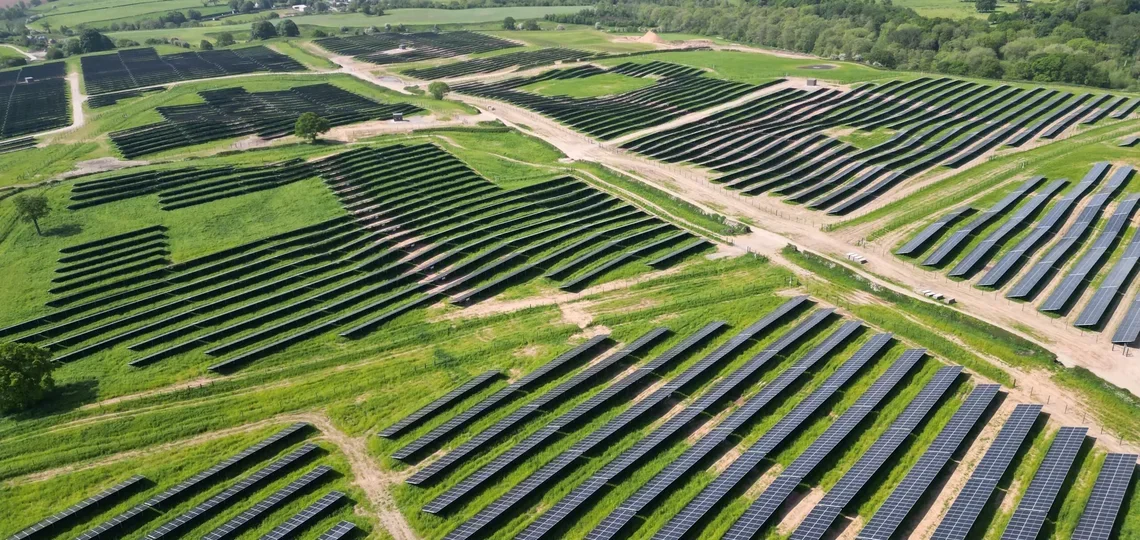
SCHOTT has signed a second power purchase agreement with Statkraft in less than a year, this time for the Nichel wind farm in Brandenburg. The new contract is bigger than the first. It is also only three years long. In German offshore wind, buyers routinely sign for fifteen. In German onshore wind, three years turns out to be entirely normal.
Key takeaways
- Statkraft announced on 22 January 2024 a three-year power purchase agreement with SCHOTT AG for power from the 16.8 MW Nichel wind farm in Brandenburg, Germany, running from January 2024 to the end of 2026.
- Under the Nichel PPA, Statkraft will supply SCHOTT with 42,000 MWh a year, about 125,000 MWh over the three years, covering a quarter of SCHOTT's electricity consumption in Germany.
- The Nichel wind farm consists of four 4.2 MW turbines totalling 16.8 MW, about 75 km southwest of Berlin, and is later extended by four further turbines to 33.6 MW.
- The Nichel agreement is one of six PPAs supporting SCHOTT's goal of carbon-neutral production by 2030, sourced from five wind farms and one solar farm, with suppliers including Statkraft, ENGIE and RWE.
- SCHOTT aimed to cover 25 percent of its electricity requirements in Germany through PPAs by 2024, having switched its global electricity procurement to 100 percent green electricity by the end of 2021.
How did SCHOTT's contracts with Statkraft evolve?
They grew in size and lengthened by a year. The sequence in Leap runs as follows.
End of 2021. SCHOTT switches its global electricity procurement to 100 percent green electricity. Its PPAs are certified with the EKOenergy label, which sets sustainability criteria for the green electricity purchased.
January 2023. SCHOTT is one of eleven buyers in a 320 MW, ten-year PPA with RWE for the Nordsee Ost and Amrumbank West offshore wind farms.
February 2023. Statkraft signs a 10 MW, two-year onshore wind PPA with SCHOTT in Germany.
2023. SCHOTT signs a PPA with CleanMax for a solar and wind hybrid project in India, taking its PPA strategy beyond Germany.
January 2024. Statkraft signs the Nichel agreement: 16.8 MW, three years, 42,000 MWh a year from January 2024 to the end of 2026.
The pattern is a buyer building a portfolio rather than signing one large contract. SCHOTT now draws on six PPAs across five wind farms and one solar farm. It mixes a long offshore contract with short onshore ones, and several suppliers rather than one.
What does 42,000 MWh a year say about Nichel?
It says the contract is expected to take the output of a reasonably productive onshore site. 42,000 MWh a year from 16.8 MW works out at a capacity factor of about 28.5 percent. A capacity factor is the share of the year's maximum possible output a plant actually delivers, given that the wind does not always blow at full strength.
It also says a small wind farm can matter to a large industrial buyer. Four turbines cover a quarter of SCHOTT's German electricity use. Leap equates the output to the annual consumption of more than 15,000 households.
The contract also covers only part of the site. Nichel is later extended by four more turbines, taking it to 33.6 MW. SCHOTT's agreement is tied to the original four, so it covers half of the eventual wind farm. For SCHOTT, contracted wind supply is a direct way to cut emissions from the power it buys.
Why is the contract only three years long?
Because short terms are the norm for German onshore wind PPAs, and the reasons run in both directions.
For the buyer, a short contract avoids locking in a price for a decade while wholesale prices move. It also lets a company like SCHOTT reshuffle its supply as its own needs change, adding or dropping suppliers every few years. For the seller, a short contract leaves room to reprice the output when the contract rolls off, and a supplier with several industrial customers can place that output again.
Long contracts serve a different purpose. A new offshore wind farm needs years of fixed revenue to raise construction finance, so its developer looks for buyers who will commit for a decade or more. That logic can be seen in EnBW's corporate contracts for He Dreiht, which were signed for 15 years before construction began.
Enerdatics records 44 wind PPAs in Germany announced across 2023 and 2024. Thirteen onshore contracts carry a disclosed duration, and their median is three years. Ten of the thirteen run for five years or less, including Statkraft's own contracts with Air Liquide (three years), Deutsche Bahn (two years) and SCHOTT in 2023 (two years). Nineteen offshore contracts carry a disclosed duration, and their median is 15 years. Only one onshore contract, a 25-year onsite deal between UKA and Mercedes-Benz, runs longer than ten years.
What does the deal signal for German corporate PPAs?
It signals two separate PPA markets operating under one label. Onshore wind in Germany is largely sold to corporates on short contracts. Offshore wind is sold on long contracts tied to new construction. A buyer that wants both price certainty and flexibility, as SCHOTT does, ends up holding both.
It also signals the role of aggregators. Statkraft is the supplier on four of the thirteen onshore contracts with a disclosed duration, Nichel included. It sits between turbine owners and industrial buyers, offering terms that suit the buyer while managing the price risk across its own portfolio.
Finally, it suggests that contract length is a poor guide to commitment. SCHOTT's onshore contracts are short, but it has come back to the same supplier, at a larger volume, within a year. The real commitment is to a supply strategy rather than to any single contract.
Frequently asked questions
How long is the SCHOTT and Statkraft PPA for Nichel? The PPA runs for three years, from January 2024 to the end of 2026.
How much power will Statkraft supply to SCHOTT from Nichel? Statkraft will supply 42,000 MWh a year, about 125,000 MWh over the three years, covering a quarter of SCHOTT's electricity consumption in Germany.
How long do German onshore wind PPAs usually run? Across 13 German onshore wind PPAs from 2023 and 2024 with a disclosed duration, Enerdatics records a median of three years, compared with 15 years for offshore wind.
Ready to get deal-ready answers in seconds? Try Enerdatics Leap AI and access verified intelligence across M&A, financings, PPAs, projects, and energy market developments through natural language.