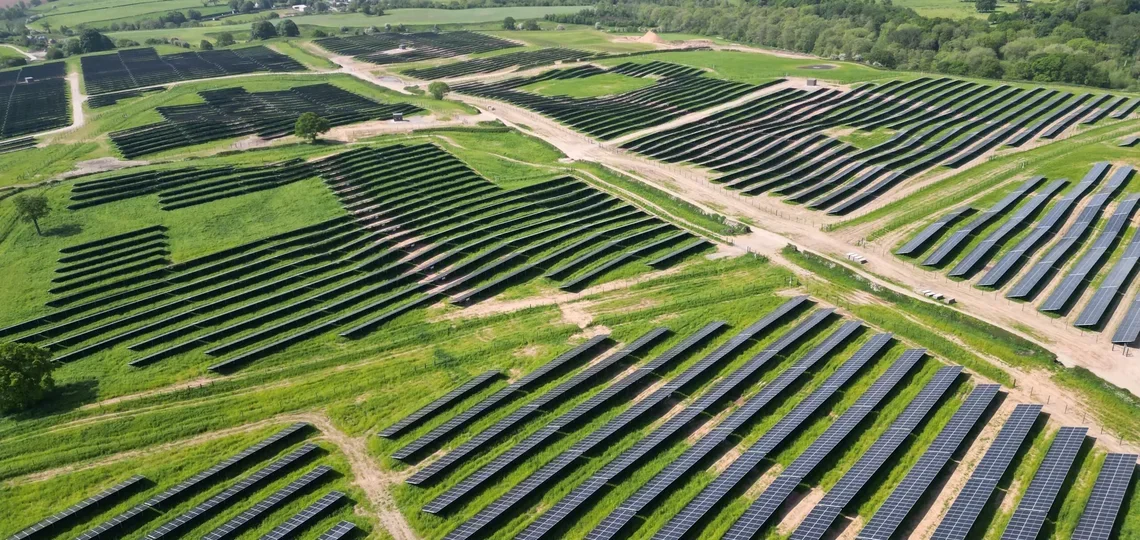
Gresham House owns a 20 MW solar farm in Devon. Workspace Group, a London office landlord, wants its output. Yet the two companies have no contract with each other. Statkraft sits in the middle, and what it does there is the part worth understanding.
Key takeaways
- Gresham House signed a 10-year power purchase agreement with Statkraft for the 20 MW Beavor Grange solar farm in Devon, UK, announced on 4 January 2024, with supply starting in February 2024.
- Statkraft sells the Beavor Grange output on to Workspace Group under a second 10-year corporate PPA, also running from February 2024, so the solar farm's power reaches Workspace through two back-to-back contracts.
- Workspace Group takes Beavor Grange power through Statkraft's Firming service, which converts as-generated solar output into a pre-agreed consistent volume by buying from the market when the plant is not producing and selling surplus when it produces more.
- The 20 MW Beavor Grange solar farm is expected to supply around two thirds of Workspace Group's total power demand, and Gresham House acquired the project from Anesco in August 2022.
- Enerdatics records 33 UK solar PPAs announced between January 2023 and June 2024, and none of them carries a disclosed tariff.
Why does a solar farm need a middleman to supply an office landlord?
Because a solar farm and an office portfolio do not use power in the same shape. A solar farm produces most of its energy around midday in summer and nothing at night. An office landlord needs electricity on winter evenings, through cloudy weeks and across every working hour of the year. A direct contract between the two would leave the landlord with too much power at some hours and none at others, and it would have to buy and sell the difference itself.
The structure around Beavor Grange removes that problem from both ends. Gresham House sells everything the plant generates to one large utility buyer for a decade. Workspace buys from that same utility and gets a supply it can plan around. The mismatch between generation and demand sits with the company in the middle, which is the party best equipped to manage it.
The result is two contracts that look like one deal from the outside. Leap records them separately: the generator leg, in which Statkraft is the offtaker, and the corporate leg, in which Statkraft is the supplier.
What is a firming service, and what does it change?
A firming service turns variable generation into a fixed delivery profile. In the arrangement Leap records, Statkraft takes the as-generated power from Beavor Grange, buys power from the market when the generator is not producing, and sells the surplus during high production periods. Workspace receives a pre-agreed, consistent amount of power rather than whatever the sun delivers on a given day.
That changes who carries the weather risk. Without firming, a dull month would leave Workspace short and buying at market prices. With firming, Statkraft absorbs that variation on Workspace's behalf. Workspace still receives renewable energy guarantees of origin, or REGOs, the certificates that prove a unit of electricity came from a renewable source. That is what lets the landlord count the power as solar even though its hour-by-hour delivery has been reshaped.
This intermediary role is familiar territory for Statkraft. Leap also records it as the buyer under two seven-year PPAs with Infinis covering 92 MW of UK solar, announced in July 2023. There too, Statkraft takes the generator's output rather than consuming it.
Why does Workspace's two thirds matter more than the 20 MW?
Because it shows how small a contract a corporate buyer now needs to move its own numbers. Twenty megawatts is a modest solar farm by UK standards, which Leap describes as enough to power 6,000 homes. For Workspace, though, it is expected to cover roughly two thirds of total power demand. One Devon site becomes the core of a London landlord's electricity supply for a decade.
The timeline shows the deal was built from the buyer's end. Leap first records Workspace's contract with Statkraft on 13 December 2023, described as the first clean energy corporate PPA made by a London office provider and as support for Workspace's goal of being net zero carbon by 2030. At that point the generating asset was identified only as a newly constructed solar plant in Devon. The Beavor Grange name and the matching Gresham House leg appear in records dated 4 January 2024. Workspace signed for a supply profile first. The asset behind it was named afterwards.
What does Gresham House gain from selling to a utility rather than the end user?
Credit and simplicity. Gresham House manages Beavor Grange as an owner of operating assets, having bought the project from Anesco in August 2022. An owner of that kind values a long contract with a large utility counterparty because it supports the asset's value and its ability to carry debt. A 10-year sale of all output to Statkraft gives Gresham House that, without having to assess the credit or the demand profile of an office landlord.
The contract terms are aligned on both legs. Each runs for 10 years from February 2024, so the generator's revenue and the buyer's supply start and end together. That alignment is what keeps the back-to-back structure clean for Statkraft as well, because it is not left holding one contract after the other has expired.
Enerdatics' data shows how opaque this market remains on price. Of the 33 UK solar PPAs Enerdatics records between January 2023 and June 2024, none discloses a tariff. Contract length is far more visible: 23 of the 33 records state a term, and 13 of those run for 10 years, the same term as both Beavor Grange contracts. Ten years is the most common tenor in UK corporate solar supply, and Beavor Grange sits squarely on it.
What does the deal signal for UK corporate solar PPAs?
It signals that the buyer pool is widening beyond heavy industry and big technology companies. Retailers, banks, an airport and a whisky distillery appear among UK solar offtakers in the same Enerdatics window. Workspace adds a London office landlord to that list. Buyers like these rarely have a trading desk or the appetite to take raw solar output, so the utility in the middle becomes essential to getting a contract signed at all.
It also signals where the differences between contracts now sit. When every tariff is undisclosed, the visible variables are structure, term and who bears the shape risk. Beavor Grange shows a 10-year term, a firming layer and an asset owner and an end user who never contract directly. For generators, a creditworthy intermediary can be worth more than a direct corporate name. For corporate buyers, a modest asset, properly firmed, can cover most of their demand.
Frequently asked questions
Who buys the power from the Beavor Grange solar farm? Statkraft buys all of the output from Gresham House under a 10-year PPA and sells it on to Workspace Group under a second 10-year corporate PPA. Both contracts start in February 2024.
What is Statkraft's Firming service? It is a service in which Statkraft takes the as-generated power from the generating asset, buys from the market when the asset is not producing and sells surplus when it is, so the buyer receives a pre-agreed, consistent volume of power.
How much of Workspace Group's electricity will Beavor Grange supply? According to Leap, the 20 MW solar farm is expected to supply around two thirds of Workspace's total power demand, with REGO certificates showing the source of the power.
Ready to get deal-ready answers in seconds? Try Enerdatics Leap AI and access verified intelligence across M&A, financings, PPAs, projects, and energy market developments through natural language.