Spanish Export Cover Doubles Up Opdenergy's Blake and Elizabeth Solar Financing

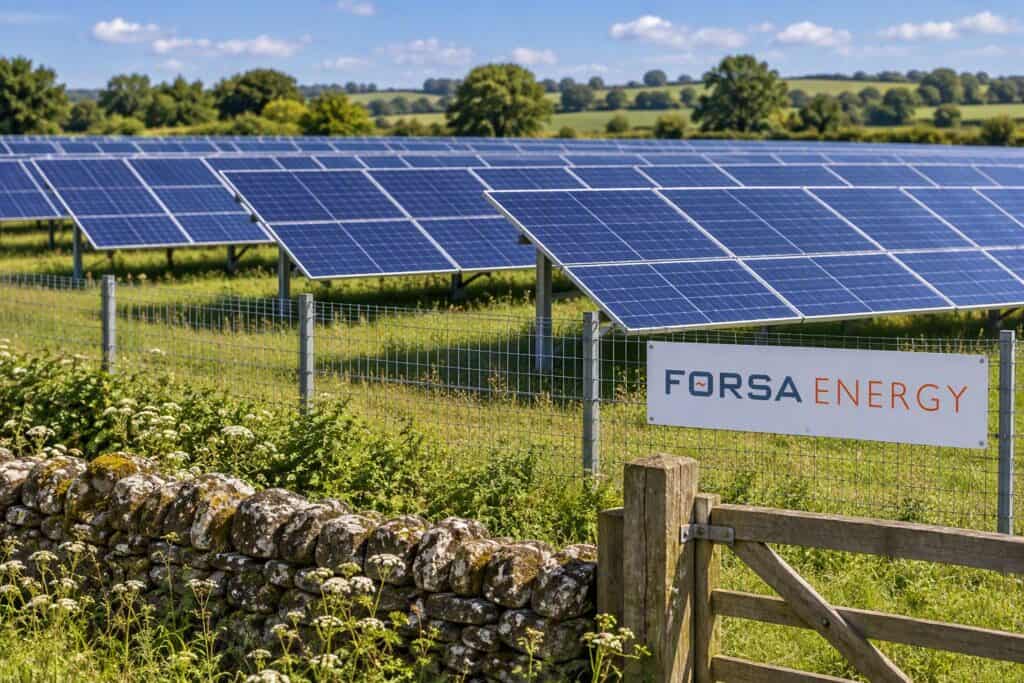
Opdenergy closed a $252 million financing package in October 2023 for two solar plants in West Virginia and Louisiana, both just entering construction. Five weeks later it signed a second facility for the same two plants. Neither the projects nor their offtakers changed in between. What changed was the job the money had to do.
Key takeaways
- Opdenergy announced on 18 October 2023 that it had closed a $252 million project financing package for the 80 MW Blake solar plant in West Virginia and the 125 MW Elizabeth solar plant in Louisiana.
- The Opdenergy package was backed by tax equity investor RBC Community Investments and financed by banks including BBVA, Intesa Sanpaolo and MUFG, with Marathon Capital Markets as exclusive financial advisor.
- The 80 MW Blake plant sells 100 percent of its output to AEP Energy Partners under a 12-year PPA signed in March 2021, and the 125 MW Elizabeth plant sells 100 percent to Entergy Louisiana under a 20-year PPA signed in September 2022.
- On 23 November 2023 Opdenergy closed a separate EUR 82.6 million (about $90 million) green investment credit agreement with BBVA and Spain's ICO for the same two plants, secured by a Cesce Green Investment Policy.
- Across the 205 MW of the two plants, the $252 million package equals about $1.23 million per MW, before counting the later $90 million facility.
What did the $252 million actually pay for?
It paid to build and run two contracted solar plants. Construction on both started in October 2023, the same month the financing closed. Blake was due to reach commercial operation by March 2024 and Elizabeth by May 2024, so the package had to carry the projects through a build window of roughly six to eight months.
The package combined two kinds of capital. Banks provided the loans. A tax equity investor, RBC Community Investments, backed the structure. Tax equity is a US financing form in which an investor puts money into a project in exchange for most of its federal tax credits and related tax benefits, which the developer often cannot use efficiently itself. For a foreign developer with a small US tax bill, it is usually the cheapest way to turn those credits into cash.
The Leap record does not split the $252 million between the bank debt and the tax equity commitment. It records the package as a single figure. That matters for anyone comparing it with plain construction loans, because part of the total may be tax equity rather than debt.
Why could two plants this size raise so much?
Because almost all of their revenue was already sold. A power purchase agreement, or PPA, is a long-term contract in which a buyer agrees to take a project's electricity at agreed terms. Both plants had one covering their entire output, and both buyers are subsidiaries of large US utility groups.
The two contracts are not the same length, and that shapes the debt. Elizabeth's 20-year term with Entergy Louisiana runs close to the useful life lenders typically underwrite for solar. Blake's 12-year term with AEP Energy Partners is shorter, which leaves its later years exposed to whatever power prices are at the time. Lenders size debt mainly on the contracted years, so the larger, longer-contracted plant is likely to have carried more of the borrowing. The record does not show the allocation between the two.
The advisor line-up points to a full project finance process. Norton Rose Fulbright acted for Opdenergy, Clifford Chance for the lenders and Allen & Overy for RBC Community Investments.
Why sign a second facility five weeks later?
Because its purpose was different. The November agreement with BBVA and ICO, Spain's state financial agency, was described as a green investment credit to improve the capital structure of Opdenergy's US assets. It was not new construction money in the same sense as the October package.
The security behind it is the telling detail. The facility was backed by a Cesce Green Investment Policy. Cesce is Spain's export credit insurer, and its green investment cover lets Spanish banks lend to Spanish companies' clean energy projects abroad on the strength of a state-backed guarantee. In plain terms, Opdenergy used its Spanish home base to borrow against US plants at terms a purely US lender might not have offered.
BBVA appears in both financings, which suggests the second facility was built around the first.
The timing fits the company's situation. Antin Infrastructure Partners had agreed in June 2023 to take Opdenergy over, as set out in Enerdatics' analysis of why Antin paid $1.4bn for Opdenergy. A company heading into private ownership has every reason to tidy up how its newest assets are funded.
How does the package compare with other US solar financings?
It is close to the middle of the market. Enerdatics records 31 US solar debt financings announced between July and December 2023, of which 29 carry a disclosed amount. The median of those 29 is $270 million. Opdenergy's $252 million sits just below it, with 13 smaller and 15 larger.
The largest deals in that set funded much bigger builds. SB Energy raised $1.65 billion for a utility-scale solar portfolio in ERCOT and Excelsior Energy Capital $1.01 billion for the Faraday solar project. Closer to Opdenergy, Origis Energy secured $344 million from MUFG for Golden Triangle I and Ashtrom $270 million for Tierra Bonita.
At about $1.23 million per MW, the Opdenergy package is generous for 205 MW of solar. Two features explain most of that. It includes a tax equity component, which plain debt figures do not. And both plants are fully contracted with utility counterparties, which lets lenders lend against nearly every unit of output.
What does the deal signal for foreign developers in US solar?
It signals that the first US projects are financed on contracts, and refinanced on home-market relationships. Opdenergy's two US plants were modest in size, each with a single utility buyer. That made them easy to finance with US tax equity and international banks working side by side.
The second facility shows the advantage a European developer can bring. Export credit cover from Cesce gave Spanish lenders a reason to back US assets they might otherwise have left to American banks. Opdenergy has raised nearly $2 billion of financing for projects worldwide over the past few years, and this pairing of a US package with a Spanish-backed credit is one route it has used.
The US projects were also a small part of a wider strategy. After the Antin takeover, Opdenergy grew in Spain as well, buying 791 MW of wind and solar from Acciona, covered in Enerdatics' post on Opdenergy's $618 million acquisition of Spanish wind and solar assets. Blake and Elizabeth were the template for the company's US build: small, fully contracted and financed twice.
Frequently asked questions
How much financing did Opdenergy raise for Blake and Elizabeth? Opdenergy closed a $252 million project financing package in October 2023, backed by RBC Community Investments as tax equity investor and banks including BBVA, Intesa Sanpaolo and MUFG. In November 2023 it added a EUR 82.6 million (about $90 million) green investment credit from BBVA and ICO for the same plants.
Who buys the power from the Blake and Elizabeth solar plants? AEP Energy Partners, a subsidiary of American Electric Power, buys 100 percent of Blake's output under a 12-year PPA signed in March 2021. Entergy Louisiana buys 100 percent of Elizabeth's output under a 20-year PPA signed in September 2022.
When were the Blake and Elizabeth plants due to operate? Construction on both plants began in October 2023. The 80 MW Blake plant was due to reach commercial operation by March 2024 and the 125 MW Elizabeth plant by May 2024.
Ready to get deal-ready answers in seconds? Try Enerdatics Leap AI and access verified intelligence across M&A, financings, PPAs, projects, and energy market developments through natural language.