Introduction:
In a climate of growing uncertainty and capital strain across the global offshore wind sector, two energy giants—Iberdrola and Masdar—have charted a bold new course. Their €5.2 billion co-investment in the 1.4 GW East Anglia 3 (EA3) offshore wind farm off the coast of the UK is more than just another renewable energy deal. It’s a textbook case in how capital-light strategy and strategic co-investment can drive large-scale infrastructure without overburdening balance sheets. This blog explores why the East Anglia 3 project is not only a landmark energy initiative but also a blueprint for next-gen renewable partnerships.
A Capital-Light Model: Iberdrola’s De-Risked Route to Mega Infrastructure
Iberdrola’s journey with East Anglia 3 exemplifies disciplined, capital-light development. Instead of holding onto full exposure throughout the project cycle, the utility firm strategically advanced EA3 through permitting, procurement, and early construction before selling 50% to Masdar. This phased approach dramatically de-risked the project, unlocking more favorable financing terms and enhancing its overall bankability.
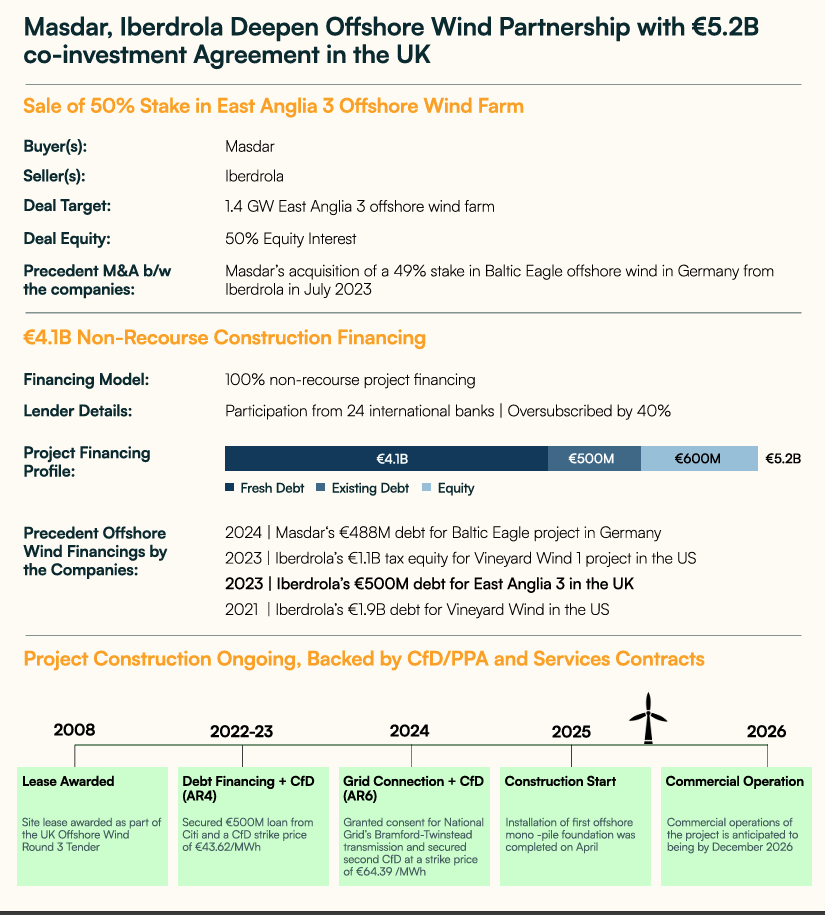
Of the total €5.2 billion CAPEX, €4.1 billion was secured through non-recourse debt from a consortium of 24 international lenders—a testament to the project's credibility. A further €500 million was raised earlier through Citi to kickstart construction. By maintaining a high gearing ratio of 90%, Iberdrola limited its equity exposure to just €600 million while retaining project momentum. This capital-light model not only preserves liquidity but also enables Iberdrola to continue investing aggressively in its broader renewables pipeline.
Strategic Scale-Up: Masdar’s Risk-Mitigated Entry into the UK Market
For Masdar, the deal isn’t just an expansion—it’s an evolution. Entering East Anglia 3 gives the UAE-based clean energy leader significant exposure to the UK’s well-regulated offshore wind market without the usual early-stage risks. The project comes with locked-in revenue via two UK government Contracts for Difference (CfDs) totaling over 1.5 GW, offering stable cash flows at strike prices of €43.62/MWh and €64.39/MWh, respectively.
Additionally, a 159 MW corporate Power Purchase Agreement (PPA) with Amazon diversifies the revenue base, combining public and private offtake arrangements. With major construction milestones already underway and key risks like permitting and grid access resolved, Masdar steps into a high-visibility, low-risk asset with strong long-term returns—perfectly aligned with its 2030 vision of 100 GW global renewable capacity.
From Suffolk to the World: Lessons in Scalable, Sustainable Energy Investments
Beyond financial elegance, East Anglia 3 is poised to generate enough clean electricity to power 1.3 million British homes, reinforcing the UK’s position as a global leader in offshore wind. The project also supports local economic development, with UK-built vessels and services playing a role in construction logistics.
For developers and investors alike, this partnership offers vital lessons: phasing development to de-risk projects, co-investing to share capital burdens, and leveraging a diversified revenue strategy are key to scaling renewable infrastructure in a high-cost environment. As peers scale back, Iberdrola and Masdar are pushing forward—with clarity, collaboration, and capital efficiency.
Conclusion:
The Iberdrola-Masdar partnership around East Anglia 3 is more than a multi-billion-euro deal—it's a roadmap for the future of clean energy investments. It showcases how smart structuring, strategic alliances, and risk-sharing can turn massive infrastructure into scalable, sustainable assets. As the global energy transition accelerates, this model might just be the gold standard.
.jpeg)