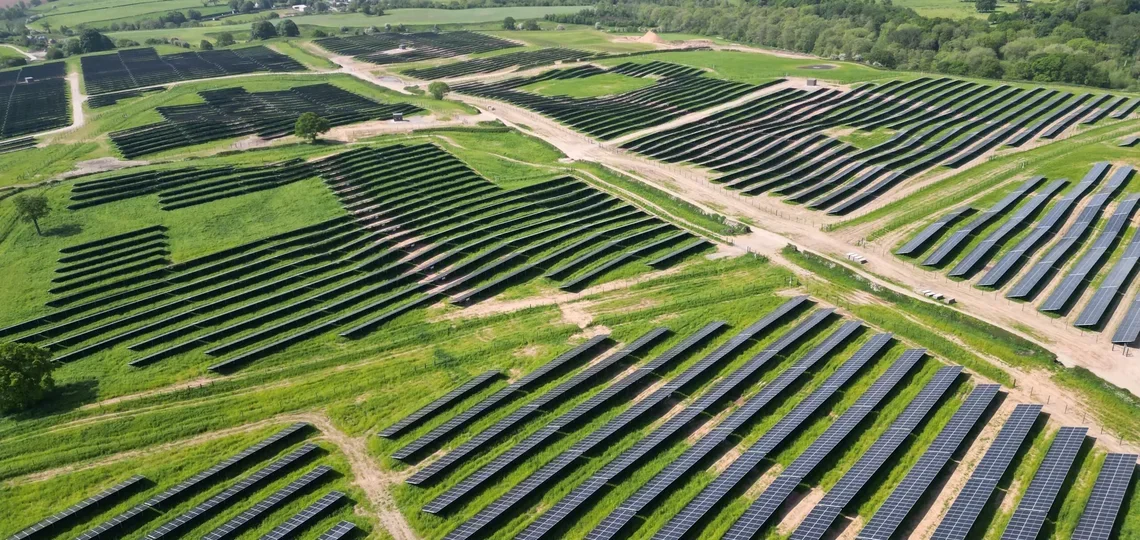
KKR has agreed to buy a majority of Avantus, the Los Angeles solar and storage developer formerly known as 8minute Solar Energy. Avantus has spent 15 years building projects and selling them on. What KKR is buying is mostly not built yet: a 46 GW pipeline. The money arriving with KKR is shaped to match.
Key takeaways
- KKR announced on 20 March 2024 that it had signed an agreement to acquire a majority stake in Avantus, a US developer of utility-scale solar and solar-plus-storage projects, for an undisclosed price; the deal completed on 30 July 2024.
- Avantus' pipeline comprises 80 projects with a combined system capacity of 46 GW, made up of 30 GWp of solar and 94 GWh of battery storage, with the company's track record concentrated in California and the US Southwest.
- KKR and existing investor EIG became the sole equity investors in Avantus, securing more than $1 billion of total financing including development debt alongside their equity commitments.
- On completion, Avantus secured a $522 million development facility arranged by KKR Capital Markets and Sumitomo Mitsui Banking Corporation (SMBC).
- Since its founding in 2009, Avantus has developed and sold 6.5 GWp of solar and 6.3 GWh of storage, and has developed, financed and built more than 2 GW of operating solar projects.
What does a developer like Avantus actually sell?
It sells projects before they are built, or soon after. A developer finds land, secures permits, wins a place in the grid connection queue and signs power contracts. It then sells the finished package to an owner with cheaper long-term capital, or brings in financing to build it. The developer's return comes from turning early-stage risk into a de-risked asset.
Avantus has done that at scale. It has sold 6.5 GWp of solar and 6.3 GWh of storage since 2009 and has executed more than 24 PPAs across the Western US, mainly with large utilities and creditworthy buyers in California and Nevada. That track record is what makes the 46 GW pipeline worth something, because pipeline value depends on how much of it a developer can actually convert.
One figure in Leap's record speaks directly to that conversion rate. Avantus reports an interconnection retention rate of 94 percent. Interconnection is the process of securing permission to connect a project to the grid, and in the US it now takes years, with many projects dropping out of the queue. Keeping 94 percent of queue positions alive suggests the pipeline is less speculative than its size implies.
How do KKR and EIG split the funding?
They share it, and they add debt on top. EIG made a preferred equity investment in Avantus in mid-2021 to fund growth. Preferred equity ranks ahead of ordinary shares for returns, usually with a fixed or capped payout, and sits between debt and common equity in risk. After the KKR deal, KKR and EIG are the only equity investors.
Together they arranged more than $1 billion of financing, including development debt. Development debt is lending against projects that are not yet built, secured on the pipeline and repaid from later construction financing or project sales. It is riskier than construction lending and is usually offered only to developers with a proven record of reaching financial close.
The development facility that followed the closing was $522 million, arranged by KKR Capital Markets and SMBC. KKR therefore sits on both sides of the structure: as majority owner and, through its capital markets arm, as arranger of the debt that funds the pipeline. KKR also plans to set up an employee ownership programme giving all Avantus staff the chance to share in the company's equity.
The deal was KKR's first US investment from its Global Climate strategy. Jefferies was KKR's sole financial adviser and Kirkland & Ellis its legal adviser. Scotiabank and Foley & Lardner advised Avantus.
What happened to the pipeline after the deal?
The first large project moved into construction with bank debt. In June 2025 Avantus secured more than $500 million from a group of four lenders led by SMBC, Truist Securities, ING Capital and Mizuho for Aratina 1 in Kern County, California. The project combines 200 MW of solar with a 125 MW, 500 MWh battery, a four-hour system, and has signed 20-year PPAs with several Community Choice Aggregators, local public bodies that buy power on behalf of California households and businesses.
The Aratina package includes construction funding, a tax equity bridge loan and letters of credit. A tax equity bridge is a short loan repaid when a tax equity investor funds at completion. That sequence, from development facility to project debt, is the conversion process the KKR investment was designed to pay for.
Enerdatics records 77 corporate acquisitions of US solar businesses announced between January 2023 and June 2025. Only 32 carry a disclosed value, together worth $22.84 billion, and the Avantus deal is not one of them. Where a per MW figure can be computed for 2024, the median is $0.18 million per MW from just three deals, a reminder that platform deals are priced on pipeline and team rather than on megawatts. Five deals in the set carry an EV/EBITDA multiple, with a median of 9.65 times.
What does the deal signal for US solar developers?
It signals that large investors are buying development capability, not just assets. Avantus already sold projects to long-term owners. By taking control and arranging the development debt, KKR has given the company, in Leap's words, the financial backing to execute its development portfolio.
Others made similar moves in the same months. Sandbrook Capital committed up to $460 million to rPlus Energies to help it shift towards owning and operating, a change covered in our post on Sandbrook's investment in rPlus. Qualitas Energy bought Heelstone Renewable Energy and its 20 GW portfolio, analysed in our post on Qualitas' return to US solar. In each case the headline gigawatts far exceed what is operating.
The test for KKR is conversion. Avantus has turned 6.5 GWp of solar into sold projects over 15 years. The 46 GW pipeline is seven times that figure. How much of it reaches construction, and how quickly, will decide whether the undisclosed price looks well judged.
Frequently asked questions
Who owns Avantus? KKR holds a majority stake following a deal announced on 20 March 2024 and completed on 30 July 2024. EIG, which invested in 2021, is the other equity investor.
How big is Avantus' pipeline? Avantus has 80 projects with a combined system capacity of 46 GW, including 30 GWp of solar and 94 GWh of battery storage.
How much financing came with the KKR deal? KKR and EIG secured more than $1 billion of total financing including development debt, and Avantus closed a $522 million development facility arranged by KKR Capital Markets and SMBC on completion.
Ready to get deal-ready answers in seconds? Try Enerdatics Leap AI and access verified intelligence across M&A, financings, PPAs, projects, and energy market developments through natural language.