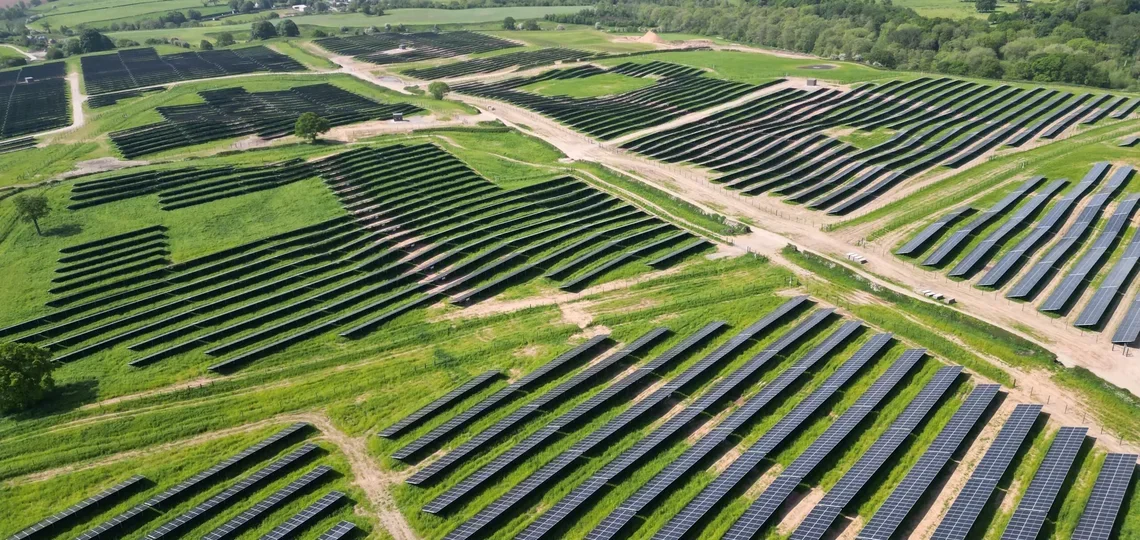
Exus has bought four wind farms in Pennsylvania with an average age of 13 years. Three of them came from Vitol, which had owned them for less than two years and had already lined up a plan to replace their turbines. The price Enerdatics estimates for the portfolio sits in the lower part of the range for operating US wind. The reason is in what happens to the sites next.
Key takeaways
- Enerdatics understands that on 18 March 2024 Exus acquired a 306 MW onshore wind portfolio of four projects in Cambria and Somerset counties, Pennsylvania, buying three projects from Vitol and one from Oppidum Green Energy.
- The Vitol assets in the Exus deal are the 139.4 MW Twin Ridges, 75 MW Highland North and 30 MW Patton wind farms, which are set to be repowered between 2024 and 2027 with a 25 percent increase in capacity; the fourth asset is Oppidum Green Energy's 62 MW Cambria wind farm.
- Vestas is repowering the 139 MW Twin Ridges wind farm, with turbine delivery from the second quarter of 2024 and commissioning set for the fourth quarter of 2024, and Vitol will provide the tax equity financing for the Pennsylvania repowerings.
- Enerdatics estimates the value of Exus' Pennsylvania wind acquisition at $260 million, or $0.85 million per MW, although the parties did not disclose a price.
- Power from the three former Vitol wind farms is sold to Inspire Clean Energy, a Shell-owned utility, under a 4-year PPA that started in April 2023, and Marathon Capital acted as financial adviser to Vitol.
What is Exus buying when the turbines are 13 years old?
It is buying sites, grid connections and permits more than turbines. Repowering means taking down ageing turbines and installing newer, larger ones on the same land. The wind farm keeps its grid connection, its landowner agreements and much of its permitting, and produces more power from the same footprint.
The existing machines are old and small by current standards. When Vitol bought the three farms in 2022, Leap recorded Twin Ridges with 68 Senvion MM92 turbines of 2.05 MW each, Highland North with 30 Nordex N100 turbines of 2.5 MW, and Patton with 15 Gamesa G87 turbines of 2 MW. Leap records the portfolio's weighted average operating age at 13 years.
The plan to raise the three Vitol farms' capacity by 25 percent turns 244 MW into roughly 305 MW without a new site. That is the asset Exus is really paying for: an expansion that avoids the slowest parts of building a new wind farm, finding land and joining the grid queue.
How did the plan change between Vitol's purchase and Exus' purchase?
It grew from a partial repowering on a mostly merchant portfolio to a full repowering backed by a contract. Vitol agreed to buy the three farms from a BlackRock fund in April 2022. At the time it planned to repower two of the three sites, subject to approvals. Power from Highland North was sold to FirstEnergy Services under a PPA, Twin Ridges sold into the merchant market, and Patton was partly contracted, with 16 MW sold to Exelon Generation.
By the time Exus bought them, all three farms were set for repowering between 2024 and 2027. Their output had been placed with Inspire Clean Energy under a 4-year PPA starting in April 2023. Vestas had been chosen for Twin Ridges, the largest site, with its new turbines due in service by the end of 2024.
Vitol is not leaving entirely. It will provide the tax equity for the repowerings. Tax equity is an investment from a party that can use US renewable tax credits, in exchange for most of those credits and a share of cash flow in the early years. By staying in as tax equity investor, Vitol keeps part of the economics of the new turbines while handing ownership and construction to Exus.
How does $0.85 million per MW compare with US operating wind?
It is cheap on paper, and the discount likely reflects the work still to be done. A buyer of an operating wind farm usually pays for years of predictable output. Exus is paying for a fleet that is likely to be partly offline while it is rebuilt, sells under a contract only four years long, and needs new turbines that someone has to fund. The tax equity from Vitol is meant to help fund part of that cost.
Enerdatics records 38 acquisitions of operating wind assets in the United States announced between January 2023 and June 2025. Twelve can be priced per MW, and their median is $1.13 million per MW, with the middle half of deals between $0.87 million and $1.38 million and a full range of $0.44 million to $2.11 million. At an estimated $0.85 million per MW, the Exus portfolio sits just below the lower quartile. Twenty-six of the 38 deals carry no usable price at all, so the benchmark rests on a third of the market.
Headline prices on US wind are easily distorted by tax structures. In Stonepeak's purchase of 80 percent of Orsted's US wind, existing tax equity made the apparent price per MW far lower than the value of the farms. The Exus estimate deserves the same care: Vitol's tax equity is part of the repowering structure, and the record does not say how it interacts with the $260 million estimate.
What does the deal signal for US wind repowering?
It signals that repowering has become a business model buyers will pay for in its own right. Ageing US wind farms with good sites and existing grid connections offer capacity growth without the delays of new development. Owners that do not want to fund new turbines can sell to buyers that do, and keep a slice through tax equity.
For Exus the purchase extends a run of US acquisitions. It followed shortly after the company bought New Mexico Renewable Development, a 15-project, 625 MW solar portfolio from PNM Resources and American Electric Power, analysed in our post on how Exus paid for 625 MW of NMRD solar. Both deals buy capacity that is partly built and partly still to come. The test for Exus is whether the Pennsylvania farms come back larger, on time, and with a longer contract than the four years they carry today.
Frequently asked questions
What did Exus buy in Pennsylvania? Exus acquired four wind farms totalling 306 MW in Cambria and Somerset counties: Twin Ridges, Highland North and Patton from Vitol, and the Cambria wind farm from Oppidum Green Energy.
How much did Exus pay? The parties did not disclose the price. Enerdatics estimates the deal value at $260 million, or $0.85 million per MW.
What is happening to the turbines? The three former Vitol wind farms are set to be repowered between 2024 and 2027, raising their capacity by 25 percent. Vestas is supplying the new turbines for Twin Ridges, and Vitol is providing tax equity for the repowerings.
Ready to get deal-ready answers in seconds? Try Enerdatics Leap AI and access verified intelligence across M&A, financings, PPAs, projects, and energy market developments through natural language.