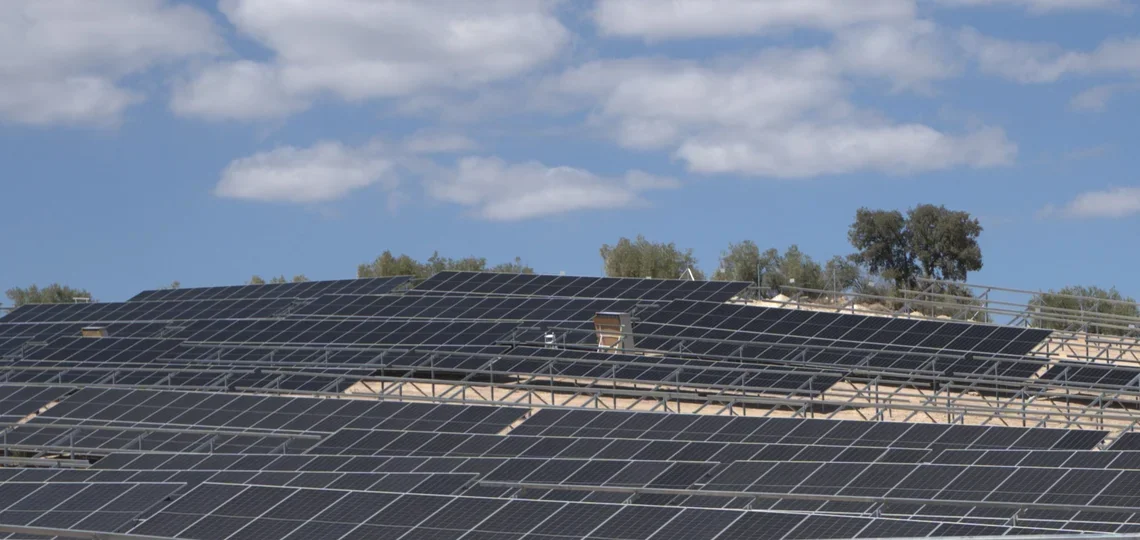
Enviromena has bought a 27.5 MWp solar project in Essex from Innova Renewables. It comes with a Contract for Difference won in September 2024, which is the part that makes it bankable. It is also the part that puts the timetable under pressure. The contract carries a date, and the project is not expected to generate until after that date has passed.
Key takeaways
- Enviromena, a subsidiary of Arjun Infrastructure Partners, acquired the Parkgate solar project in Rivenhall, Essex, from Innova Renewables on 22 October 2026. Neither side disclosed the consideration.
- Parkgate is rated 27.5 MWdc across its panels and 22.5 MWac at its grid connection, and won planning permission in December 2023 on appeal against Braintree District Council.
- The project secured a Contract for Difference in September 2024 under the UK's Allocation Round 6, at a 2012 strike price of £50.07 per MWh, equivalent to $67.02 per MWh, with a delivery year of 2027/28.
- Parkgate is the first asset in a partnership under which Enviromena expects to acquire 233 MWp of solar and 75 MW of co-located battery storage from Innova before the end of 2026, roughly 12 percent of the solar half of that programme.
- Enerdatics records 11 UK transactions since the start of January 2024 in which Innova Renewables is the seller, covering about 2,232 MW, and exactly one of the 11 carries a disclosed value.
What does a 2012 strike price pay in 2028?
More than £50.07 per MWh. A Contract for Difference is a government-backed contract that tops a generator's revenue up to an agreed strike price when wholesale prices sit below it, and claws the difference back when they sit above. Every strike price in the scheme is quoted in 2012 money and uprated each year in line with inflation, so the figure in the award notice is a reference point rather than a cash price.
That is why the £50.07 per MWh attached to Parkgate reads low against current wholesale expectations. The cash amount the project receives in its delivery year is that figure carried forward by more than a decade of indexation. Leap records the award at 2012 prices, as the scheme publishes it, and not the indexed figure.
What the contract buys is certainty about the shape of revenue rather than its level. For a project expected to produce more than 28 GWh a year, enough for over 10,000 homes, it removes the merchant price risk that would otherwise sit between the panels and the lenders.
Why does the delivery year matter more than the strike price?
Because a Contract for Difference is dated, not open ended. Allocation Round 6 assigned Parkgate a delivery year of 2027/28, the twelve months running from April 2027 to March 2028. The subsidised term is anchored to the start of that window rather than to the day the plant first exports.
Parkgate is not expected to be there. The deal record puts first operations in 2028. Enerdatics estimates commercial operation in August 2028 and construction financing in place by January 2028. Both are estimates rather than confirmed dates, and both fall after the delivery year closes.
The consequence is arithmetic rather than drama. Months between the start of a delivery year and first export are months the contract runs without the project earning under it. Late energisation does not push the end of the term back, so time lost at the front is subsidised life gone rather than deferred. That is the risk Enviromena has taken on, and it is why the planning history matters: the permission arrived only after an appeal, and appeals consume the same calendar the award assumes.
What is Enviromena buying when no price is disclosed?
A pipeline position, and the archive is the only guide to what one costs. Parkgate opens a partnership under which Enviromena expects to take 233 MWp of solar and 75 MW of co-located storage from Innova before the end of 2026, with further completions expected within weeks. It is also the company's second large solar investment in Essex, after the 71 MWp Medebridge farm, operational since September 2025.
Enerdatics has identified a consideration on three earlier Enviromena purchases where neither party published one. Steeraway, 30 MW, came in at $8.55 million in June 2025. Rock Farm, 40 MW of solar with 12 MW of storage, came in at $11.79 million in August 2025. Longpasture, 70 MW of solar with 40 MW of storage, came in at $10.07 million the same month. Those three are Enerdatics identifications rather than disclosed figures, and on combined ratings they span $0.09 million to $0.29 million per MW.
Against that band the build is the larger number. Enerdatics estimates Parkgate's total project investment at $31.62 million, or $1.15 million per MW, in line with reported figures for UK solar projects of similar scale. That is construction cost, not purchase price, and the distance between the two is what a late-stage developer sells. Note also that the project has two capacity ratings, so any per MW figure depends on which one is used, a split Octopus ran into at Barnsdale eight days earlier.
Enerdatics records 97 UK solar M&A transactions since the start of January 2024, of which 19 carry a usable value per MW. Narrow that to late-stage projects, the category Parkgate sits in, and the sample collapses to 20 transactions with exactly one disclosed value, at $0.28 million per MW. Innova's sell-side record looks the same. Across 11 UK disposals since the start of 2024, covering about 2,232 MW of solar and battery projects, one carries a price: the 25 MW Newbold Pacey park sold to ISG Renewables for $21.6 million in May 2024, and that project was already in construction.
What does the deal signal for UK solar?
That the auction, not the negotiation, is where UK solar revenue is now set. When a late-stage project arrives with an Allocation Round award attached, the buyer is not forming a view on power prices. It is forming a view on whether the project can be built inside the window the award assumes. Enviromena's Duxhurst acquisition in June followed the same logic, with an Allocation Round 6 contract and energisation targeted for summer 2027.
It also shows what a development business looks like when it stops selling projects and starts selling programmes. Innova holds over 30 connected or developing sites, more than 6 GW of solar and storage and over 4.4 GW of data centres in development, and it has moved assets to Uniper, Zenobe, Fidra, Schroders Greencoat, Alpha Real Capital and ISG since 2024. Parkgate is not a disposal into an open market. It is the first drawdown on an agreed quantity, which is why the capacity was published and the price was not.
Frequently asked questions
What did Enviromena pay for the Parkgate solar project? Neither side disclosed the consideration, and Leap records no deal value. Enerdatics estimates the project's total investment at $31.62 million, or $1.15 million per MW, which is build cost rather than purchase price.
What strike price does Parkgate's Contract for Difference carry? The project secured a CfD in September 2024 under Allocation Round 6 at a 2012 strike price of £50.07 per MWh, equivalent to $67.02 per MWh, for delivery year 2027/28. UK strike prices are quoted in 2012 money and indexed annually, so the cash price in the delivery year is higher.
How much capacity will Enviromena buy from Innova Renewables? Enviromena expects to acquire 233 MWp of solar projects and 75 MW of co-located battery storage from Innova before the end of 2026. Parkgate, at 27.5 MWp, is the first of those completions.
Ready to get deal-ready answers in seconds? Try Enerdatics Leap AI and access verified intelligence across M&A, financings, PPAs, projects, and energy market developments through natural language.