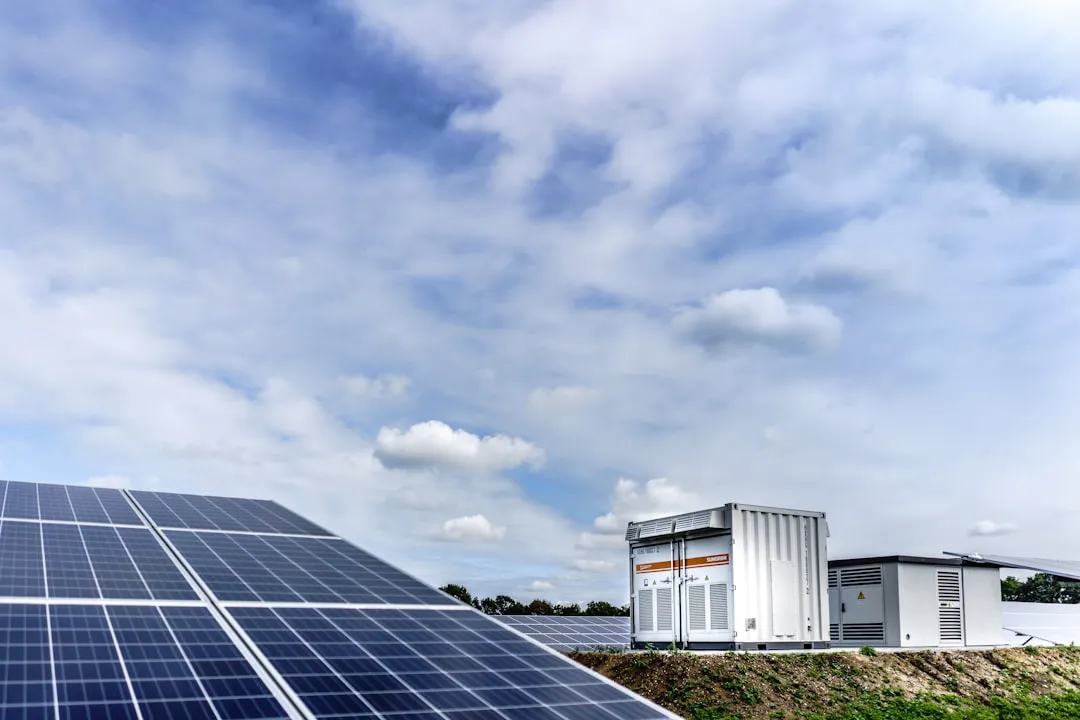
Daiwa Energy & Infrastructure has bought 49 percent of a 157 MW solar plant with a battery attached in Saxony, four months after it started generating. A German solar asset of this size usually reads as a subsidised one. This plant has a fixed market premium on 40 MW of its capacity, and the other 117 are somebody's job every day.
Key takeaways
- Daiwa Energy & Infrastructure has acquired a 49 percent stake in the 157 MW Elsterheide solar project and its co-located 20 MW/80 MWh battery in Saxony, Germany, from AMPYR Solar Europe. The consideration was not disclosed and KPMG advised the seller.
- Support under Germany's Renewable Energy Sources Act covers 40 MW of the plant's 157 MW of solar capacity, just over a quarter, secured as two separate 20 MW awards in the March 2024 and March 2025 tenders.
- The March 2024 tender awarded bids between 36.2 and 54.9 euros per MWh at a volume-weighted average of 51.1 euros per MWh. The March 2025 tender ran from 39.9 to 48.8 euros per MWh at an average of 46.6 euros per MWh.
- AMPYR Solar Europe secured an import grid connection alongside the project's existing export capacity, so the battery can charge from the grid as well as from the solar plant beside it.
- Elsterheide began operating in July 2026 across more than 130 hectares, including around 20 hectares of restored brownfield on a former GDR-era military site, and is the second-largest photovoltaic installation in Saxony.
What does Daiwa's 49 percent actually earn from?
Four separate revenue lines, and only one of them is a subsidy. Germany's Renewable Energy Sources Act, the EEG, pays successful tender bidders a fixed market premium, which tops up whatever the generator earns in the wholesale market to the level of its awarded bid. At Elsterheide that mechanism reaches 40 MW, secured in two 20 MW tranches a year apart and at two different prices.
The rest of the plant is contracted and traded. A route-to-market PPA with multiple Tier 1 counterparties covers 120 MW of solar capacity. A tolling contract covers optimisation of the battery, which means a counterparty pays a fixed fee for the right to dispatch it and keeps the trading upside. Guarantees of Origin, the certificates that let a buyer claim electricity as renewable, sell under a contract of their own. Whatever battery capacity the toll does not cover sits in the merchant market.
So Daiwa is buying a share of a contract stack, not a share of a tariff. Everything beyond that quarter depends on counterparties performing and on a price spread existing.
Why does the battery have an import grid connection?
Because a battery that can only charge from the panels next to it is a smaller business than one that can charge from anything. AMPYR secured an import connection alongside the export capacity the solar plant already held, which lets the 20 MW/80 MWh system draw power off the grid rather than wait for a sunny afternoon.
That distinction gets missed because co-located is read as dependent. A solar-charged battery can only move electricity the plant itself generated, so its best trade is shifting midday surplus into the evening. An import connection removes that boundary. The unit can buy whenever prices are low, including overnight, and sell into every price spike rather than the subset that follows a generating day.
At four hours of duration, 80 MWh across 20 MW, this is a battery built for daily cycling rather than short grid services, and AMPYR's first to enter operation in Germany. The import connection is what makes it a trading asset sharing a site rather than an accessory to the panels.
What did AMPYR keep by selling 49 percent?
Control and the operating mandate. AMPYR retains 51 percent and continues to operate and manage the project, which is the structure rather than a leftover. The company develops, commissions, operates and manages assets across their operating lives while an investment partner comes in for the operational phase alone.
That splits the risk by stage, and the risky stage here is finished. Elsterheide was originated in-house, began life as a 20 MW project, grew through successive phases to 157 MW and had the battery added afterwards. Construction completed on time and within budget. Daiwa arrives after all of it, buying cash flows rather than a build.
The capital then goes back out of the door. Construction was funded by AMPYR equity and NORD/LB debt under an existing 200 million euro framework facility for German solar and battery projects, and AMPYR says it intends to extend the partnership with Daiwa to further German assets. Selling 49 percent of a finished plant is how the next one gets its equity. The same company has been buying at the opposite end of the cycle in the UK, where AMPYR Solar Europe acquired the consented 530 MWp East Yorkshire Solar Farm next to the Drax substation.
Enerdatics records 16 German solar transactions with co-located storage since the start of 2024, Elsterheide included, covering 2,167.6 MW, and not one carries a disclosed price. Across German solar as a whole the record holds 69 transactions in the same period with six disclosed values. Three of those are single-asset prices, all from one seller, Orron Energy, selling undeveloped projects at roughly $61,000 to $72,000 per MW. Two are platform acquisitions, and the sixth is KKR and Viessmann's $5.15 billion purchase of Encavis, a 7 GW company rather than a plant. No individual operating German solar asset in the record carries a disclosed price, which is why a 42 MW Bavarian project with 22 MW of panels went undisclosed as well.
What does the deal signal for German solar?
It signals that a German solar asset is now a portfolio of contracts rather than a tariff, and that the subsidy is the smallest piece of it. An investor pricing Elsterheide has to price four counterparties and a spread, not a 20-year award. That is a different underwriting exercise from the one German solar is still described with, and it is the one every plant commissioned from here will need.
The second signal is about who buys, and when. Sixteen co-located German transactions in under three years, none priced in public, is a segment running entirely on private comparables. Daiwa entered at the operational phase of an asset originated, built and still run by its developer, and both sides say they intend to repeat it. Expect more German solar to change hands this way: a minority of a finished plant, sold to a financial partner, at a number nobody outside the deal will see.
Frequently asked questions
How much did Daiwa pay for its 49 percent of Elsterheide?The consideration was not disclosed. Enerdatics records 16 German solar transactions with co-located storage since the start of 2024 and none of them carries a disclosed price, so there is no comparable in that segment to benchmark against.
How much of the Elsterheide solar plant is subsidised?EEG support covers 40 MW of the 157 MW solar capacity, just over a quarter, awarded as two 20 MW tranches in the March 2024 and March 2025 tenders. The volume-weighted average award price was 51.1 euros per MWh in the 2024 round and 46.6 euros per MWh in the 2025 round.
Can the Elsterheide battery charge from the grid?Yes. AMPYR secured an import grid connection alongside the plant's existing export capacity, so the 20 MW/80 MWh system can charge from the grid as well as from the co-located solar plant.
Ready to get deal-ready answers in seconds? Try Enerdatics Leap AI and access verified intelligence across M&A, financings, PPAs, projects, and energy market developments through natural language.